


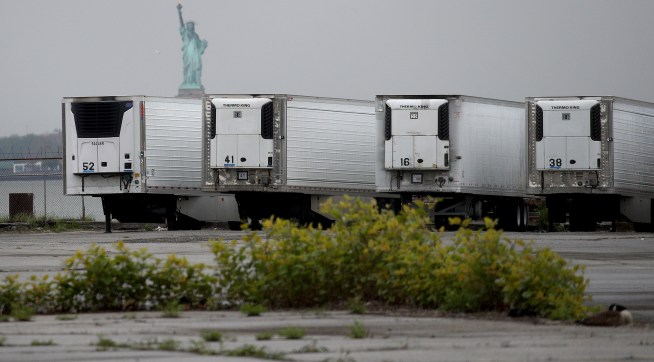
As I noted below, we are now getting sufficiently dense data on the genetic lineages of COVID19 to map its introduction and spread within the United States – both in time and geography. The preliminary evidence suggests the epidemic in New York City began after COVID was introduced from Europe in mid-February. Perhaps there were isolated introductions earlier. Given the scale of international travel in and out of the city it seems hard to imagine there wasn’t. But it was this mid-February introduction that took root and exploded, ultimately infecting more than 1.5 million city residents and killing at least 20,000 people. Now that this virological, genomic history is coming into clearer view it is time to consider an alternative history of the epidemic, one in which the US fielded tests two or three weeks before the point of introduction to what would become the epicenter of the US epidemic.
I am generally skeptical of arguments that COVID19 will permanently change the way we socialize, work, travel, seek out entertainment. If anything I think that once there is a vaccine for COVID (the creation of a viable vaccine is not a given but I assume it for these purposes) that people will return to many of these activities with a renewed gusto. The exceptions – and they may be very big ones – are those cases where people decide that new ways of operating are more efficient, cost effective or simply better. This may particularly affect how we work.
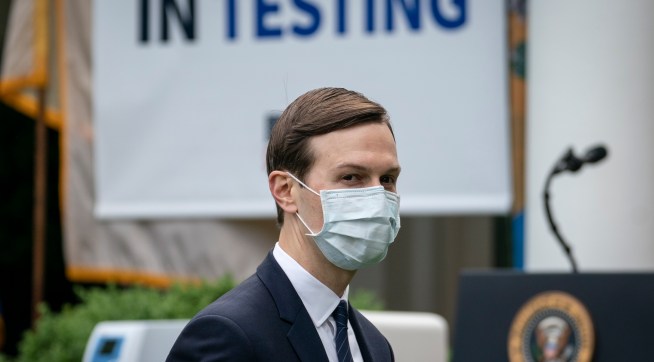
White House senior adviser and son-in-law to the President Jared Kushner is walking back his outrageous suggestion about pushing back the presidential election.
As he should.
When I posted my COVID19 turning points one of mine – and one that many TPM Readers shared – was listening to New York Times science and health reporter Donald McNeil on The Daily podcast on February 27th clearly comparing COVID to the 1918 Spanish Flu epidemic in which “not everybody died, but everybody knew somebody who died.”
Here is McNeil talking to Christiane Amanpour about the federal response to the epidemic. There’s no new fact you won’t know. Or not many. But he puts the whole picture together with great concision.
Donald G. McNeil Jr: The CDC “is a great agency but it’s incompetently led, and I think Dr Redfield should resign.” pic.twitter.com/7tUPDGsE86
— Christiane Amanpour (@camanpour) May 12, 2020
Let me share with you some graphs of the COVID19 outbreak in New York, across the United States and then their relationship to each other.
Some new and very interesting information from the Bedford Lab in Washington State. I’ve mentioned Bedford’s work a few times. He runs a research lab at the Fred Hutchinson Center where he studies viral genomes. It was his work that initially revealed that in late February that COVID19 had been spreading in Washington state for some six weeks. He just posted another Twitter thread in which he says there is now a critical mass of genomic sequencing data from different parts of the United States and the world that allows us to construct a preliminary map of how the disease spread across the United States.
Was there a single patient zero from whom the US epidemic originated or were there multiple separate introductions from different parts of the world? Or what was the mix of the two?
Senator Rand Paul said a short while ago that all the public health interventions New York City ended up taking probably didn’t make any difference in the outcome of the epidemic – a completely ignorant statement that flies in the face of over 150 years of modern public health work more and arguably thousands of years of human history. He harnesses the facts of public health to the shibboleths of his libertarian ideology: “A lot of what happens with the virus is independent of what government does.”
Whenever Paul says nonsensical stuff like this I’m reminded that he either could not or would not get board certified in his area of medical specialty – ophthalmology – and instead created his own mail order professional certification organization to accredit himself. He’s the story, from a decade ago.
The whole conversation about ‘reopening’ continues to presume growing public pressure to do so and to move faster than the country already is. But all the available evidence about public opinion suggests this isn’t the case. The smattering of public polls which have come out over the last month show the states with aggressive containment policies with sky high approval ratings for their governors and much lower ones for states that are moving quickly to end or loosen the lockdowns. Now a new poll from The Washington Post shows the pattern even more systematically and starkly.
Here’s the visual breakdown.

We’ll have more coming soon that takes up the points TPM Reader SS raises here about the oral arguments in the Mazars/Deutsche Bank cases:
I found the livestream of the arguments fascinating. I also found, somewhat disturbingly, that none of the commentators/blogs/websites that I follow (all of a liberal bent, so to speak) seemed to speak to what I thought was the main weakness of Congress’ case. (Note: while I’m not a practicing lawyer, I was, at one point, a member of the DC Bar).
Join
President Trump has repeatedly conflated limiting air travel from China to avoiding “Chinatowns” in the United States. But recent articles note something perhaps counterintuitive about the experience of New York City. Both historic Chinatown in Lower Manhattan (see here) and at least one other Queens neighborhood (see here) with a high concentration of immigrants from Asia have among the lowest COVID19 infection rates. The reasons are intuitive: these communities were focused on COVID early and they’re part of a cultural space in which the experience of SARS in 2003 is very strong. Mask wearing among Asian-Americans and Asian immigrants started in New York City two or three weeks before the city locked down.
TPM Reader JGi thin draws what I think is the most important lesson we can draw …