

This post is a part of TPM Cafe, TPM’s home for opinion and news analysis.
In the fog of the redistricting wars to come, it may be easy to remember the audacity of President Trump demanding state legislatures immediately redraw maximally rigged maps. But this didn’t come out of nowhere. It is the next logical step in decades-long sequence of events that have led, rather predictably, to this moment.
In 2021, after the Supreme Court’s decision in Brnovich v. DNC deeply eroded the Voting Rights Act, I wrote with FairVote’s David Daley that “a central goal of conservative jurisprudence is the carving back of federal protections, and the empowerment of states over vast swaths of social and civil life.” We warned that Chief Justice John Roberts had been “patiently preparing to dismantle Section 2 of the Voting Rights Act for 40 years,” and that “his careful long game may end in checkmate for majority rule as we know it.”
That checkmate has arrived. In Louisiana v. Callais, the Court’s 6-3 ruling gutted Section 2 — the last enforceable provision of the Voting Rights Act — by requiring plaintiffs to prove intentional racial discrimination while allowing partisan gerrymandering as a defense. As Justice Elena Kagan wrote in dissent, the “decision renders Section 2 all but a dead letter.”
The immediate headlines focused on Congress: the potential loss of as many as 19 House seats held by Democrats, including as much as 30% of the Congressional Black Caucus. These consequences are grave. But an equally consequential and far less discussed impact is what Callais means for state legislatures — the overlooked institutions that have quietly been growing in power over the past few decades, and that now hold more of it than ever, with even fewer guardrails.
The Venue Is the Strategy
The conservative strategy for consolidating state-level power has never been a secret. In March 2010, Karl Rove penned a Wall Street Journal op-ed literally titled “The GOP Targets State Legislatures.” The sub-head: “He who controls redistricting can control Congress.” The piece laid out the whole playbook for Project REDMAP: by flipping a few handfuls of state legislative seats in the 2010 midterms, Republicans could redraw congressional and state legislative maps for a generation. Democrats either did not believe them or had nothing to counter it. That year, Republicans gained control of 11 additional state legislatures and ran the table on redistricting. Today, they hold 23 trifectas — a net loss of just two in 15 years.
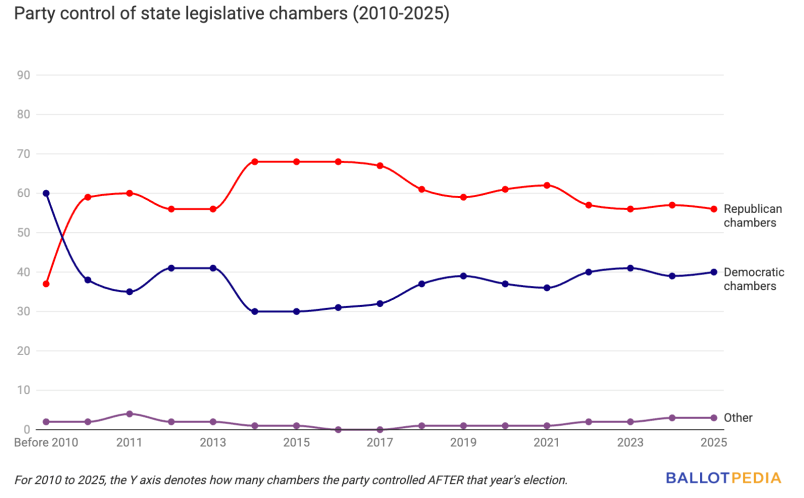
But REDMAP was only one part of a larger architecture. The deeper strategy has three moves. First, build and solidify power in state legislatures. Second, strip away federal protections — through the courts, and by dismantling federal regulations, funding, and programs. Third, devolve that authority to the states where you’ve already built structural advantages through gerrymandering, voter suppression and long-term policy infrastructure. The linchpin of the whole operation is control of state legislatures.
The Court has been an essential partner. As Mother Jones’ Ari Berman and FairVote’s Daley have both exhaustively chronicled, Roberts’ entire career could be characterized as a crusade against the Voting Rights Act. On his watch, Shelby County removed federal preclearance. Rucho declared partisan gerrymandering beyond judicial review, leaving states free to draw lines advantaging the party already in power. Brnovich chipped further away at Section 2. And now Callais eliminates the last federal check on racially discriminatory redistricting, freeing the very legislatures that draw the maps from accountability for the maps they draw.
The result is a self-reinforcing cycle: the Court removes federal oversight; Trump pressures state legislatures to rig maps with impunity; already gerrymandered legislatures further entrench themselves. Power flows downward to the venue already rigged to receive it: states.
The Scale We’re Not Talking About
Most analysis since Callais has focused on Congress. But the devastation in state legislatures may be as bad or worse, and the consequences even more immediate for people’s daily lives.
A recent analysis by Fair Fight Action and Black Voters Matter examined 10 Southern states and found that Republican-controlled legislatures could eliminate nearly 200 state legislative seats currently held by Democrats — the vast majority held by Black representatives. Nearly half of all majority-minority state legislative districts in the South could simply disappear. And those 10 states are less than half of the 23 Republican trifectas nationwide. The full scale of the looming Republican gerrymandering monster will be vast.
This will be, first and foremost, a decimation of Black political representation — likely the largest reduction since the end of Reconstruction. And that representational decimation will be tied to policy decimation. State legislatures draw district lines for Congress and for themselves. They set election rules. They determine whether to expand Medicaid, fund public schools, protect reproductive freedom, or safeguard workers’ rights. As the Court rolls back federal protections and the administration slashes programs, these decisions increasingly fall to the states. The legislators who champion these issues — including Black lawmakers in majority-minority districts — are exactly the ones whose seats will be on the chopping block.
The danger is clear: when you eliminate the legislators who fight for a participatory, multiracial, functional democracy, you eliminate the policies they champion.
The Overlooked Arena
In 2021, Daley and I concluded our piece with a warning: “On voting rights and so much more, the buck does and will continue to stop with state legislatures. We must elect legislators who will fight to protect voting rights — down-ballot, where it matters most and is too often overlooked — or risk becoming a nation filled with democracy deserts, where your right to vote depends on where you live and your access to the polls depends on the color of your skin.”
That warning has been borne out with punishing precision. Americans can name their U.S. senators. But few can name their state representative or correctly identify what state legislators do. Yet it is that state representative who will determine whether their district is drawn fairly, whether their vote counts equally, and increasingly, whether their fundamental rights are protected at all.
The conservative movement understood this decades ago. The American Legislative Exchange Council, the State Policy Network, and Americans for Prosperity have treated state-level coordination as a core organizing principle, drafting model bills, convening officials, and spreading policy from statehouse to statehouse with discipline. Pro-democracy allies are beginning to build comparable infrastructure, with states finding ways to coordinate through interstate compacts, pooled purchasing power, and shared strategies. But the gap remains enormous, and the clock is running.
What Comes Next
Callais did not create the crisis of lopsided, weaponized state legislative power. It completed a long trajectory, one that has systematically dismantled federal protections and concentrated authority in the institutions least subject to public scrutiny and most vulnerable to structural manipulation: state legislatures.
What will come next is a redistricting war unlike anything we have seen, fought not primarily in Congress, but in state capitols, where the stakes are higher and the spotlight dimmer.
It’s as true now as it was five years ago: the buck stops with state legislatures. The question is whether we will finally pay attention before we lose the chance for another generation.






The long term goal of the GOP is to build a political machine which can roll over the Democrats. It will be built with parts from the anti-New Deal, anti-1960’s, anti-Civil Rights, and pro-Big Business, pro-Confederacy, pro-megawealth authoritarianism.
This was never a secret and the political parties are not the same. The Democrats need to get over their aversion to the dirty nuts and bolts of politics and get to work. When the Republicans are coming with a Tiger tank you had better have at least a Sherman.
The major difference between today and 1880 when the first reconstruction era ended with the Compromise of 1877 is the shrinking of the white, non-hispanic population. Post Civil war in was almost 90%. Control was easy, as the vast majority of Whites if not out and out KKK were mostly indifferent.
In 2026 it was 56-57% and falling. In approximately 20 years it will be below 50%. The racist alpha hotels that are attempting to kill black representation will be able to maintain the gerrymander for only so long before being forced to expand to POC. And while they made significant headway among the Latino population in 2025, aggressive ICE raids launched by a Kapo name Stephan has pretty much reversed this trend.