

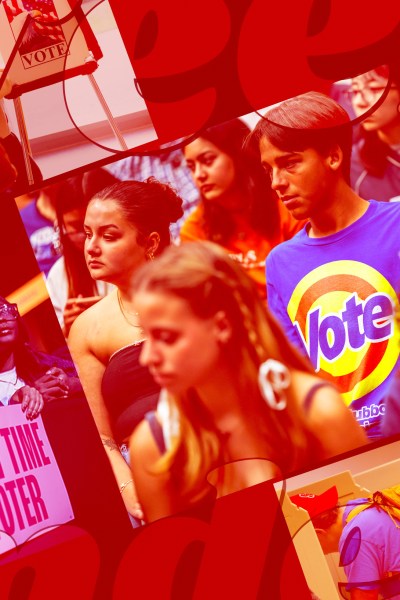




Young Voters Never Liked Trump All That Much
As the dust settled in the days after the 2024 election, one of the narratives that quickly took shape was that young people had helped elect Donald Trump to a second term. As The Independent put it at the time, “Democrats may no longer be able to rely on young voters to boost numbers, as Harris appears on track to have the lowest support among voters aged 18-29 in this century.”
Here’s what actually happened. According to data from the Center for Information & Research on Civic Learning and Engagement at Tufts University (CIRCLE), young voters preferred Kamala Harris over Trump 52% to 46%. Young women supported Harris 58% to 40%; 75% of Black voters under 30 supported Harris; 58% of young Latino or Hispanic voters backed Harris; and 72% of young Asian voters backed Harris. The supposed youth swing towards Trump was predominantly among young white men, who backed him by 14 points (56% to 42%). Overall, CIRCLE’s staff found, while Trump saw a “10-point jump (36% to 46%) in youth support for Trump compared to 2020, young people were still the age group with the highest support for the Democratic candidate this year.” (Emphasis mine!)
Ahead of the 2026 midterms, we’re getting a round of articles about how Gen Z has once again decided to reject Trump and the GOP. Politico Playbook this week highlighted the results of a new survey showing that “economic concerns are pushing 18- to 34-year-olds back to the left for the midterms,” and the headline on a TIME feature blared that “Young Voters Are Turning Away From Trump.”
This narrative boomerang can be attributed in no small part to treating 2024 as just another presidential race versus a bonkers aberration of an election cycle. I mean, the 81-year-old Democratic nominee dropped out of the race less than four months before Election Day! Young people were on the record as deeply disliking both Trump and Biden, and Harris, as Biden’s VP, was inextricably tied to the president’s record in office.
But since Obama’s first election, voters under 29 have consistently tilted left. They’ve voiced support for abortion, opposition to foreign wars and deep concern about the climate emergency. A percentage of young white male voters shifting towards Trump in one election cycle does not mean that young people, as a whole, ever swung significantly to the right. And framing this as a trend among “young voters” erases the views and votes of the millions of young women and young people of color who supported Harris and have campaigned, volunteered, and voted for Democratic candidates in election cycle after election cycle, not to mention engaged in other forms of civic activism.
On that note, it’s true that overall turnout among young people is disappointingly low. In the 2024 presidential race, it dropped to 42%, compared to 50% in 2020, according to CIRCLE. What I heard from young people during the six years I spent as the politics director at Teen Vogue is a deep disillusionment with electoral politics as a path for change and the rejection of a system that they see as hopelessly corrupt and unrepresentative of their interests. (Can you blame them? Just look at what’s happening with the Supreme Court’s VRA ruling and the GOP’s redistricting power grab as we speak). That is not the same as apathy or disinterest. And these voters will turn out with bells on for candidates who speak their language and campaign on issues that matter to them, like the housing crisis and income inequality. (See: Bernie Sanders’ 2020 presidential campaign and Zohran Mamdani’s winning mayoral bid.)
The political media loves a new narrative, but the youth swing for Trump was always overblown.
—Allegra Kirkland
Alito Says the ‘Atmosphere’ in DC Gave His Dog ‘Mental Illness’
Fresh off of gutting the Voting Rights Act, Supreme Court Justice Samuel Alito headed to Texas where he told a bizarre story about his dog.
Alito was in Austin on Thursday because his former clerk, Kyle Hawkins, was one of two judges being given a ceremonial swearing-in for their appointment to the Lone Star State’s highest civil court. Before administering the oath to Hawkins, Alito offered what began as an anecdote about friendship.
“You do need friends … as a judge. You do need people who will tell you sometimes you really did the right thing in that difficult case,” Alito said. “Now, when I went to Washington, I heeded Harry Truman’s advice: If you need a friend in Washington, get a dog. And we did have a dog.”
Alito then launched into a well-worn quip that he’s previously used for speeches where he suggested his springer spaniel, Zeus, was a source of canine counsel.
“After I had been pondering a difficult decision when everybody else was in bed, Zeus and I were the only ones up. I would ask Zeus about the decision, and whether I had done the right thing,” he recounted. “And Zeus agreed with me 100% of the time.”
We’ll skip the psychoanalysis of what it means for one of the nation’s most powerful jurists to seek constant, uncritical agreement because Alito’s comments got even weirder from there.
“Poor Zeus, however, was afflicted by the disease that tends to strike so many people when they move within the Washington Beltway. There is something in the atmosphere of the Beltway that drives people crazy,” Alito said. “And Zeus is the case study — proof of this.”
Alito claimed his dog was “perfectly sane” when they lived in his home state of New Jersey. He said the pet even worked as a “certified therapy dog” and made visits to nursing homes alongside his wife, Martha Ann Alito.
“He loved the people there, the people there loved him,” Alito said of the pup. “And no sooner did we move to Washington, he became afflicted with mental illness, with a very severe case of separation anxiety.”
Alito’s suggestion that everyone in the nation’s capital is unwell came just as some of his other conservative colleagues were trying to assure people the Supreme Court is not politically prejudiced. He went on to describe how he and Zeus both needed to work on themselves because of the crazy-making DC vibes.
“Zeus and I had to go to a special behavioral vet to undergo the treatment that we, the two of us, needed to adjust to — to have him adjust — to the atmosphere in the Beltway,” Alito said.
We can’t help but wonder if there are other things that may have freaked out the dog, particularly since Alito’s wife has a documented history of associating herself with paranoid and angry political movements. Alito did not say whether he has completed his course of treatment with the doggie doctor. For all of our sakes, we hope the judge gets the help he needs.
—Hunter Walker
Democrats Can Still Win the House — But Courts Have Made It Harder
As southern states race to draw Black people out of voting power following the Supreme Court’s Callais decision, experts are all over the map in their estimates of how many seats Republicans will ultimately net.
This is because: a) each of these maps has been/will be sued, so some of them may be struck down or at least bogged down too long to be used in the midterms and b) by decimating these majority-Black districts, Republicans will be forced to draw some fairly competitive seats (this will especially be the case if states go maximal and eliminate all of their Democratic districts).
As of now, the high end of those predictions seems to be around five seats — unfair, but not insurmountable for Democrats in a wave election.
—Kate Riga
Has Anyone Figured Out What Tucker Carlson Believes Yet?
In the roughly 25 years that Tucker Carlson has occupied a space in American culture, journalists from our top publications have been attempting to pin down what he believes. This pursuit has been so dogged that it has spawned something of a microgenre in American media — a phenomenon that media reporter Parker Molloy has documented not once but twice over the last five years. The need to understand what Tucker Carlson believes has so preoccupied the minds of certain journalists and editors that their colleagues’ attempts to understand this obsession has itself become a microgenre. What Tucker Carlson believes is like a perpetual motion machine inside American journalism, an ouroboros of “what” chasing “why” ad infinitum. The trick seems to be never to find the answer.
The latest entry was published last weekend in The New York Times Magazine, an interview from journalist Lulu Garcia-Navarro perfectly titled, “What Does Tucker Carlson Really Believe?” As Parker Molloy pointed out, it ups the stakes from a 2019 article in The Atlantic that merely asked: “What Does Tucker Carlson Believe?” Knowing what he really believes is obviously better than knowing what he believes, but does it get us any closer to really answering the question? How does it compare to the many, many past attempts at answering this question?
To help you sort this all out, here is a non-exhaustive ranking of Tucker Carlson profiles based on how close the journalist comes to discovering what Carlson really believes.
What Tucker believes: “All I’m saying is don’t act like the way things are is somehow ordained by God or a function or raw nature.”
4. What Does Tucker Carlson Believe? (The Atlantic, Dec. 15, 2019)
What Tucker believes: “I hate litter.”
3. What Does Tucker Carlson Really Believe? (New York Times Magazine, May 2, 2026)
What Tucker believes: “[I]f you had to sit across from Ted Cruz — it’s just there’s something about him. It’s just repulsive, disgusting. Like if you entered a men’s room and Ted Cruz was there, you would be like, I can hold it, I’m leaving.”
2. Tucker Carlson’s Fighting Words (The New Yorker, April 3, 2017)
What Tucker believes: “I like bow ties, and I certainly spent a lot of time defending them.”
1. The mystery of Tucker Carlson (CJR, Sept 5. 2018)
What Tucker believes: “There is not a lot of shouting. I do the show every night. I know what’s on it.”
— Derick Dirmaier
Programming Note
Starting next Saturday, a revamped version of The Weekender will be landing in your inboxes. We’re launching some fun new recurring segments, and refocusing our essays away from the news of the week and towards the entertaining, strange, surreal elements of our politics and political culture that we don’t always get to cover on-site. (It’s the weekend, after all!) It will also have a fancy new layout.
I’ll be leading up the new Weekender alongside our Head of Product Derick Dermaier, and you’ll also still regularly hear from our other editors and reporters, including the indefatigable Nicole LaFond, who has often anchored this email. She’ll also be helming Where Things Stand for you Monday through Thursdays. Please give me a shout at allegra@talkingpointsmemo.com if there are things you love/hate about the look or content of the new Weekender.
— Allegra Kirkland
No Words



Oh. Wow. First?
Requisite Cats…
Enough to last all weekend
Thanks for the assist.
There are a lot of people who would like you to run for president in 2028," said Axelrod. “And there are others who would like you to run for the Senate.”
“In this op-ed that Bezos paid for in The Washington Post, there was a veiled threat — it was the elite saying if you want this job, you just stepped out of line,” said Ocasio-Cortez. “What’s funny about that is they assume my ambition is positional. They assume my ambition is a title or a seat. My ambition is way bigger than that. My ambition is to change this country. Presidents come and go, elected officials come and go, single payer healthcare is forever.”
“Probably the best answer anyone has given to this question … in a very very long time,” wrote former Biden administration press secretary and MS NOW host Jen Psaki.
“Well that’s one of the most compelling answers to that question I’ve ever heard,” wrote former Obama speechwriter and podcaster Jon Favreau.
“The reason Republicans are so freaked out by @AOC is because they know when normie Americans of any party hear her speak like this, they all agree with her,” wrote Zeteo News editor-in-chief Mehdi Hasan.
I’d say it is the way Donnie dances to The Village People’s “YMCA” that did him in with the youth vote. His dancing is almost as bad as Elaine Bennes’s on “Seinfeld.”