We recently asked if you’d help us out by answering some survey questions. First of all, thank you to everyone who did. These are massively helpful in terms of helping us decide how to improve TPM and better serve all of you.
There’s one particular piece of feedback I saw going through the thousands of results that I thought I’d address here. Several people asked if we’d bring back free or reduced-rate memberships for senior citizens and/or students. So here’s the good news: We still have free memberships for seniors and students. In fact, anyone who can’t afford a membership can apply for a community-sponsored membership here.
Read More


In my post yesterday, I said Israel’s campaign in Gaza has reached a point of diminishing returns, even on its own terms, and that the U.S. needs to help Israel, even in spite of itself or at least in spite of the current government, to bring it to a halt. A friend of mine got in touch with me and asked basically, how precisely can the U.S. do that? He meant this not in a challenging way but literally, what power does the U.S. have to make this happen? This led to an interchange that helped me think through why the U.S. has been doing what it has been doing, what it can do and what it can’t.
First, why is the U.S. sending arms and munitions to Israel at all? Israel has an incredibly powerful military and huge stockpiles of weapons of all sorts. Set aside the policy or moral questions. Why is it even necessary? At the very beginning of the conflict the U.S. provided fulsome support and arms in part simply to signal support, that the U.S. was backing Israel to the hilt after October 7th. But beneath that messaging and symbolism there was something much more concrete.




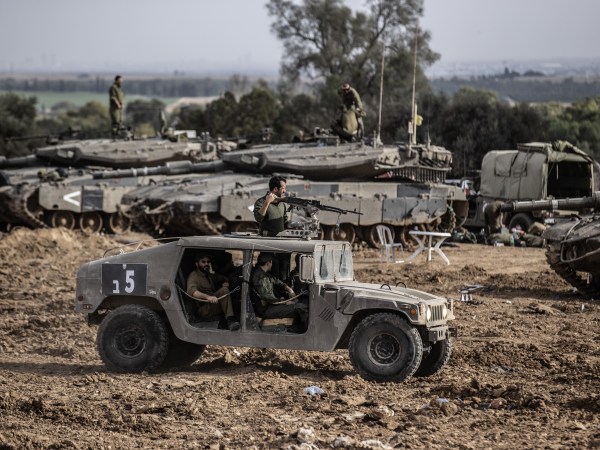

On Tuesday in the Michigan primary we had a protest vote that was nominally about forcing President Biden either to demand or actually force a permanent ceasefire in the ongoing fighting in the Gaza Strip. I’ve written a lot about the pros and cons of this both on the ground in Israel-Palestine and within U.S. domestic politics. That dynamic however shouldn’t obscure a greater and more immediate reality, which is that even on its own terms, the current Israeli operation in Gaza has largely reached a point of diminishing returns. It is Israel which desperately needs the U.S. to put an end to it.
This isn’t to say that there are not still legitimate military goals Israel has. The Hamas leadership is still holed up in Rafah. The hostages, imprisoned for four months, are still held captive there. Hamas as a military force is clobbered but not yet broken. But as is always the case, military action is a tool to accomplish political ends. Military action which makes sense on its own terms can be revealed as folly when viewed through a broader and more consequential political prism. Tom Friedman covered a lot of this in his most recent column from a couple days ago.
Read More



A new episode of The Josh Marshall Podcast is live! This week, Kate and Josh talk about Mitch McConnell’s big announcement and the primaries in South Carolina and Michigan.
You can listen to the new episode of The Josh Marshall Podcast here.


Mitch McConnell is one of those perhaps historic figures for whom the greatness of his skill and impact are matched only in inverse by the malignity of his impact on our politics. To put it more brashly, McConnell was great at doing political evil. There is now a kind of rearguard effort to remake McConnell as an institutionalist, a last vestige of the pre-Trumpian GOP. And on that last point, being a vestige, there’s some truth. On being an institutionalist, not at all.
Mitch McConnell’s great legacy is the thorough institutionalization of minority rule in U.S. politics, especially at the federal level. The first and most obvious part of that is that McConnell, more than anyone else, is the man who broke the United States Senate, largely by domesticating the filibuster. No more a wild bull kept out in the stockade for ugly moments but now living within the household, almost a family member, though no less dangerous and wild.