

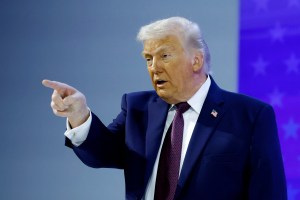

With Trump’s first official State of the Union of his second term upon us, I wanted to share a few previewing thoughts. First, who knows the particulars we’re going to see in this speech. We start with the degenerate unpredictability of Trump and added to it we have whatever mix of senescence or loosening we’ve seen so clearly in the last year. And there I am really open to either possibility. I think sometimes that in term two he has kind of maxed out on all his desires for power, for adulation. And getting everything we want has a way of undoing many people, at least putting a lot of slack in the inner chords that give us quickness and alacrity. In any case, we start with Trump and all the additional feralness and distention we have in this second term. So who the eff knows what to expect.
But this is the prism I think we should be looking at the speech through.
Read More
You’ve probably seen some hints of it. But I wanted to focus your attention on a genuine piece of news out of the Epstein Files, even weeks after their original release. In 2019, a woman came forward and spoke to the FBI claiming that Donald Trump had assaulted her in the early 1980s. In her allegations, Jeffrey Epstein essentially provided her to Trump. Other files in the Epstein trove say that the FBI conducted four interviews with the woman. But only one of them was released in the larger trove — one that detailed her accusations against Epstein. Meanwhile, Rep. Robert Garcia (D-CA), the top Democrat on the House Oversight Committee, says he went to view the unredacted version of the files that members of Congress can access and the missing interviews aren’t there either.
There have been other accusations against Trump in the files. But this one appears to be more specific and detailed. And there are various signs and reasons that the FBI took the allegations seriously: those reasons and details about the accusations are discussed in this NPR article once you get past the first few paragraphs. The accuser, according to one FBI note contained in the files, eventually refused to cooperate with the investigation.
Read More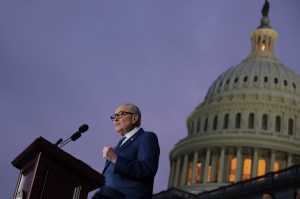
The Post has an article today, an exclusive they say, about a draft executive order purportedly being circulated between the White House and various conspiracy theorists and right-wing extremists in its broader circle. The proposed order claims that China has been found to be interfering in U.S. elections — specifically rigged the 2020 election in Joe Biden’s favor — and that as a result of that the president, as commander-in-chief, can and must directly take control of U.S. elections for the midterms and the 2028 presidential elections.
Two points merit saying on this. The first is that these are the rehashed, insane theories that were literally and figuratively laughed out of court in 2020. These are all absurd. Everybody knows they are absurd and false. The legal theory is what demands our attention. The authors of the order believe that if something is an emergency the president can invoke a kind of hidden dictator clause in the Constitution which allows him to assert powers which the Constitution explicitly forbids to him. This is not so. They secondarily believe in what we might call a “because” or “therefore” logic or clause. So because we have found that Threat X exists, the president can do whatever he wants to combat that threat. And as commander-in-chief, he can do anything he wants. This is also not so.
Read More
News came today that Warner Bros Discovery decided that Paramount-Skydance’s bid ($111 billion) to acquire the company was superior to that from Netflix ($82.7 billion). WBD told Netflix it had four days to up its offer. Little more than an hour later Netflix said it didn’t need four days. It was bowing out. The deal was no longer economic at the price Paramount was offering. An additional fact is that Netflix co-CEO Ted Sarandos was at the White House while these things were happening, apparently trying to see whether Netflix had the thing any major company needs for a merger in 2026: the personal approval of Donald Trump. Apparently they didn’t have it. That’s the autocracy playbook. And at the federal level, that’s the game we’re playing right now.
Read More
We’re used to Americans, at least as judged by polls, going into wars generally supportive and then trailing off quickly as the complications and fatalities mount. Some of that is a rally-’round-the-flag effect. In some cases there’s been a precipitating event which the public wants vengeance for. Here we are seeing none of that. The public was very skeptical going in. And the attack itself seems to have done nothing to change that. A new CNN poll has the familiar 59% of Americans disapprove of the attacks and expect things to get worse. What is most interesting to me, however, is not so much public opposition but the disconnect between elite and popular opinion.
Read More
It’s the perhaps tired refrain of foreign policy and defense professionals that wars are easy to start (if you’re still, mostly, the preeminent global military power) but much harder to finish. They are unpredictable. They quickly spread in directions you don’t anticipate. As the still preeminent global military power, you tend to be on the line for other sorts of instability that your war of choice creates. And yet Donald Trump has mainly been able to engage in what we might call impulsive unilateralism without generating too many problems for himself in the short run. He decapitated the Venezuelan regime through what amounted to a dramatic raid and is now, improbably, running the country as a kind of American presidential subsidiary through the mechanisms of the Chavista regime itself. He assassinated Qasem Soleimani in 2020. He launched a massive but brief bombing raid against Iranian nuclear facilities last year. In each case the U.S. was mostly able to end things quickly and on its own terms.
Read More
A short time ago I got email from a TPM reader with a version of this question: Josh, are you sure there’s going to be a November election? Because everything I’m seeing tells me they don’t think there are any consequences, even political consequences, coming from any of this. It wasn’t a challenge so much as a question: are you sure? I have no way to predict the future. But yes, I am as confident there’s going to be a November election as I’ve ever been. I’m not trying to get in an argument about that. This is my opinion. You might have another.
A couple months ago, I said that we were starting to see a pattern. As Trump grew less popular and less powerful at home, he would need to compensate to maintain his psychic equilibrium. He’d lean more and more into the presidency’s prerogative powers that are untrammeled and unrestrained regardless of what’s going on at home or how much support he has. He’ll be increasingly aggressive and violent in those realms of power as he becomes more constrained and limited in others. In Trump’s world, there is dominating and there is being dominated. For him, the latter is a psychic death. So leaning hard into these prerogative powers where a president is, in effect, all powerful amounts to a kind of grand and bloody self-care.
Read More
Sometimes I write a post where I don’t know the topic well enough to discuss it expertly but I understand it enough to point to the outlines of the debate and where to find more information. This is one of those posts. Here, I want to discuss drones and missiles deployed by Iran and the expensive, high-tech weapons the U.S. and its allies use to shoot them down. This applies right now in the Persian Gulf where Iran is using a strategy of “asymmetric attrition.” But it would apply in even more complicated and hard-to-address ways if and when the U.S. got into a major conflict with, say, China over Taiwan. It’s that basic challenge of asymmetric warfare for a Great Power like the United States: the U.S. relies on often quite effective but very expensive and hard to replace weaponry. Iran’s clunky but effective drones cost in the low five-figures to produce, while U.S. missile defense tech can costs millions for a single shot.
Read More
Every president wants favorable press coverage. Most feel a surprising level of grievance when they don’t get it. Donald Trump is singular in using the powers of his office to force news organizations to bend to his will. But when is it beyond friendly or fawning coverage, or always giving the president the benefit of the doubt? At the gym a couple days ago I watched the soon-to-be-gobbled-up CNN doing a news segment on gas prices with an energy industry analyst. They’re not the only ones talking about gas prices. But the tone of the segment seemed out of sync with a lot of other press coverage. It occurred to me that what Trump wants, distinctly if not uniquely, is a kind of spell preservation as much as good coverage or fawning per se. He governs the country by a kind of manic coaxing which is at war with short-term memory and thrives on the ability to keep as many people fixated on the super dramatic crisis of the moment without remembering that it was preceded by an endless litany of other crises with similar branding.
Read More