



I’m starting to get a strong Iraq War vibe about Greenland.
By this, I want to be clear, I don’t mean that I expect a catastrophic and ruinous U.S. invasion to take place. I’m referring to something different … but let’s just say: still not great. One of my strongest memories of those dark times 20-plus years ago was a peculiar dynamic that took hold in Washington after the 9/11 terrorist attacks. The desire to invade Iraq was already a big thing in elite conservative circles in the late Clinton years. That was the origin of the “Iraq Liberation Act” of 1998. After the 9/11 attacks, the Bush administration quickly made clear it wanted to overthrow the Iraqi regime either as retaliation for the attacks or as some sort of preemptive action to forestall future attacks. The ambiguity was of course an important tell about what and why any of this was happening.
Read More
I’m not one to tell people how they should react to or experience things. But for me I’m taking all of this in with a serene impassivity. They won. They’re entitled to their day. The Trump people have been signaling for days that they’re going to hit the ground running with what they describe as an executive “shock and awe.” I don’t see any reason to be shocked or awed. I don’t say this in any grand metaphysical sense. I mean that I’ve seen headstrong winners of close elections high on their own supply before. As I wrote a couple weeks ago, all of this is meant to hit you with so much sensory stimulus that you become overwhelmed. But the images you see wrapped around you in an iMax theater aren’t real. It’s still a movie.
Note this “for the ages” picture, above, of Jeff Bezos with the CEOs of Meta, Google and Apple from left to right, at an inaugural service feting Donald Trump this morning at St. John’s church across the street from the White House. You may not have a billion dollars but your dignity is all yours. No one can take it from you. Compared to some you can already be ahead of the game.
One step at a time. They’re not as big as they look.
Read More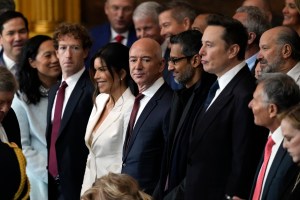
After a morning meeting, I sat down to my computer around 11:30 a.m. ET and read two reader emails picked more or less at random out of my inbox. The first was from an American expat. The gist of his email was that American liberals — Blue America, for lack of a better descriptor — are totally unprepared for what’s coming down the pike toward them. The second was from a federal government employee reviewing the executive orders relevant to the federal workforce and explaining to me in so many words, ‘yeah, good luck with that.’ The expat’s email was generally more pessimistic and totalizing than I’m inclined to be. You may differ and you may be right; who knows? But in general the two emails together captured the moment as well or better than any report, essay or interview I might have read — a mix of actions and red flags almost unimaginable by any normal standard (though in virtually every case unsurprising) mixed with an underbrush of the sheer size, inertia and difficulty of whatever changes Trump is trying to make. They’re both true. Both true at once.
Read More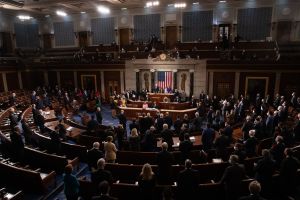
Yesterday my colleague Kate Riga noted a trap Senate Democrats keep falling into: in an effort to court Republican defectors they temper their criticism of the various Trump nominees. But since there are and will be no defectors they lose on both sides of the equation, gaining no defectors and making their critiques tepid and forgettable. This is unquestionably true. But we can go a step further still. Far from courting potential defectors, they should be attacking them.
Potential defectors are almost always those from marginal states, and some are senators from marginal states who face voters at the next election. 2026 doesn’t have a lot of great prospects. But there are some. So Susan Collins, Thom Tillis, possibly Joni Ernst and new Florida senator Ashley Moody. The criticisms of the bad nominees should be as intense as possible and all focused on the support of these senators. No one does you a favor in these settings for being nice: senators defect when they think they may pay a price at the ballot box. That is the only way to have messaging that takes the initiative and stays on the attack. If things get too hot and the senator pulls their support, great. If not, that just lays the groundwork for beating that senator in the next election. Those two possibilities are the only outcomes of any consequence and the same game plan advances both goals. It’s simple. When they’re upset or hiding you’ll know you’re doing it right. One more point: no one cares about press releases. Getting on camera or activity on social media matter.
Read More
Here’s a simple but inarguable point: Trump’s decision to pardon (and/or commute release of) all the January 6th insurrectionists is deeply unpopular. Your best evidence for that is the responses of Republicans who are asked to react to or justify it. They’re doing the most practical thing: dodge the questions and wait for those questions to subside. Wait for it to become old news, something that happened in the past. Democrats’ job is to prolong the period of questions for as long as possible. There are many ways to do it, as I explained yesterday. The job of a political opposition is to spend every day illustrating for the public what’s bad about the current government being in power. That’s not tawdry or institutionally selfish or unhelpful. It’s a functional, essential feature of our political system. To the extent you’re not able to do that, the folks in power must be doing a fairly good job. And that’s a good thing to know, even if it’s an unpleasant reality for the opposition. It’s quite literally what you’re supposed to do for the broader framework of government to function.
Read More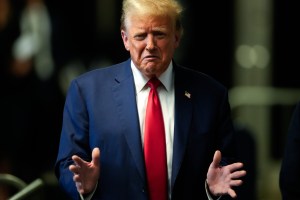
Back in June I asked you to tell me about your favorite TPM posts. I read through your responses at the time. But the project I was investigating was soon overtaken by the rush of campaign events, particularly the aftermath of the Trump-Biden presidential debate at the end of the month. I was finally able to go through them more systematically this weekend. First, thank you for the attention and thought so many of you put into those contributions. They were gratifying and illuminating to read. My aim with this exercise was to pull together a list of posts for something kind of but not precisely like an anthology.
Read More
So I write the following with the caveat that everything in the unfolding Trump administration is cloaked in secrecy and uncertain from one moment to the next. But overnight President Trump kicked off, what can only be called both a wide-ranging constitutional crisis, and also very likely a fiscal crisis. He has unilaterally halted – as of yesterday evening, according to an executive memorandum first reported by independent journalist Marisa Kabas – all “grant, loan and federal assistance programs” for at least 90 days. This appears to include everything the federal government does beyond the salaries of federal employees, direct checks to Social Security and Medicare beneficiaries and the US military. Mainstream media journalists are calling this “temporary” or a “pause.” But that’s like saying you’re “temporarily” shutting down Congress or “pausing” elections. “Temporary” isn’t a meaningful term in this case. It’s hard to think through everything affected. Already the halt to USAID budgets has cut off funding for the prison guards holding 9,500 ISIS prisoners in northeastern Syria, according to Syria expert Charles Lister. Cancer research, major parts of every state’s budget, the grants that keep the local daycare center running. This hits basically everything.
Read More
One of the features of Donald Trump’s flood-the-zone tactics is not only to overwhelm opponents but to spark a mix of overwhelm, angst and confusion that drives those opponents to fall into arguing amongst themselves. If you can’t meaningfully strike back at the instigator, that ravaged energy has to seek release somewhere and it erupts in doom-scrolling, competitive doomerism and most importantly infighting over who’s responsible for what the instigator is doing. If you can’t lash out at the boss you kick the dog. I’m as susceptible to all of this as anyone. But I would be lying if I didn’t confess that I find those responses eternally exhausting down to the depths of my soul. I’ll just share my own thoughts.
Read More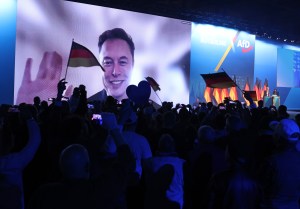
We’re getting clearer indications now that the effort to bamboozle, frighten and entice federal workers into resigning their positions in exchange for non-existent “buy outs” was very much a product of the Elon Musk/DOGE cabal now wilding through and embedding itself within the federal government. We don’t need a lot of confirmation: they left a slew of meme Easter eggs scattered through the process more or less announcing it. What’s notable is that the White House is now going out of its way to tell reporters that it definitely wasn’t them. They were, in that well-worn phrase, out of the loop, etc.
I suspect this is true, as far as it goes. But that understates — straight up ignores, really — the degree to which Donald Trump and his top advisors have, entirely by design and intentionally, spun up a series of independent fiefdoms, with Musk’s being the largest, to move fast and break things and push every boundary in the interest of a number of overlapping but distinct ideological agendas. In other words, they probably did “bypass key Trump officials.” But that’s pretty much the idea when you wind up guys like Elon Musk and Russell Vought with “let’s be legends” gusto and give them the keys.
Read More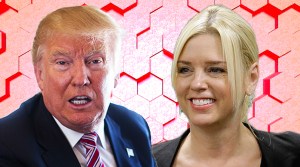
I wanted to note some details in the rapid evolution of Trump’s misrule over the criminal justice system. It is old hat, expected really, that a Trump-run Justice Department won’t investigate, let alone indict, Donald Trump or any of his top deputies. We also saw in Trump’s first term that accomplices and key supporters will be pardoned or have investigations shuttered. But the dawn of Trump’s second term now sees the rollout of a host of new Justice products and payment plans.
This week, matters took a degree of a step forward (or backward, depending on your metaphor) when Trump had his acting U.S. attorney abandon the criminal case against former Rep. Jeff Fortenberry (R-NE). Fortenberry wasn’t some high-profile Trump ally. And his crimes weren’t particularly political or Trump-adjacent. He got caught taking laundered political contributions from a Nigerian billionaire and then repeatedly lied about it to the FBI. Pretty generic graft, pretty garden-variety political corruption.
Read More