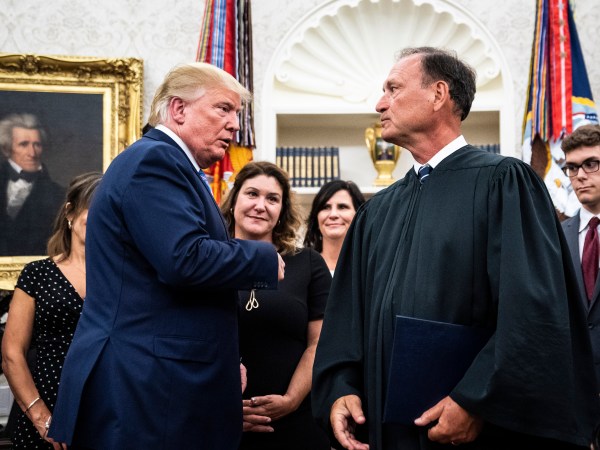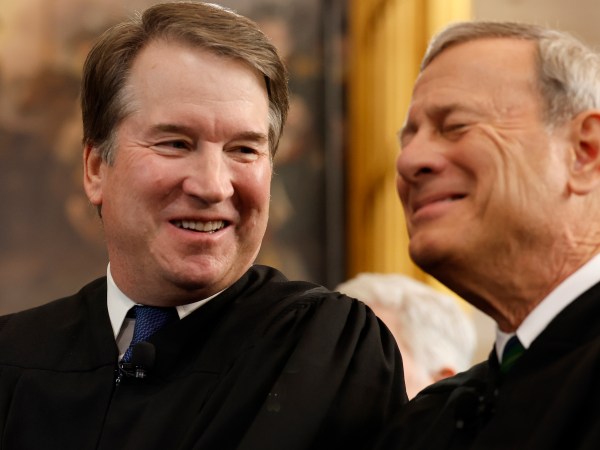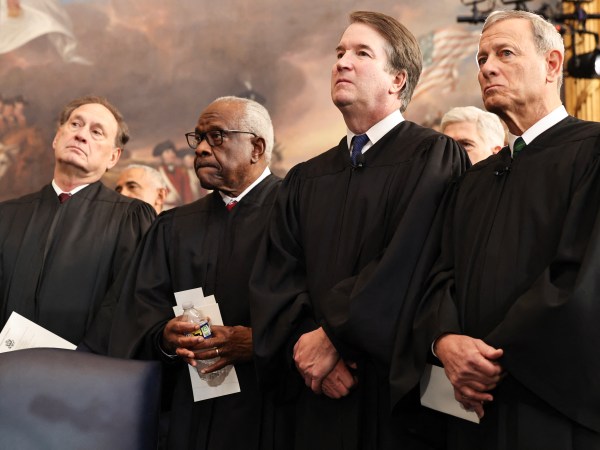
Yesterday, Lauren Egan — who authors The Bulwark’s newsletter about Democrats — sent out a newsletter edition entitled “Get Ready for the Dem Court-Expansion Litmus Test.” (Egan tends to be fairly dismissive of Democrats’ intentions, with a kind of mainstream media vibe.) Today Chief Justice John Roberts is complaining that the public is misinformed thinking that the Supreme Court is made up of corrupt political actors. As I’ve written repeatedly, there are deep inertia pools of opposition to Supreme Court reform. It’s a much heavier, though just as critical, lift than contesting the gerrymandering wars or abolishing the filibuster. But these and other hints show that a movement and a coherent push are beginning to take shape.

Read More
I’m hoping to bring you some news on the DOJ-in-Exile front in the not-too-distant future. It was probably simply too early in the spring and summer of 2025. It’s not too early now. But the DOJ-in-Exile idea was and is part of a more general ambition and agenda — to create a baseline record, a predicate and an expectation of future accountability for the Trump administration’s criminal conduct. Some of that effort is a kind of opposition therapy, resisting the authoritarian aim of convincing the public that the law, the ecosystem of criminal accountability has disappeared. It heartens people. It provides a framework of expectation: the law hasn’t disappeared. We’re in an interregnum. It will return, as will accountability. The battle over expectations about the future is a central battle in any authoritarian takeover.
But it’s not solely a matter of heartening, strengthening the morale of the opposition. It is also very directly and literally laying the groundwork for criminal accountability for a renegade executive and all the corrupt actors and criminals who now populate the executive branch.
Read More
It’s a good day to return to the question of the Supreme Court’s corruption and the necessity of reforming it in order to make democratic self-government possible again in the United States. The federal constitution is an expansive document. Within the system begun with Marbury v. Madison – which is subject to many reasonable critiques – it is possible to have more liberal or conservative jurisprudences, loosely tethered to the progress of presidencies and senates. The Roberts court is a different beast. It is the product of a decades-long effort to corrupt the federal judiciary. That degree of corruption first came into full view in the second decade of this century when the Court openly began to do three closely interrelated but conceptually distinct things.
First, The Meaning of Words is For Little People.
The Court has, with increasing boldness, manufactured new doctrines and text out of the constitution which simply do not exist in the document. Often they are implicitly or even explicitly ruled out by the plain text itself. The greatest example is the 2024 presidential immunity decision, a ruling contradicted by all the history of the document as well as its clear language. The framers knew how to create immunity. They did it for the work of Congress. They declined to do it for Presidents. The entirety of the decision is manufactured out of whole clothe. Whether the majority falsified this immunity because they thought it should exist or specifically for the benefit of Donald Trump hardly matters. It is corrupt, illegitimate and a wholesale attack on the constitution itself. The Court have also increasingly resorted to plainly absurd textual analysis to change the meaning of constitutional language the meaning of which has never been in doubt. The current birthright citizenship case, whatever the majority decides, is another example.
Second, The Choose Your Own Adventure Constitution.
Closely related to point one, the Court no longer has any consistent or even comprehensible jurisprudence. It simply has political goals it seeks to achieve – presidential immunity, an increasingly absolute right to firearms, a 14th amendment focused primarily on race not actually existing. Arguments are chosen by convenience simply as backfill to arrive at the desired end. The corruption often emerges most clearly in those brief moments when the logical conclusions of the Court’s own arguments are too much for even it to bear. Again, we have a recent example. Presidents can fire anyone in the executive branch based on nothing more than the presidential will, even when Congress has specifically given them protections against such dismissals. Except the Federal Reserve, even thought it is by every measure an independent federal agency constitutionally indistinguishable from the rest. Why is it different? Because Federalist Society ideologues actually don’t like inflationary monetary policy. So in this one case, it’s different … even when it’s not.
Third, Political Power if For Republicans Only.
While the corrupt majority has consistently advanced and enforced an ideological vision of how the country should be run it has another simpler brief: not allowing Democrats to govern when they are in power. When Republicans are in power the powers of presidency are almost limitless; when it’s Democrats the office is feeble and hemmed in by a cobweb of invented doctrines. We had the ironic benefit of two Trump presidencies sandwiching a Biden presidency to make this principle of action crystal clear. Quite simply, the corrupt majority ensures that only Republicans actually get the fruits of political victories.
In our thinned out political discourse people often use the term “corruption” to refer only to venal corruption – bribes, conflicts of interest mostly involving money, kept Justices like Clarence Thomas. That is neither the only nor the most significant form of corruption. In most cases venal corruption is significantly self-correcting. It gets exposed and prosecuted. The more general meaning of corruption is when a form of rot takes over an office or institution because of systemic and ingrained abuses of power. That is the case with the Supreme Court and it’s especially dangerous with the Supreme Court because a mix of history and restraint have left very few checks on its abuses. The Supreme Court is given specific powers to achieve specific ends. Over the last 15 years it has assumed vast new powers and used them consistently for anti-constitutional ends. Far from interpreting or defending the constitution it is at war with it. An orderly, proper and essential process of reform is entirely possible by simple statute law on simple majority votes.
We had an illustration Tuesday night of one of the most crucial questions in our current politics and the one that will determine whether civic democracy can have a rebirth in the U.S. Gerrymandering is a bane to civic democracy because it dilutes the expression of the popular will by building district lines around partisan advantage or to diminish the power of disempowered minorities. Democrats spent much of the 2010s and 2020s fighting a legal and legislative battle against gerrymandering. But the Roberts Court has chosen to legalize every manner of gerrymandering, making the current a destructive race to the bottom.
Democrats had a choice. They could express effete outrage and a meaningless devotion to broken norms and principles and agree to wage elections on a permanently tilted plane. Or they could decide to play by the rules Republicans had forced on everyone. They did just that and it was unquestionable the right decision by every measure. It really never seemed to occur to Trump Republicans that Democrats would fight on the playbook Republicans created. There’s a special comedy to this because anyone familiar with the facts on the ground knew that Republicans had already used gerrymandering much more aggressively than Democrats. So there was much more juice in the gerrymandering lemon for Democrats if and when they decided to employ tactics Republicans have been using for more than a decade. It’s worth Democrats considering how deeply Republicans had internalized the belief that Democrats would simply never respond in kind.
Read More