

The House of Representatives passed the Build Back Better reconciliation bill Friday, a sweeping package that contains wide swaths of President Joe Biden’s agenda. It goes now to the Senate.
Continue reading “The Reconciliation Bill Clears The House. Now It Has To Survive The Senate”Biden To Take Key Step Toward Ousting Postmaster Louis DeJoy
President Joe Biden is slated to announce on Friday that he won’t keep a top ally of controversial Postmaster General Louis DeJoy on the U.S. Postal Service board of governors next month, according to the Washington Post.
Continue reading “Biden To Take Key Step Toward Ousting Postmaster Louis DeJoy”McCarthy Stalls BBB Vote With 8-Hour Audition For House Speaker
A lot of things happened. Here are some of the things.
Round Of Applause
House Democratic leadership moved the chamber’s vote on Democrats’ sweeping $1.85 reconciliation bill to Friday morning after House Minority Leader Kevin McCarthy (R-CA) spent more than eight hours ranting about the legislation, Biden’s agenda and, uh, this in a floor speech that didn’t end until after 5 a.m. ET. McCarthy’s gambit won’t actually stop the reconciliation bill from passing
- McCarthy took advantage of the House’s “magic minute rule”, which lets the House speaker, the majority leader and the minority leader to speak for as long as they want.
- The monologue went on for eight hours and 32 minutes, surpassing what was believed to be a record-breaking speech in 2018 by Nancy Pelosi (D-CA) on Dreamers.
- Pelosi’s office put out a statement shortly before midnight asking “Is Kevin McCarthy OK?”
- Democrats roasted McCarthy throughout the night:
GOP Guv. Slams Conservative Anti-CRT Group’s Bounties On Teachers
New Hampshire Gov. Chris Sununu (R) slammed the right-wing “Moms for Liberty” nonprofit yesterday for offering a $500 cash reward to anyone who snitches on a public school teacher they believe broke the state’s new law that allows teaching licenses to be revoked if the instructor teaches what conservatives call “critical race theory.”
- Offering a financial incentive to hunt down teachers is “wholly inappropriate,” Sununu said in a statement, despite being the one who signed the law and making all this possible in the first place.
- The law, which bans teachers from teaching anything with a “divisive concept” and the idea that “an individual, by virtue of his or her race or sex, is inherently racist, sexist, or oppressive,” led the state government to put up a website where parents can report teachers.
Biden Admin Funds The Police
The Justice Department announced yesterday that it’ll hand out $139 million to police departments nationwide.
- 1,066 police officers will get hired with the new funding, according to the DOJ.
- 183 law enforcement agencies will get the money.
Fired Ferguson Cop Prowls Around Rittenhouse Trial Courthouse
An ex-cop who got canned from the Ferguson Police Department in Missouri and calls himself “Maserati Mike” showed up to Wisconsin’s Kenosha County Courthouse, where Kyle Rittenhouse’s trial is being held, with a long rifle on Wednesday.
- His real name is Jesse Kline.
- Kline was apparently there to support Rittenhouse, who’s become a hero on the right and so-called Blue Lives Matter supporters.
- Kline was seen carrying a gun case in the area on Thursday, according to the Milwaukee Sentinel. It was unclear whether the case was empty or not.
McDaniel Sympathizes With Wyoming GOP Shunning Cheney
Republican National Committee chair Ronna McDaniel said during a Christian Science Monitor breakfast yesterday that she understands why the Wyoming GOP officially decided to stop recognizing Rep. Liz Cheney (R-WY) as a Republican.
- McDaniel said that “I get from a state party standpoint” why the organization did so. The chair accused Cheney of “not supporting” the Wyoming GOP and “not talking about electing Republicans up and down the ballot.”
- But McDaniel didn’t go as far as agreeing that Cheney wasn’t a Republican anymore, saying the congresswoman was “obviously” still part of the party, so … congratulations, Cheney?
Trump Endorses Gosar
In the grand tradition of owning the libs and screaming for attention, the ex-president put out an endorsement for white nationalist-adjacent Rep. Paul Gosar (R-AZ) yesterday, 24 hours after the lawmaker was censured for posting a murder fantasy of Rep. Alexandria Ocasio-Cortez (D-NY).
- Gosar “has been a loyal supporter of our America First agenda, and even more importantly, the USA,” Trump said in a statement through his Save America PAC.
- Gosar is not in a competitive race in Arizona’s 4th Congressional District in the 2022 midterms.
Must-Reads
“Outside court, Ahmaud Arbery’s killing is a racial justice issue. Inside, the trial skirts race.” – The Washington Post
“Can a Machine Learn Morality?” – The New York Times
Do you like Morning Memo? Let us know!
Where Things Stand: House GOPers Roll Out Bad Faith Spin On FBI Plan To Track School Threats
The DOJ announced in October that it would launch a task force aimed at helping local law enforcement track and investigate threats against teachers and school staff. We knew this.
But this week House Republicans released information about a new FBI tracking program reportedly designed to help the DOJ field these threats. The GOP campaign was, seemingly, part of a broader attempt to push a bad faith narrative: that the Biden administration is seeking to intimidate and silence parents and community members who disagree with local school policies.
That framing is, of course, not true or fair.
Continue reading “Where Things Stand: House GOPers Roll Out Bad Faith Spin On FBI Plan To Track School Threats”GOP Revives McCarthyism While Grilling Biden’s Pick For Bank Regulator
Senate Republicans suggested on Thursday that a Soviet-trained communist was about to take over a key office in the country’s banking regulation infrastructure.
Continue reading “GOP Revives McCarthyism While Grilling Biden’s Pick For Bank Regulator”Jury Enters Third Day Of Deliberations In Rittenhouse Murder Trial
The jury in the Kyle Rittenhouse trial will reconvene Thursday morning, entering the third day of closed-door deliberations. We saw very little movement yesterday. The jury requested permission to review certain video evidence and the judge, prosecution and defense spent several hours discussing if and how the footage could be viewed.
While awaiting a verdict, conservatives and some in the right-wing media have doubled down in their support of Rittenhouse, the teen accused of killing two and injuring a third person when he shot people with an AR-15 during a Black Lives Matter protest in Kenosha, Wisconsin last year.
Listen To This: Inflation Consternation
A new episode of The Josh Marshall Podcast is live! This week, Josh and Kate discuss inflation, some low-balled jobs numbers and the vote to censure Republican congressman Paul Gosar.
You can listen to the new episode of The Josh Marshall Podcast here.
Report: Eastman Pitched Coup Plan Directly To Arizona GOP Leader
John Eastman, the conservative legal scholar who drew up a full scheme to have then-Vice President Mike Pence throw out certain states’ 2020 electoral votes to steal the election for Donald Trump, reportedly took his ideas straight to at least one Republican leader in a state Trump lost.
Continue reading “Report: Eastman Pitched Coup Plan Directly To Arizona GOP Leader”McCarthy Vows To Give Greene And Gosar Their Committee Seats Back If GOP Retakes Majority
House Minority Leader Kevin McCarthy (R-CA) on Thursday promised to restore Reps. Paul Gosar (R-AZ) and Marjorie Taylor Greene’s (R-GA) committee assignments if Republicans take back the majority in next year’s midterm elections.
Continue reading “McCarthy Vows To Give Greene And Gosar Their Committee Seats Back If GOP Retakes Majority”Trouble On The Belarus-Poland Border: What You Need To Know About The Migrant Crisis Manufactured By Belarus’ Leader
This article is part of TPM Cafe, TPM’s home for opinion and news analysis. It first appeared at The Conversation.
Using migrants as pawns is perhaps nothing new. But rarely do you have a situation in which one country encourages a migrant crisis on its own border for nakedly geopolitical reasons.
That is what appears to be happening at the Poland-Belarus border, where violence has broken out between Polish border guards and Middle Eastern migrants who traveled there via Belarus, and who are set on reaching the European Union. Meanwhile, there is growing concern over those camped out in freezing conditions.
The Conversation asked Tatsiana Kulakevich, a specialist on Eastern European politics at the University of South Florida, to break down how the migrant crisis came about and what the fallout might be.
What is going on at the Belarus-Polish border?
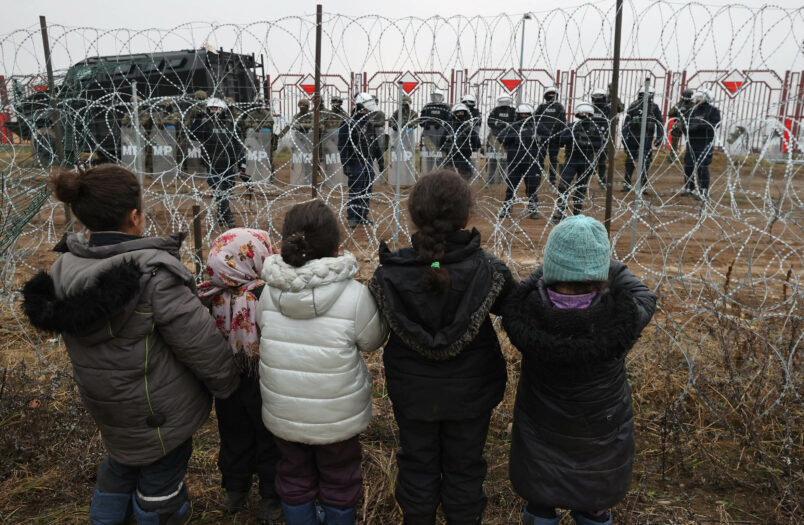
Images of migrants – many of them families with children – camped at the Belarus-Poland border, trying to force their way into Poland and being deterred by water hoses, have gained international attention in recent days. On Nov. 18, it was reported that many of the migrants were being moved back from the border, to a government-run facility. But it is not clear what the long-term plan is for those who have gathered in Belarus with no intention of returning to their countries of origin.
The crisis has been months in the making.
The influx of migrants to Belarus from the Middle East began in early summer 2021. But they didn’t come to stay in Belarus. Their ultimate destination was Western Europe. Now, there are thousands of people spending nights near the barbed-wire fence separating Belarus from EU member Poland.
The situation took a dramatic turn on Nov. 8 when thousands of new arrivals showed up at the Belarus-Poland border and tried to break through makeshift fences on the border, with the goal to crossing into the European Union.
This migrant crisis has a twist – it appears to be encouraged by Alexander Lukashenko, Belarus’ leader, who’s at the center of the border conflict as part of a ploy to flood the EU members that border Belarus – Poland, Lithuania and Latvia – with large numbers of migrants in retaliation for a series of sanctions against the Lukashenko government.
Lukashenko has denied encouraging migrants into Europe. The evidence suggests otherwise.
Belavia, the Belarus state airline, increased the number of flights from the Middle East – including Iraq, Lebanon and Syria – in recent months to enable more migrants to come. For example, flightradar24.com, which monitors global air traffic, reported 27 flights from Beirut to Minsk from August to November 2021, compared to only five in the whole of 2020.
And according to some of the migrants from Iraq, Belarusian officials arranged for their stay in hotels and helped them reach the border with Poland. Belarusian border guards, it has been reported, led migrants to a gap which had been cut in the border fence, allowing them to bypass the official checkpoint. Meanwhile, other migrants say they were provided axes and wire cutters by Belarusian border guards to cut through fences.
In response, the Polish government has closed its border with Belarus.
What is the background to the crisis?
The actions of the Belarusian government appear to be in retaliation for economic sanctions imposed by the international community in response to Lukashenko’s increasingly autocratic rule.
In August 2020, Belarusian authorities cracked down on protesters demanding the resignation of Lukashenko following a disputed – many say rigged – election. Opposition leaders say as many as 30,000 people were detained in efforts to suppress demonstrations.
The United States and the European Union refused to recognize Lukashenko’s legitimacy as president and, in September 2020, imposed a series of sanctions targeting Belarusian officials with asset freezes and travel bans.
The EU followed that up with two further rounds of sanctions in November and December of that year.
A fourth packet of EU sanctions came after Belarus intercepted a Ryanair flight carrying Raman Pratasevich, an opposition journalist and a former editor-in-chief of the Telegram Nexta news channel, along with 132 other passengers in May 2021. Belarusian authorities arrested the journalist and his partner before allowing the plane to continue to its destination. In June 2021, Pratasevich was moved under house arrest.
Lukashenko has sought to suppress any signs of protest activities. Since the beginning of the presidential election campaign in May 2020, the number of political prisoners in Belarus has increased from three to 868 as of November 18, 2021.
Where are these refugees coming from, and why?
The asylum seekers are mostly Kurds from Iraq, fleeing persecution and poverty. But there are also migrants from Lebanon, Syria and Afghanistan. They are trying to cross into EU member states Lithuania, Latvia and Poland.
Previously, Middle Eastern migrants mainly crossed the Turkish border with the EU, and from Africa via the Mediterranean Sea.
These crossings can be treacherous, so the prospect of flying straight into Belarus instead of risking drowning proved an attractive option.
But now thousands are stuck or hiding along the Belarusian-Polish border, facing freezing temperatures. The cold and lack of humanitarian support have caused multiple cases of hypothermia and at least nine deaths.
What chances are there for a resolution to the crisis?
Lukashenko is using the border issues as leverage against the EU. He wants the lifting or easing of existing sanctions and recognition that he is the legitimate ruler of Belarus.
The EU, meanwhile, has announced plans for more sanctions against Belarus. But it has also held out the possibility of negotiations on resolving the migration crisis.
Lukashenko and Germany’s acting Chancellor, Angela Merkel, have held two phone calls since the escalation of the border crisis on Nov. 8. They represented Lukashenko’s first conversations with a European leader since the 2020 presidential election.
The phone calls happened after Russian President Vladimir Putin, an ally of Lukashenko and the Belarusian regime, called on EU leaders to talk directly with Lukashenko.
What could be the fallout?
The EU, the U.S. and NATO have strongly condemned Lukashenko’s ushering migrants to the EU border. The EU recently announced plans for a fifth round of sanctions against Belarus, targeting airlines, travel agencies and individuals believed to be facilitating the push of migrants.
Lukashenko, in turn, has threatened to retaliate against further sanctions, including cutting off natural gas transit from Russia to EU countries through Belarus.
Setting the stage for this, on Nov. 17, Belarus restricted the pumping of oil through the Druzhba pipeline to Poland, saying it was the result of “unscheduled repair work” that would last approximately three days.
But cutting off the gas supply to Europe would likely only be a short-term measure for Lukashenko. Anything more than a few days would go against Russia’s interests and could cause a rift with Putin – and keeping Putin on his side is crucial for Lukashenko.
Moscow has provided a financial lifeline to Lukashenko’s regime and promised to protect Belarus from external military threats. As long as Lukashenko retains Putin’s support, he will be able to continue to suppress dissent internally and ignore international pressure to respect borders.
Tatsiana Kulakevich is an assistant professor of Instruction at SIGS and a research fellow of the affiliate faculty at the Institute on Russia at the University of South Florida.
This article is republished from The Conversation under a Creative Commons license. Read the original article.
