There Are Dire Signs Of Trouble Ahead For Our Election System

This article is part of TPM Cafe, TPM’s home for opinion and news analysis. It was originally published at The Conversation.

As the U.S. moves closer to the 2022 midterm elections, a sizable number of Americans express a lack of confidence in the accuracy of the vote count.

That distrust is built largely on the widespread – and false – assertion that Donald Trump was re-elected in the 2020 presidential election, and that Joe Biden’s win was based on fraud. Despite the 2020 election being the most secure in American history, and the courts and U.S. Department of Justice uncovering no evidence of widespread voter fraud that could change the outcome, consistently about 70% of Republican voters suspect election fraud, and overall mistrust in the neutrality of the election process remains high.

In some states, this has prompted the passage of voting restrictions and legislation aimed at interfering with the administration of elections. Legislation passed in various states has changed rules on how voters cast ballots, reduced the role of state chief election officials and shifted some aspects of election administration to partisan bodies.

As a scholar of public governance and a former local government official, I believe that there’s trouble ahead for the bedrock institution of U.S. democracy: elections. U.S. elections long relied on the good faith of the public, the nonpartisan behavior of election officials, as well as a two-party system of political checks and balances to ensure the legitimacy of results. Now, the public’s mistrust of elections is combining with changes to election law and a major voter shift away from party affiliation to endanger the integrity of those elections.

50 ways to run an election

The administration of elections in the U.S. is a decentralized and complex system that gives considerable authority to state and local officials.

At the local level, election administrators determine who can vote, where they vote and how they vote. At the state level, election administration covers a range of logistics, including maintaining the statewide voter registration file and ensuring state and federal election laws are followed.

The result is that no state administers elections in exactly the same way, and there is variation even within states.

Additionally, the U.S. is one of the few democracies in which partisans run the election administration system.

That partisan system largely worked until now because, in essence, each party checked the other party’s ability to influence election outcomes. As long as states were politically diverse, members of the two major parties acted in good faith, and this model functioned – albeit imperfectly.

In my new book, “The Independent Voter,” my colleagues Jacqueline Salit, Omar Ali and I explore this U.S. partisan election system, whose nature has changed now that 25% to 50% of the voting population in each state is not affiliated with a major political party. That means one quarter to one half of the voting population in each state is shut out from playing a role in, or being represented by, any aspect of election administration.

This puts election administration into the hands of an increasingly partisan set of officials.

Public trust has eroded

The U.S. is the only democracy in the world that elects its election officials, and one of the very few to allow high-ranking party members to lead election administration.

The selection process for each state’s chief election officials can itself undermine trust in our election system. Most state chief election officers, known as secretaries of state, are chosen through explicitly partisan processes, such as partisan elections or political appointment. They conduct highly partisan and polarizing election campaigns.

Then, if they win election, they are expected to be seen by the public as trusted, neutral arbiters of election information and the electoral process.

A new threat to the integrity of elections comes with the recent moves to exploit these partisan models. This is being done explicitly by attempting to assign supporters, poll workers and observers to disrupt voting centers, tamper with equipment or call voting procedures into question.

Further underscoring this partisan system, the research I co-authored with Jeremy Gruber, John Opdycke and Jacqueline Salit, in which we reviewed 30 states with partisan voter registration, found that 27 states gave preferential treatment to partisans wanting to serve on election boards or as poll workers. Additionally, nearly half gave preference to partisans wanting to serve as election judges.

The partisan control of election administration in the states now serves to erode public trust and intensify partisan gamesmanship, which in turn further erodes public trust.

Who’s going to run elections?

Another hurdle to ensuring the integrity of U.S. elections has emerged recently as a result of the retirement or resignation of election personnel, in part due to violent threats and related personal safety concerns.

Approximately 35% of local election officials are eligible to retire by the 2024 election. A recent study found that 1 in 3 election officials feel unsafe because of their job in election administration, and nearly 1 in 5 indicated their lives had been threatened. Another poll found 1 in 5 local election officials say they are likely to resign before the 2024 presidential election.

Add the heavy workload and relatively low pay for many election officials to the harassment many are now experiencing, and it is unclear whether there will be an adequate pool of qualified talent available to replace them by the next presidential election. Job qualification and duties vary significantly across state and local election offices, with many of these positions requiring college degrees.
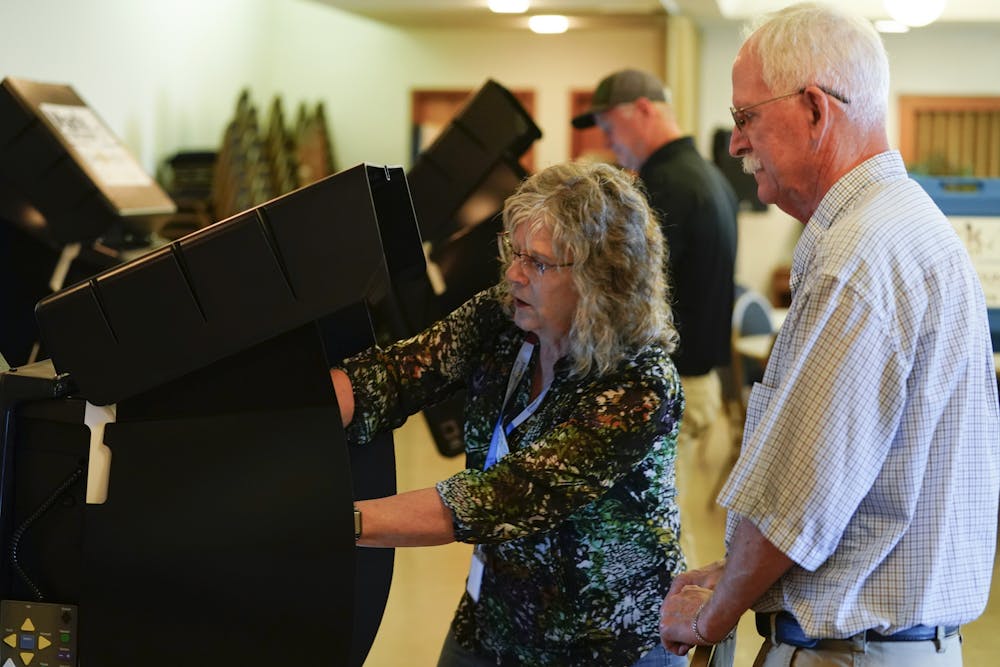
A woman with gray hair helps a man with gray hair cast a ballot at a voting machine.
A poll worker helps a voter cast a ballot in the Kansas primary election at Merriam Christian Church on Aug. 2, 2022, in Merriam, Kan. Kyle Rivas/Getty Images

Lies undermine trust

Lastly, widespread misinformation and disinformation on election administration is hobbling the ability of election officials to do their job and has created fertile ground for mistrust.

Former President Trump and other high-profile individuals have exacerbated this by continuing to promote false claims regarding the 2020 presidential election results. State and local election offices have launched efforts to counter inaccurate information; however, these efforts often fail to reach or convince many audiences.

Social media companies have often been slow in identifying these false claims on their platforms. And local election offices have minimal or no presence on these popular social media sites such as Facebook, TikTok and Twitter, missing the opportunity to correct misinformation and amplify accurate information to the large number of people who use these sources to get news and information.

This article is republished from The Conversation under a Creative Commons license. Read the original article.

The Conversation

Alex Jones Ordered To Pay Nearly $1B To Sandy Hook Families In Costly Reaping

A lot of things happened. Here are some of the things. This is TPM’s Morning Memo.

The Price Of F’ing Around And Finding Out

A Connecticut jury awarded $965 million to the Sandy Hook families and an FBI agent on Wednesday in their defamation lawsuit against far-right conspiracy theorist Alex Jones, whose supporters terrorized the families over his ghoulish lies claiming the shooting was a hoax.

  • What probably didn’t help Jones’ case was him snarling during one of the hearings last month that he was “done saying I’m sorry” for lying about the shooting:
  • This was Jones’ second Sandy Hook defamation trial. A jury in a different Sandy Hook lawsuit in Texas ordered Jones to pay almost $50 million to the plaintiffs in August.
  • Jones still has a third defamation trial to go through. It’ll be held in Texas and is expected to begin before the end of the year.

Today’s (Likely Last) Jan. 6 Panel Hearing

The House Jan. 6 Committee is holding what’s probably going to be its last public hearing today before the panel releases its final report. Here’s what to expect going into the session, which begins at 1 p.m. ET:

  • The committee will present a trove of internal Secret Service communications sent and received around Jan. 6 that the agency has handed over to the panel, which amount to over one million records, according to NBC News.
  • There’ll be new video testimony but no live witnesses, according to committee aides.

Must Read

“Penn denied ties to slavery. Students sought the truth.” – The Philadelphia Inquirer

Trump Ordered Docs To Be Moved After Getting Subpoena

A Trump aide has told the FBI that the ex-president ordered the boxes of government documents he was hoarding at Mar-a-Lago to be moved somewhere else at the resort after he received a grand jury subpoena for the records in May, according to the Washington Post and CNN.

  • There’s surveillance footage at Mar-a-Lago that shows an employee moving the boxes, per the Post, CNN and the New York Times.
  • The boxes were moved from a storage room in the basement to Trump’s residence, according to CNN.

Racist L.A. City Council Member Resigns

Nury Martinez, who stepped down as the president of the Los Angeles City Council after a leaked recording earlier this week revealed her making racist comments, resigned from the council entirely on Wednesday.

  • Martinez’s resignation letter didn’t include an apology to the people she’d aimed at with her racist attacks, though she had apologized in a previous statement when she was resigning as president of the council.
  • The letter did include a weird line saying that she hoped she’d “inspired” L.A.’s young Latina girls “to dream beyond that which you can see.”

Top Wisconsin Paper Wants RonJohn RonGone

The Milwaukee Journal Sentinel put out a scathing editorial yesterday dragging Sen. Ron Johnson (R-WI) to hell and back while giving readers eight reasons why he needs to be booted out in November as an “election deceiver,” “science fabulist,” and “billionaire benefactor.”

In fact, Ron Johnson is the worst Wisconsin political representative since the infamous Sen. Joseph McCarthy.

– A brutal editorial board

GOP Nebraska Governor’s Wife Backs Dem House Nominee

First Lady of Nebraska Susanne Shore, the wife of Gov. Pete Ricketts (R), has been endorsing Democratic state Sen. Patty Pansing Brooks’ U.S. House bid against Rep. Mike Flood (R-NE)–who’s being endorsed by her husband. In fact, Shore first endorsed Pansing Brooks over Flood (who was being backed by Ricketts then, too) in June in the special election to fill now-convicted Jeff Fortenberry’s seat.

Gabbard Now Shilling For Bolduc; It’ll Be Interesting Tulsi How This Goes

(Okay, that’s the last stupid name pun in today’s Morning Memo.)

Former Rep. Tulsi Gabbard of Hawaii is off to a great start in her non-Democratic career: About 24 hours after Tucker Carlson’s BFF made her earth-shattering declaration that she was leaving the Democratic Party, New Hampshire GOP Senate nominee and election denier Don Bolduc announced that Gabbard will be joining him on the campaign trail.

Dennis Prager Has Ordinary Thoughts About Adult Incest

Do you like Morning Memo? Let us know!

Outlaw

The latest news out of the Mar-a-Lago case, which Josh Kovensky explains here, really makes it hard to see how the government can avoid charging Trump with a crime even if they’d prefer not to. The government appears to have clear, corroborated evidence that after receiving subpoenas for the retrieval of classified documents, Trump directly ordered a resort employee to remove the records from the storerooms where the government’s investigation focused and to his personal residence.

Continue reading “Outlaw”

Where Things Stand: Cheers To Whoever Had Gabbard And Bolduc On Their 2022 Bingo Card

Tulsi Gabbard has not walked or talked or looked like a Democrat in years, so the collective response to her announcing yesterday that she was leaving the Democratic Party was … 🙃🙃🙃🙃🙃.

Continue reading “Where Things Stand: Cheers To Whoever Had Gabbard And Bolduc On Their 2022 Bingo Card”

Jan. 6 Hearing Will Focus On New Secret Service Docs Showing Trump Was Warned About Violence

The Secret Service handed over a trove of electronic communications surrounding the January 6 insurrection to the House select committee ahead of the panel’s likely final hearing on Thursday, which will reportedly reveal more evidence of what President Trump knew about the violence that day and when he knew it.

The panel intends to highlight findings from over a million pages of records recently handed over by the Secret Service to illustrate that the former president was not only warned about the violence as it was unfolding that day, but that he also helped stoke it, despite being aware of the risk, according to the Washington Post.

The committee will reportedly share new video footage to corroborate previous accounts of that day, including that of former White House aide Cassidy Hutchinson, who testified back in June that Trump was briefed that his supporters were preparing for violence.

While the Secret Service records will be a key feature of Thursday’s hearing, obtaining data from the agency has been a news cycle of its own. As has been previously reported, over the course of its investigation the congressional committee has asked several federal agencies, including the Secret Service, to turn over all written correspondences that were sent on or around January 6, 2021. But in response to the requests, several agencies admitted that they’d deleted all the text messages from that day in either planned data transfers or as part of standard protocol for outgoing employees. Experts can’t agree if the lack of oversight was part of a cover-up or just negligence, but they do agree that the messages shouldn’t have been deleted.

The Secret Service in particular has taken steps to prevent future slip-ups and meet Congress’s demands. This week, the Secret Service shared over one million pages’ worth of written correspondences, including information that the committee didn’t request—excluding, of course, the text messages.

“We have and continue to fully cooperate with the Jan. 6 select committee,” Secret Service spokesperson Steve Kopek told NBC News. “While no additional text messages were recovered, we have provided a significant level of details from emails, radio transmissions, Microsoft Teams chat messages and exhibits that address aspects of planning, operations and communications surrounding Jan. 6.”

One of the Secret Service documents handed over to the panel reportedly shows that between 1:30 and 2:00 p.m. ET that day, Secret Service supervisor Ronald L. Rowe emailed Bobby Engel, then head of Trump’s security detail, warning him that the protest was becoming unruly and anxiously enquired about whether Trump still planned to go to the Capitol. He then urged Engel to call him.

During her public testimony, Hutchinson provided her under oath account of what she witnessed and heard from others about Trump’s behavior that day. Most notably, she told the panel that then-White House Deputy Chief of Staff Anthony Ornato relayed a story to her in which Trump lunged at a Secret Service agent after he was told they wouldn’t take him to the riot as it unfolded. 

But some anonymous Secret Service sources have since tried to poke holes in her story, telling the Washington Post and other news outlets that Ornato and Bobby Engel, former leader of Trump’s security detail, have disputed that any altercation occurred in the vehicle. Neither Ornato nor Engel have confirmed or denied the account up until this point. 

Minnesota Man Pleads Guilty After Burning Down His Own Camper And Blaming It On Antifa ‘Hate Crime’

A Minnesota man and Trump supporter who vandalized his own property to pretend to be a hate crime victim has pleaded guilty to scamming insurers and GoFundMe donors in the charade.

Continue reading “Minnesota Man Pleads Guilty After Burning Down His Own Camper And Blaming It On Antifa ‘Hate Crime’”

Musk and Putin

Yesterday I noted this odd report that Elon Musk’s weird foray into Russo-Ukraine War peacemaking was preceded by a call with Vladimir Putin. This was revealed in a global intelligence newsletter published by Ian Bremmer. Then Musk denied that any such call had happened. That’s where we got to yesterday. But there’s more from overnight that I want to update you on.

The short version is that it seems pretty clear that Musk’s denial is a lie. And the original tweets themselves have a variety of references that seem like they come from a Russian nationalist or someone very familiar with the set of post-Soviet grievances which are the mother’s milk of Putin’s political world. (They refer to “Khrushchev’s Mistake” and the conquest of Crimea in 1783.)

Here’s the somewhat longer version.

Continue reading “Musk and Putin”

Ken Chesebro Hit With Ethics Complaint Over Big Lie Involvement

A group of attorneys brought an ethics complaint this week against Ken Chesebro, the 2020 Trump campaign attorney who sought to help the former President overturn the results of the election.

Continue reading “Ken Chesebro Hit With Ethics Complaint Over Big Lie Involvement”

Walker’s Ex Says She Had To Repeatedly Push Him To Pay For Abortion He Wanted Her To Get

Georgia GOP Senate nominee and former NFL star Herschel Walker allegedly wanted his then-girlfriend to have an abortion in 2009 – but he was apparently less eager to pony up to pay the bill.

Continue reading “Walker’s Ex Says She Had To Repeatedly Push Him To Pay For Abortion He Wanted Her To Get”