

I really hope Raphael Warnock wins the runoff election in Georgia this week. That’s an understatement. It’s hard for me to imagine what Herschel Walker winning would even be like. But set that aside. There’s an important dimension of this and the Kelly race in Arizona. If Warnock wins, both of these guys will have won two successive Senate contests in two years in states that have been considered off limits for Democrats for years. One cycle can be a fluke. But these are two successive cycles under dramatically different political conditions.
Continue reading “These Are Two Strong Candidates”The Cold War Legacy Lurking in US Groundwater
This story first appeared at ProPublica. ProPublica is a Pulitzer Prize-winning investigative newsroom. Sign up for The Big Story newsletter to receive stories like this one in your inbox.
In America’s rush to build the nuclear arsenal that won the Cold War, safety was sacrificed for speed.
Uranium mills that helped fuel the weapons also dumped radioactive and toxic waste into rivers like the Cheyenne in South Dakota and the Animas in Colorado. Thousands of sheep turned blue and died after foraging on land tainted by processing sites in North Dakota. And cancer wards across the West swelled with sick uranium workers.
The U.S. government bankrolled the industry, and mining companies rushed to profit, building more than 50 mills and processing sites to refine uranium ore.
But the government didn’t have a plan for the toxic byproducts of this nuclear assembly line. Some of the more than 250 million tons of toxic and radioactive detritus, known as tailings, scattered into nearby communities, some spilled into streams and some leaked into aquifers.
Congress finally created the agency that now oversees uranium mill waste cleanup in 1974 and enacted the law governing that process in 1978, but the industry would soon collapse due to falling uranium prices and rising safety concerns. Most mills closed by the mid-1980s.
When cleanup began, federal regulators first focused on the most immediate public health threat, radiation exposure. Agencies or companies completely covered waste at most mills to halt leaks of the carcinogenic gas radon and moved some waste by truck and train to impoundments specially designed to encapsulate it.
But the government has fallen down in addressing another lingering threat from the industry’s byproducts: widespread water pollution.
Regulators haven’t made a full accounting of whether they properly addressed groundwater contamination. So, for the first time, ProPublica cataloged cleanup efforts at the country’s 48 uranium mills, seven related processing sites and numerous tailings piles.
At least 84% of the sites have polluted groundwater. And nearly 75% still have either no liner or only a partial liner between mill waste and the ground, leaving them susceptible to leaking pollution into groundwater. In the arid West, where most of the sites are located, climate change is drying up surface water, making underground reserves increasingly important.
ProPublica’s review of thousands of pages of government and corporate documents, accompanied by interviews with 100 people, also found that cleanup has been hampered by infighting among regulatory agencies and the frequency with which regulators grant exemptions to their own water quality standards.
The result: a long history of water pollution and sickness.
Reports by government agencies found high concentrations of cancer near a mill in Utah and elevated cancer risks from mill waste in New Mexico that can persist until cleanup is complete. Residents near those sites and others have seen so many cases of cancer and thyroid disease that they believe the mills and waste piles are to blame, although epidemiological studies to prove such a link have rarely been done.
“The government didn’t pay attention up front and make sure it was done right. They just said, ‘Go get uranium,’” said Bill Dixon, who spent decades cleaning up uranium and nuclear sites with the state of Oregon and in the private sector.
Tom Hanrahan grew up near uranium mills in Colorado and New Mexico and watched three of his three brothers contract cancer. He believes his siblings were “casualties” of the war effort.
“Somebody knew that this was a ticking atomic bomb,” Hanrahan said. “But, in military terms, this was the cost of fighting a war.”
A Flawed System
When a uranium mill shuts down, here is what’s supposed to happen: The company demolishes the buildings, decontaminates the surrounding soil and water, and encases the waste to stop it from leaking cancer-causing pollution. The company then asks the Nuclear Regulatory Commission, the lead agency monitoring America’s radioactive infrastructure, to approve the handoff of the property and its associated liability to the Department of Energy’s Office of Legacy Management for monitoring and maintenance.
ProPublica’s analysis found that half of the country’s former mills haven’t made it through this process and even many that did have never fully addressed pollution concerns. This is despite the federal government spending billions of dollars on cleanup, in addition to the several hundred million dollars that have been spent by companies.
Often, companies or agencies tasked with cleanup are unable to meet water quality standards, so they request exemptions to bypass them. The NRC or state agencies almost always approve these requests, allowing contaminants like uranium and selenium to be left in the groundwater. When ingested in high quantities, those elements can cause cancer and damage the nervous system, respectively.
The DOE estimates that some sites have individually polluted more than a billion gallons of water.
Bill Dam, who spent decades regulating and researching uranium mill cleanup with the NRC, at the DOE and in the private sector, said water pollution won’t be controlled until all the waste and contaminated material is moved. “The federal government’s taken a Band-Aid approach to groundwater contamination,” he said.
The pollution has disproportionately harmed Indian Country.
Six of the mills were built on reservations, and another eight mills are within 5 miles of one, some polluting aquifers used by tribes. And the country’s last conventional uranium mill still in operation — the White Mesa Mill in Utah — sits adjacent to a Ute Mountain Ute community.
So many uranium mines, mills and waste piles pockmark the Navajo Nation that the Environmental Protection Agency created a comic book superhero, Gamma Goat, to warn Diné children away from the sites.
NRC staff acknowledged that the process of cleaning up America’s uranium mills can be slow but said that the agency prioritizes thoroughness over speed, that each site’s groundwater conditions are complex and unique, and that cleanup exemptions are granted only after gathering input from regulators and the public.
“The NRC’s actions provide reasonable assurance of adequate protection of public health and safety and the environment,” David McIntyre, an NRC spokesperson, said in a statement to ProPublica.
“Cleanup Standards Might Suddenly Change”
For all the government’s success in demolishing mills and isolating waste aboveground, regulators failed to protect groundwater.
Between 1958 and 1962, a mill near Gunnison, Colorado, churned through 540,000 tons of ore. The process, one step in concentrating the ore into weapons-grade uranium, leaked uranium and manganese into groundwater, and in 1990, regulators found that residents had been drawing that contaminated water from 22 wells.
The DOE moved the waste and connected residents to clean water. But pollution lingered in the aquifer beneath the growing town where some residents still get their water from private wells. The DOE finally devised a plan in 2000, which the NRC later approved, settling on a strategy called “natural flushing,” essentially waiting for groundwater to dilute the contamination until it reached safe levels.
In 2015, the agency acknowledged that the plan had failed. Sediments absorb and release uranium, so waiting for contamination to be diluted doesn’t solve the problem, said Dam, the former NRC and DOE regulator.
In Wyoming, state regulators wrote to the NRC in 2006 to lambast the agency’s “inadequate” analysis of natural flushing compared to other cleanup options. “Unfortunately, the citizens of Wyoming may likely have to deal with both the consequences and the indirect costs of the NRC’s decisions for generations to come,” the state’s letter said.
ProPublica identified mills in six states — including eight former mill sites in Colorado — where regulators greenlit the strategy as part of a cleanup plan.
When neither water treatment nor nature solves the problem, federal and state regulators can simply relax their water quality standards, allowing harmful levels of pollutants to be left in aquifers.
County officials made a small area near the Gunnison mill off-limits to new wells, and the DOE suggested changing water quality standards to allow uranium concentrations as much as 475 times what naturally occurred in the area. It wouldn’t endanger human health, the agency said, because people wouldn’t come into contact with the water.
ProPublica found that regulators granted groundwater cleanup exemptions at 18 of the 28 sites where cleanup has been deemed complete and liability has been handed over to the DOE’s Office of Legacy Management. Across all former uranium mills, the NRC or state agencies granted at least 34 requests for water quality exemptions while denying as few as three.
“They’re cutting standards, so we’re getting weak cleanup that future generations may not find acceptable,” said Paul Robinson, who spent four decades researching the cleanup of the uranium industry with the Southwest Research and Information Center, an Albuquerque-based nonprofit. “These great mining companies of the world, they got away cheap.”
NRC staffers examine studies that are submitted by companies’ consultants and other agencies to show how cleanup plans will adequately address water contamination. Some companies change their approach in response to feedback from regulators, and the public can view parts of the process in open meetings. Still, the data and groundwater modeling that underpin these requests for water cleanup exemptions are often wrong.
One reason: When mining companies built the mills, they rarely sampled groundwater to determine how much contamination occurred naturally, leaving it open to debate how clean groundwater should be when the companies leave, according to Roberta Hoy, a former uranium program specialist with the Wyoming Department of Environmental Quality. She said federal regulators also haven’t done enough to understand certain contaminants at uranium mills.
In one recent case, the NRC fined a mining company $14,500 for incomplete and inaccurate groundwater modeling data. Companies use such data to prove that pollution won’t spread in the future. Freeport-McMoRan, the corporation that owns the fined mining company, did not respond to a request for comment.
At a 2013 conference co-hosted by the NRC and a mining trade group, a presentation from two consultants compared groundwater modeling to a sorcerer peering at a crystal ball.
ProPublica identified at least seven sites where regulators granted cleanup exemptions based on incorrect groundwater modeling. At these sites, uranium, lead, nitrates, radium and other substances were found at levels higher than models had predicted and regulators had allowed.
McIntyre, the NRC spokesperson, said that groundwater models “inherently include uncertainty,” and the government typically requires sites to be monitored. “The NRC requires conservatism in the review process and groundwater monitoring to verify a model’s accuracy,” he said.
Water quality standards impose specific limits on the allowable concentration of contaminants — for example, the number of micrograms of uranium per liter of water. But ProPublica found that the NRC granted exemptions in at least five states that were so vague they didn’t even include numbers and were instead labeled as “narrative.” The agency justified this by saying the groundwater was not near towns or was naturally unfit for human consumption.
This system worries residents of Cañon City, Colorado. Emily Tracy, who serves on the City Council, has lived a few miles from the area’s now-demolished uranium mill since the late 1970s and remembers floods and winds carrying mill waste into neighborhoods from the 15.3-million-ton pile, which is now partially covered.
Uranium and other contaminants had for decades tainted private wells that some residents used for drinking water and agriculture, according to the Department of Health and Human Services. The company that operated the mill, Cotter Corp., finally connected residents to clean water by the early 1990s and completed cleanup work such as decontaminating soil after the EPA got involved. But the site remains without a final cleanup plan — which the company that now owns the site is drafting — and the state has eased water quality standards for molybdenum, a metal that uranium mining and milling releases into the environment.
“We have great concerns about what it might look like or whether cleanup standards might suddenly change before our eyes,” Tracy said.
Jim Harrington, managing director of the site’s current owner, Colorado Legacy Land, said that a final cleanup strategy has not been selected and that any proposal would need to be approved by both the EPA and the state.
Layers of Regulation
It typically takes 35 years from the day a mill shuts down until the NRC approves or estimates it will approve cleanup as being complete, ProPublica found. Two former mills aren’t expected to finish this process until 2047.
Chad Smith, a DOE spokesperson, said mills that were previously transferred to the government have polluted groundwater more than expected, so regulators are more cautious now.
The involvement of so many regulators can also slow cleanup.
Five sites were so contaminated that the EPA stepped in via its Superfund program, which aims to clean up the most polluted places in the country.
At the Homestake mill in New Mexico, where cleanup is jointly overseen by the NRC and the EPA, Larry Camper, a now-retired NRC division director, acknowledged in a 2011 meeting “that having multiple regulators for the site is not good government” and had complicated the cleanup, according to meeting minutes.
Homestake Mining Company of California did not comment on Camper’s view of the process.
Only one site where the EPA is involved in cleanup has been successfully handed off to the DOE, and even there, uranium may still persist above regulatory limits in groundwater and surface water, according to the agency. An EPA spokesperson said the agency has requested additional safety studies at that site.
“A lot of people make money in the bureaucratic system just pontificating over these things,” said William Turner, a geologist who at different times has worked for mining companies, for the U.S. Geological Survey and as the New Mexico Natural Resources Trustee.
If the waste is on tribal land, it adds another layer of government.
The federal government and the Navajo Nation have long argued over the source of some groundwater contamination at the former Navajo Mill built by Kerr-McGee Corp. in Shiprock, New Mexico, with the tribe pointing to the mill as the key source. Smith of the DOE said the department is guided by water monitoring results “to minimize opportunities for disagreement.”
Tronox, which acquired parts of Kerr-McGee, did not respond to requests for comment.
All the while, 2.5 million tons of waste sit adjacent to the San Juan River in the town of 8,000 people. Monitoring wells situated between the unlined waste pile and the river have shown nitrate levels as high as 80 times the limit set by regulators to protect human health, uranium levels 30 times the limit and selenium levels 20 times the limit.
“I can’t seem to get the federal agencies to acknowledge the positions of the Navajo Nation,” said Dariel Yazzie, who formerly managed the Navajo Nation Environmental Protection Agency’s Superfund Program.
At some sites, overlapping jurisdictions mean even less cleanup gets done.
Such was the case near Griffin, North Dakota, where six cows and 2,500 sheep died in 1973; their bodies emitted a blue glow in the morning light. The animals lay near kilns that once served as rudimentary uranium mills operated by Kerr-McGee. To isolate the element, piles of uranium-laden coal at the kilns were “covered with old tires, doused in diesel fuel, ignited, and left to smolder for a couple of months,” according to the North Dakota Geological Survey.
The flock is believed to have been poisoned by land contaminated with high levels of molybdenum. The danger extended beyond livestock. In a 1989 draft environmental assessment, the DOE found that “fatal cancer from exposure to residual radioactive materials” from the Griffin kilns and another site less than a mile from a town of 1,000 people called Belfield was eight times as high as it would have been if the sites had been decontaminated.
But after agreeing to work with the federal government, North Dakota did an about-face. State officials balked at a requirement to pay 10% of the cleanup cost — the federal government would cover the rest — and in 1995 asked that the sites no longer be regulated under the federal law. The DOE had already issued a report that said doing nothing “would not be consistent” with the law, but the department approved the state’s request and walked away, saying it could only clean a site if the state paid its share.
“North Dakota determined there was minimal risk to public health at that time and disturbing the grounds further would create a potential for increased public health risk,” said David Stradinger, manager of the Radiation Control Program in the North Dakota Department of Environmental Quality. Contaminated equipment was removed, and the state is reevaluating one of the sites, he said.
“A Problem for the Better Part of 50 Years”
While the process for cleaning up former mills is lengthy and laid out in regulations, regulators and corporations have made questionable and contradictory decisions in their handling of toxic waste and tainted water.
More than 40 million people rely on drinking water from the Colorado River, but the NRC and DOE allowed companies to leak contamination from mill waste directly into the river, arguing that the waterway quickly dilutes it.
Federal regulators relocated tailings at two former mills that processed uranium and vanadium, another heavy metal, on the banks of the Colorado River in Rifle, Colorado, because radiation levels there were deemed too high. Yet they left some waste at one former processing site in a shallow aquifer connected to the river and granted an exemption that allowed cleanup to end and uranium to continue leaking into the waterway.
For a former mill built by the Anaconda Copper Company in Bluewater, New Mexico, the NRC approved the company’s request to hand the site off to the DOE in 1997. About a decade later, the state raised concerns about uranium that had spread several miles in an aquifer that provides drinking water for more than 15,000 people.
The contamination hasn’t reached the wells used by nearby communities, and Smith, the DOE spokesperson, said the department has no plans to treat the uranium in the aquifer. It’s too late for much more cleanup, since the DOE’s Office of Legacy Management’s mission is to monitor and maintain decommissioned sites, not clean them. Flawed cleanup efforts caused problems at several former mills after they were handed off to the agency, according to a 2020 Government Accountability Office report.
“Uranium has been overplayed as a boom,” said Travis Stills, an environmental attorney in Colorado who has sued over the cleanup of old uranium infrastructure. “The boom was a firecracker, and it left a problem for the better part of 50 years now.”
“No Way in Hell We’re Going to Leave This Stuff Here”
Mining companies can’t remove every atom of uranium from groundwater, experts said, but they can do a better job of decommissioning uranium mills. With the federal government yet to take control of half the country’s former mills, regulators still have time to compel some companies to do more cleanup.
Between 1958 and 1961, the Lakeview Mining Company generated 736,000 tons of tailings at a uranium mill in southern Oregon. Like at most sites, uranium and other pollution leaked into an aquifer.
“There’s no way in hell we’re going to leave this stuff here,” Dixon, the nuclear cleanup specialist, remembered thinking. He represented the state of Oregon at the former mill, which was one of the first sites to relocate its waste to a specially engineered disposal cell.
A local advisory committee at the Lakeview site allowed residents and local politicians to offer input to federal regulators. By the end of the process, the government had paid to connect residents to a clean drinking water system and the waste was moved away from the town, where it was contained by a 2-foot-thick clay liner and covered with 3 feet of rocks, soil and vegetation. Local labor got priority for cleanup contracts, and a 170-acre solar farm now stands on the former mill site.
But relocation isn’t required. At some sites, companies and regulators saw a big price tag and either moved residents away or merely left the waste where it was.
“I recognize Lakeview is easy and it’s a drop in the bucket compared to New Mexico,” Dixon said, referring to the nation’s largest waste piles. “But it’s just so sad to see that this hasn’t been taken care of.”
Methodology
To investigate the cleanup of America’s uranium mills, ProPublica assembled a list of uranium processing and disposal sites from the Nuclear Regulatory Commission’s most recent “Status of the Decommissioning Program” annual report, the WISE Uranium Project and several federal agencies’ websites. Reporters reviewed fact sheets from the NRC and the Department of Energy before studying the history of each mill contained in thousands of pages of documents that are archived mainly in the NRC’s Agencywide Documents Access and Management System, known as ADAMS.
We solicited feedback on our findings from 10 experts who worked or work at the NRC, the Environmental Protection Agency, the Wyoming Department of Environmental Quality, the Southwest Research and Information Center, the University of New Mexico and elsewhere. Additionally, we interviewed dozens of current and former regulators, residents of communities adjacent to mills, representatives of tribes, academics, politicians and activists to better understand the positive and negative impacts of the uranium industry and the bureaucracy that oversees uranium mill cleanup.
We also traveled to observe mill sites in New Mexico, Utah and Colorado.
An Epic Joke
I don’t really know how to summarize it. But to great fanfare this evening Elon Musk announced the release of “The Twitter Files,” basically an exposé of the purportedly corrupt decision of Twitter’s former management to suppress links to the NYPost’s story on the Hunter Biden laptop in the final days of the 2020 campaign. He pulled back the curtain and it was none other than Matt Taibbi, now apparently another of Musk’s hirelings, laying it out in one massive Twitter thread.
I was frankly shocked at how underwhelming it was.
Continue reading “An Epic Joke”The Sweetheart Deal Gets Sweeter
We’ve discussed already how a GOP-connected defense contractor, Vertol Systems Company, was awarded a no bid contract to run Gov. Ron DeSantis’s controversial immigrant relocation program which flew those bamboozled Venezuelan asylum seekers to Martha’s Vineyard back in September. The guy who ran the program for DeSantis, public safety czar Larry Keefe, was Vertol’s longtime lawyer. So everyone is real tight. The state of Florida had to waive its normal rules to pay Vertol in advance for the Martha’s Vineyard “project” and two more stunts, the latter two of which ended up getting scuttled or at least delayed after the controversy blew up in September and October. That meant that the state of Florida had paid Vertol $1.5 million for transporting just fifty immigrants to Massachusetts.
But now there’s more.
Continue reading “The Sweetheart Deal Gets Sweeter”Annals of Boom and Bust
You may have noticed that storied Disney CEO Bob Iger is back in his old job after successor Bob Chapek was unexpectedly fired last month, the corporate equivalent of a drumhead trial and summary execution. The issues at Disney are partly the bearish stock market, partly Chapek’s poor performance. But the central issue is managing Disney’s transformation or attempted transformation into a streaming behemoth. You may already subscribe to Netflix or Amazon Prime or Hulu or AppleTV. If you do, maybe you’ll sign up for one or two more such services. But not more than that. There’s been a furious competition to be one of those one or two more. Under his long tenure at Disney, Iger made a series of acquisitions — Marvel, the Star Wars franchise, Fox entertainment and more — that made that plausible. Now the future of Disney as a streaming business is in question and that is a central reason why Iger is back.
This may seem far from your concerns. But it is part of a larger dynamic that is central to the early 21st century world. We live in an informational and entertainment world in which there are successive cycles of lavish spending to build market share followed by job losses, diminished quality and general chaos when the winners and losers get sorted out.
Continue reading “Annals of Boom and Bust”MAGA Wing Makes Noise About McCarthy Speakership With No Alternative
The cartoonish staring contest between the House Republicans has lingered this week, with neither side showing any signs of blinking. The small but mighty chorus of MAGA-aligned detractors in Minority Leader Kevin McCarthy’s (R-CA) caucus have stepped up their opposition and are now calling on McCarthy to drop out so they can find an alternative.
Continue reading “MAGA Wing Makes Noise About McCarthy Speakership With No Alternative”The Walls May Finally Be Closing In On Donald J. Trump
A lot of things happened. Here are some of the things. This is TPM’s Morning Memo.
Devastating Ruling In MAL Case
A DC lawyer emailed me shortly after the 11th Circuit panel handed down its decision in the Mar-a-Lago case: “Wow. Complete and total rejection of everything the district court did.”
That pretty much sums up the reaction from legal observers.
Joyce Vance: 11th Circuit to Trump: You’re Not Above the Law!
George Conway: “To say that the court of appeals today completely eviscerated Judge Cannon’s ruling and Trump’s arguments is an understatement.”
Barb McQuade: “11th Circuit decision dismissing the special master in the Mar-a-Lago case is obviously correct, yet still a relief to see the court get it right. This will clear the way for special counsel Smith to review all of the documents and make a charging decision.”
Neal Katyal: “The Mar-a-Lago Trump investigation is now going forward with the blessing of the Court of Appeals, in a decision signed by all 3 judges (two of whom were appointed by Trump and one by President George W. Bush) This Trump maneuver backfired spectacularly. Like all he touches.”
More Really Bad News For Trump
As if the Mar-a-Lago loss wasn’t enough, CNN first reported Thursday that Trump also lost his bid to use executive privilege to block the grand jury testimony of his own White House counsel.
In secret proceedings, the chief judge of federal district court in Washington, D.C., has ordered former Trump White House counsel Pat Cipollone and his deputy Patrick Philbin to provide additional grand jury testimony in the Jan. 6 investigation.
Scavino Testifies Before Jan. 6 Grand Jury
The NYT buries this little nugget in its MAL coverage:
In recent weeks, several witnesses connected to the investigation have appeared in front of a grand jury in Federal District Court in Washington. On Thursday, that included three close aides to Mr. Trump, according to two people familiar with the matter.
The aides included Dan Scavino Jr., Mr. Trump’s former social media guru, William Russell and William B. Harrison, who worked for Mr. Trump when he was in the White House, the people said.
Mike Flynn Still Fighting Georgia Grand Jury Subpoena
Former Trump National Security Adviser turned conspiracist Mike Flynn has been ordered by a Florida judge to testify to the Georgia grand jury investigating 2020 election subversion, but he’s appealing that decision trying to avoid having to appear as scheduled on Dec. 8.
Jury Will Soon Get The Trump Org Criminal Case
Closing arguments in the criminal case highlighted by the testimony of Trump Org CFO Allen Weisselberg should wrap up today and the case will go the jury.
Making Sense Of the Oath Keepers Verdict
The mixed verdict was a huge win for the rule of law and the Justice Department, but the way the jury approached the case leaves a lot to chew over: “Five Stray Thoughts on the Oath Keepers Verdict.”
Bad News For Tina Peters
Tina Peters’ ex-deputy has agreed to testify against her in her upcoming trial. Peters, the Mesa County, Colorado clerk who boosted election conspiracy theories, is facing criminal charges arising from a data breach at her office.
Flat Out Funny
Republicans are starting to figure out that Trump’s war on mail-in voting may not be good for them. Go figure!
I snorted over this Politico headline: “Pennsylvania Republicans reconsider their war on mail voting”
And this quote is golden:
“There’s no question in my mind that Republicans have to have a different mail-in strategy,” said Andy Reilly, a Republican National Committeeman in Pennsylvania. “When one party votes for 30 days and one party votes for one, you’re definitely going to lose.”
Joel Greenberg Sentenced To 11 Years
The Matt Gaetz buddy who ultimately cooperated with prosecutors was sentenced to 11 years in prison, the upper end of the sentence range prosecutors were seeking.
IRS Audits Of Comey And McCabe Were Legit Random
A Treasury Department inspector general has concluded that the unusual audits of former top FBI officials James Comey and Andrew McCabe were in fact random. The IG found no evidence of political mischief involved in the surprising coincidence that two of Donald Trump’s leading provocateurs were singled out for IRS scrutiny.
Another Kanye Meltdown
How to sum it up? A totally masked Kanye West went full Nazi on Alex Jones’ Infowars show and was suspended from Twitter after posting a swastika. As crazy as all that sounds, it really doesn’t do Kanye’s day justice.
- The Infowars interview was too much even for Alex Jones:
This InfoWars interview with Kanye West is getting so thoroughly antisemitic that even Alex Jones is pushing back, after West has spent the last few minutes accusing Jews of being pedophiles. “I think most Jews are great people,” Jones says. “But I agree there’s a Jewish mafia.”
- Benjy Sarlin: “We are in the worst case scenario mode here of celebrity, neo-Nazism, conspiracy thinking, partisanship, and reflexive anti-woke contrarianism all colliding at once and it’s genuinely extremely concerning.”
- Even chief twit Elon Musk couldn’t take it anymore: “I tried my best. Despite that, he again violated our rule against incitement to violence. Account will be suspended.”
- It was too much even for the Jim Jordan Republicans on the House Judiciary Committee, who had steadfastly refused to delete their notorious tweet until yesterday:
Supreme Court Takes Up Challenge To Biden Student Loan Debt Relief
The top line news: Biden’s student loan debt relief program is now on a Supreme Court fast track, and the court is keeping in place the pause on the program while the case proceeds.
But equally interesting is the dramatic pattern of the Supreme Court intervening in high-profile cases with deep partisan stakes before the appeals courts have finished weighing in. Take a look:
How Bad Is The Western Drought?
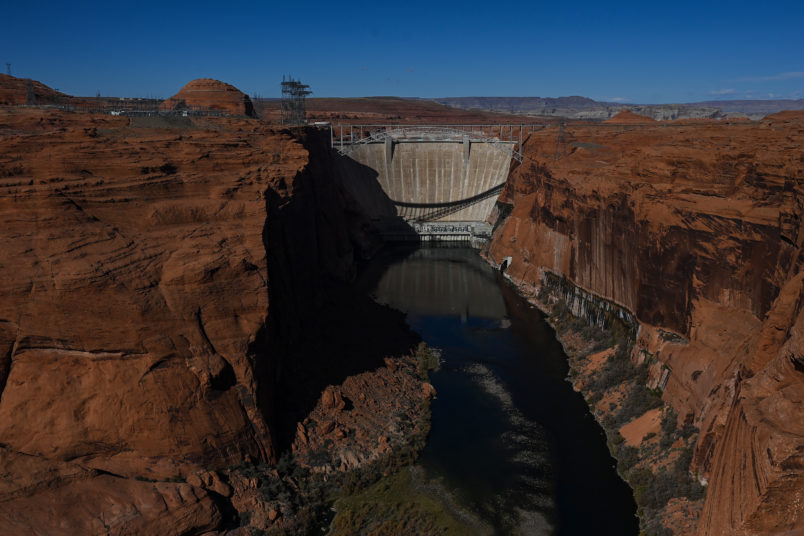
The Colorado River is facing a “complete doomsday scenario.”
Obama Still Got It
Do you like Morning Memo? Let us know!
Area Judge Drop Kicked to Eternal Shame
I wanted to slow down a bit and make sure you absorb the full weight of the 11th Circuit ruling today in the Mar-a-Lago documents case. Specifically this was a ruling on the civil suit which Donald Trump brought to short circuit and hobble the Justice Department probe of his theft and illegal possession of a host of highly classified documents at his South Florida villa. Remember Judge Aileen Cannon, the Trump appointee judge who Trump forum-shopped into the case and who then proceeded to disregard logic, precedent and self-respect to take up as, in essence, Trump’s own lawyer from the bench? The three-judge panel on the 11th Circuit, made up of two Trump appointees and one George W. Bush appointee, ruled against every aspect of Cannon’s involvement in the case, including being involved at all in the first place. The whole special master episode? Nope. Done. Josh Kovensky walks us through the details.
Where Things Stand: Catching Up On The Trump Org Tax Fraud Case
There are about a hundred Donald Trump-related investigations happening at the moment, so today I’ll save you the Google with this brief rundown of the Trump Organization criminal tax fraud case, which is wrapping up closing arguments either this evening or sometime tomorrow morning. The jury will then begin its deliberations.
Continue reading “Where Things Stand: Catching Up On The Trump Org Tax Fraud Case”BREAKING
Federal appeals court rules that the U.S. District Judge Aileen Cannon has no jurisdiction to hear former President Trump’s challenge of the FBI’s seizure of government documents at Mar-a-Lago and orders her to dismiss the case.