

Remember that 51 senators is substantially different from 50. Big picture, 50 Senate seats plus Vice President Harris’s tie-breaking vote made Chuck Schumer the Majority Leader. He and his caucus controlled the calendar, what came to a vote. But the committees had equal numbers of Democratic and Republican members. That meant issuing subpoenas required agreement between the parties. Nominees couldn’t be voted out of committee on straight partisan votes. There were workarounds for some of these issues. But they were complicated and time-consuming. So in addition to decreasing the clout of Senators Manchin and Sinema and positioning Democrats marginally better for retaining the Senate in 2024, the difference between 50 and 51 senators is a big deal on the basic nuts and bolts of running the Senate, getting judicial nominees confirmed and more.
Save Your Brain: Don’t Watch TV on Election Night
Something came home to me last night that I’ve realized for a while but crystalized for me in a new way. If you’re into elections and want to watch results on election night you should never watch them on TV. Ever. If you were watching last night’s election on TV you probably had the sense the race was a close run thing with the lead bouncing back and forth, with Herschel Walker possibly mounting a comeback after weeks of coverage that made Raphael Warnock appear a favorite to win a full term. If you watched the results through my curated Twitter feed of election number crunchers, though, you saw something very different: from the very first returns it looked likely — and then with growing clarity — that the results would roughly bear out the polls, which showed Warnock with a modest but significant lead. The final results this morning show Warnock beating Walker by just shy of three percentage points, almost on the dot of what the consensus of polls predicted.
Continue reading “Save Your Brain: Don’t Watch TV on Election Night”Agents of Influence: How Russia Deploys an Army of Shadow Diplomats
This article was first published by ProPublica and the International Consortium of Investigative Journalists.
BUDVA, Montenegro — Near a teeming town square along the Adriatic coast, where ancient city walls surround the ruins of bygone empires and shops and churches rise over the sea, Russia’s newly appointed representative to this tiny Balkan nation opened his consulate office.
Boro Djukic, the first honorary consul named by Russia in Montenegro, was supposed to use his prestigious post to champion cultural ties and the interests of local Russian business owners and tourists — a benevolent bridge between the two countries.
Instead, the middle-aged former bureaucrat took on an aggressive role in Montenegro’s politics, backing a movement that aimed to empower allies of the Kremlin and working to undermine the fragile government of a country considered a valuable U.S. ally in a turbulent region.
While honorary consul from 2014 to 2018, Djukic helped found a hard-line, Kremlin-backed political party that sought to force the country’s withdrawal from NATO. When the party needed a headquarters, he went one step further, offering his family home in a posh neighborhood in Podgorica, Montenegro’s capital.
A sign near the front door read: “Residence of the Honorary Consul of the Russian Federation.”
Djukic was part of a faithful network of honorary consuls embedded by the Russian government around the world that has supported President Vladimir Putin amid his most contentious military and political campaigns, including the February invasion of Ukraine that has killed or injured thousands of civilians, an investigation by ProPublica and the International Consortium of Investigative Journalists found.
Under Putin, Russia has become an enthusiastic supporter of the largely unregulated system of international diplomacy, which for centuries has empowered private citizens in their home countries to serve as liaisons for foreign nations.
Experts say Russia is using honorary consuls as part of a strategy to move public opinion in the Kremlin’s favor and, over time, weaken pro-Western governments, particularly in European countries vulnerable to influence. In one high-profile case, intelligence officials tied two consuls in North Macedonia to an alleged Russian propaganda campaign to destabilize a stretch of southeastern Europe.
In Montenegro, Ljubomir Filipovic, a political scientist and former deputy mayor of Budva, said Djukic helped spread chaos and dysfunction in a country that has struggled to establish an identity since it became a sovereign nation in 2006.
“He went beyond what an ordinary honorary consul would do. He went even beyond what an official diplomat would do,” said Filipovic, who tracked Djukic’s activities as consul. “The intention was to damage the social fabric of Montenegro — and he did that.”
Honorary consuls were once deployed primarily by smaller countries unable to afford career diplomats in critical foreign outposts. The arrangement is now used by most of the world’s governments as a way to further their interests in regions where embassies are far away or too costly to maintain.
Under international treaty, honorary consuls receive some of the same privileges and protections provided to career diplomats, including the ability to move consular bags across borders without inspection and maintain archives and correspondence that cannot be searched.
Consuls, however, are widely expected to be unobtrusive advocates, volunteers who focus on cultural and economic ties without proselytizing the political views of the governments they represent. “Apolitical in their words and deeds,” according to guidelines approved by an international association of consuls.
Many consuls fulfill that role honorably: promoting industry, the arts and academia on behalf of their appointing countries; assisting stranded or sick travelers; and helping with visa applications.
But a global investigation led by ProPublica and ICIJ identified at least 500 current and former honorary consuls who have been accused of crimes or become embroiled in controversy, including some who exploited their status for profit, to advance criminal activities or to dodge law enforcement. The scale of the abuse emerged in a review of thousands of pages of court documents, government reports and media accounts from dozens of countries.
Russia, which for decades did not appoint honorary consuls, has increasingly leveraged the system in service of its political agenda. Inside Russia, several of Putin’s closest associates secured their own honorary consul appointments — with the privileges that come with the title — and formed an advocacy group called The League of Honorary Consuls. Outside Russia, the government has appointed honorary consuls on six continents, quadrupling their number to more than 80 in the first decade after Putin took office.
Consuls appointed by the Russian government have denounced Western sanctions and criticized NATO. An American who served as Russia’s honorary consul in Denver traveled to Crimea several years after Russia invaded Ukraine and seized the peninsula. She visited a museum and posed for photos, while the U.S. State Department reported that torture, arbitrary arrests, ethnic violence and corruption were rampant there under Russian rule.
This year, as Russian rockets fell on Kyiv and other Ukrainian cities, at least two honorary consuls representing Russia spoke out again. “I’m sorry he did not do it sooner,” one consul, Constantine van Vloten in the Netherlands, declared in support of Putin.
A consul in Spain appeared on Russian state television to decry violence he attributed to the “Ukrainian terrorist state.” Before he was named consul, Pedro Mouriño Uzal traveled to Crimea as an independent observer and vouched for the “absolute normality and tranquility” of a 2014 referendum, widely condemned as illegitimate, to incorporate the region into Russia.
Uzal told ProPublica and ICIJ that criticism of the vote was unfounded and that Ukraine has “joined the ranks of terrorist organizations that attack civilian infrastructure and take lives of civilians.” Van Vloten said in a statement that he has no personal relationship with Putin and that he wished the military operation had started sooner “so that it could end sooner the civil war.”
Several of Russia’s honorary consuls quit to protest the invasion. But others have remained in place even as countries in Europe and Asia expelled Russia’s career diplomats.
Though Russia does not release lists of its honorary consuls, ProPublica and ICIJ were able to identify consuls appointed by Russia who have served in at least 45 countries.
One is a hotel and nightclub owner in Mexico whose personal security guard is accused by Mexican officials of meeting at the consul’s properties with leaders of an organized crime gang known as The Russians, according to a 2021 military intelligence report.
Another was a businessman in Equatorial Guinea whom Russia named an honorary consul in 2011 after he was imprisoned for selling cruise missiles — capable of carrying nuclear warheads — to Iran and China. He is no longer a consul and could not be reached for comment. The consul in Mexico did not respond to requests for comment.
In Montenegro, Djukic remained a consul for about four years. In 2018, the government stripped him of his title reportedly as part of a coordinated response by governments, unrelated to Djukic, to the poisoning of a former Russian military intelligence officer who had become a British spy. Russian agents were accused of carrying out the attack; Moscow denied any involvement.
Djukic, who did not respond to requests for comment, has denied acting improperly as consul. “I am not a Russian citizen, but as a person who loves Russia, I represented it in the best possible way,” he told local media after Montenegro terminated his diplomatic status.
This year, one day after the invasion of Ukraine, Djukic denounced NATO and praised Putin on social media.
Putin, he wrote between heart emojis, stopped “American domination over the whole world.”
Putin’s Circle
Honorary consuls are nominated by foreign governments but serve at the discretion of their home countries. There are thousands of consuls, though no one has a more precise estimate because dozens of governments don’t publicly release the names of their appointees.
Under the 1963 Vienna Convention on Consular Relations, consuls are entitled to a coveted series of benefits that can include special identity cards, passports and license plates. They cannot be prosecuted for crimes committed in the official course of duty and their offices, and correspondence and consular bags are protected from searches.
For decades, what was then the Soviet Union declined to appoint consuls overseas or approve requests by foreign governments for consuls on Soviet soil. Soviet leaders saw honorary consuls as nothing more than “bourgeois spies,” scholar Geoff Berridge wrote in his widely cited book about diplomatic law and practice.
Soon after Putin became president in 2000, however, Russia fully embraced the honorary consul system. The title afforded protections and diplomatic credentials to a new class of well-connected elites.
ProPublica and ICIJ found a who’s who list of Russian power brokers and oligarchs — in mining, steel, gas, oil and banking — who have had honorary consul status.
In 2002, four of Putin’s associates founded the League of Honorary Consuls. Little is publicly known about the group, but Russian government documents show that the league spends donations on the “defense and support” of consuls.
The organization is based in Putin’s hometown of St. Petersburg, where he was a leading liaison to foreign diplomats during his rise to national power.
The founders secured their own honorary consul appointments: one from Brazil, another from Bangladesh, a third from Seychelles. Putin himself reportedly recommended that the government of Thailand appoint as consul the fourth organizer, Yury Kovalchuk, an oligarch the U.S. government has called “a personal banker” to Putin and other senior government officials.
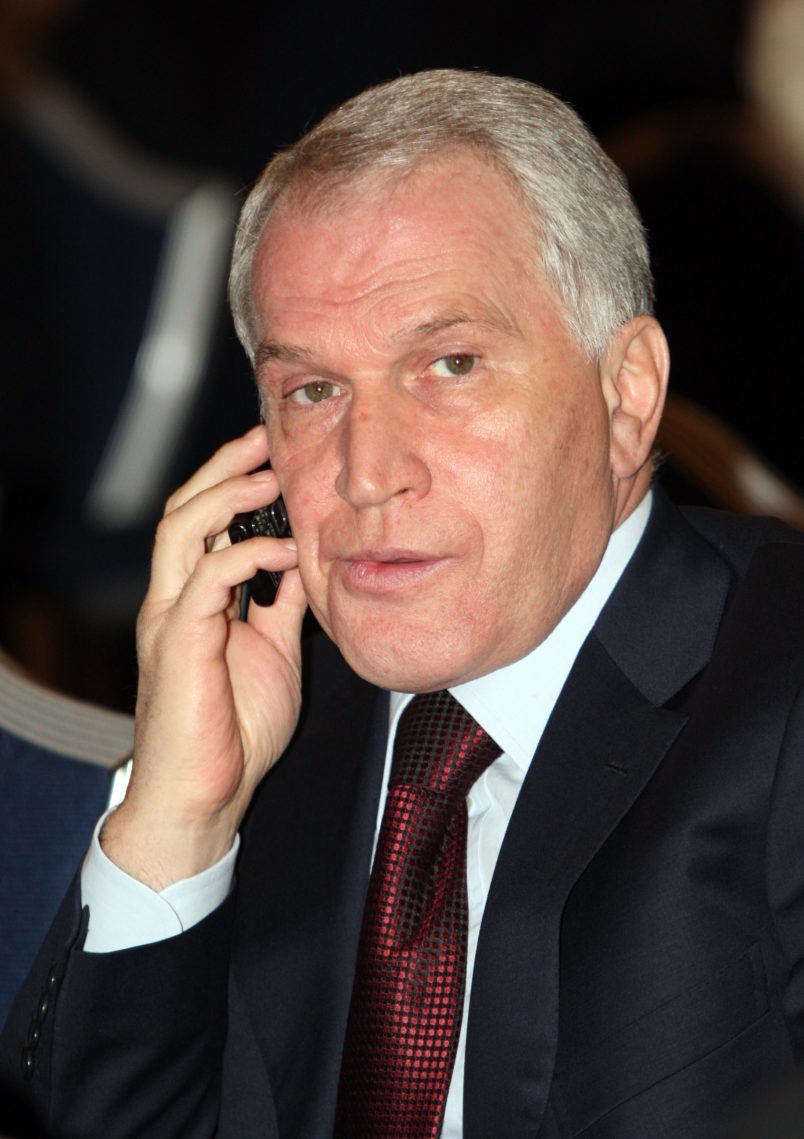
In 2019, Russian Foreign Minister Sergey Lavrov made clear that his government supported the honorary consul system. Meeting with the leaders of some of the smallest countries in the Pacific region at the United Nations in New York, Lavrov announced: “We are actively using the institution of honorary consuls. … I think we should expand the practice.”
ProPublica and ICIJ found that at least nine current and former consuls in Russia have been sanctioned for their reported ties to Putin or for supporting Russia’s war against Ukraine. That includes Kovalchuk, whom U.S. authorities blacklisted in 2014 after the Russian invasion of Crimea and again in March after the latest attack on Ukraine.
Kovalchuk did not respond to requests for comment.
Under Putin, Russia also nominated a cadre of its own consuls around the world. Some were Russian expatriates, others influential local magnates of culture and industry.
Russian regulations for honorary consuls in the late 1990s said the volunteer diplomats would promote “friendly relations … the expansion of economic, trade, scientific, cultural and other ties.”
In Montenegro, Djukic went much further.
“He’s Everywhere”
Born in Podgorica in 1970, Djukic grew up eating his mother’s dumplings and borscht. His father worked for a time as a director of a tobacco factory and later moved to the Soviet Union.
In 1989, with the Soviet bloc unraveling, Djukic went to Moscow. Then 19 and knowing little Russian, he struggled to find his way.
“My first impressions were not very joyful,” he later told a Russian-language newspaper in Montenegro. “It was like being thrown into the past by a time machine. … I ended up in a half-starved Moscow with dirty, broken streets, empty counters, shops without shop windows. People were driving old cars.”
After working for an Austrian trading company, he returned in 1997 to Montenegro and found work as an adviser at the Ministry of Foreign Affairs. In 2013, Ukraine named him an honorary consul in Montenegro.
Djukic said in an interview at the time that he wanted to give back, helping Ukrainian tourists with visa problems and families with emergencies while on vacation, routine duties of honorary consuls.
“It’s time to give from yourself, to do useful things,” he said.
That consulship ended; Djukic said only that the decision was tied to leadership changes after Russia annexed Crimea in early 2014.
He was soon appointed a consul by Russia, initially maintaining a low profile even as tensions in Montenegro continued to rise.
The country of 620,000 had once been part of Yugoslavia and, later, part of a smaller federation with neighboring Serbia. By the time Djukic became consul in 2014, setting up his office near a town square in Budva, Montenegro was an independent nation seeking to become a member of NATO.
That position made Montenegro, with longstanding ties to Moscow and an influx of Russian tourists and investment, a high-stakes battleground between Russia and the West.
In 2016, Montenegrin authorities disrupted an Election Day coup attempt by Russian military intelligence operatives and others who had plotted to overthrow Montenegro’s government and kill its pro-Western prime minister.
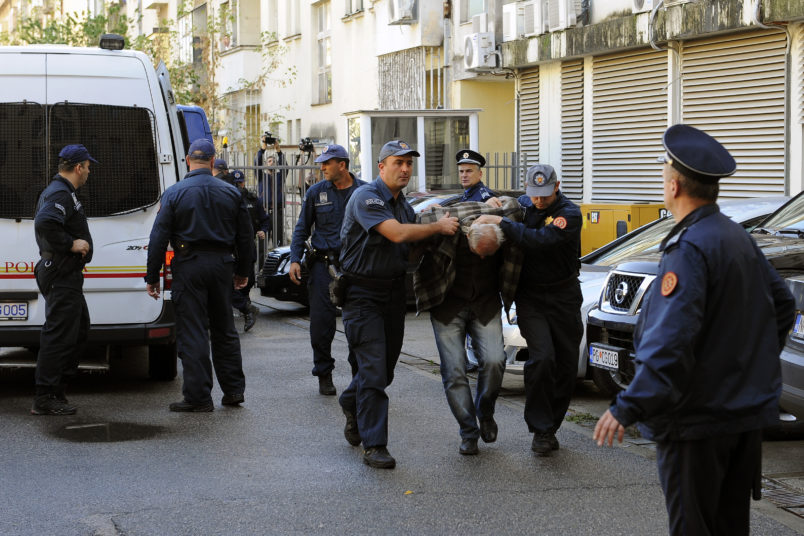
Montenegro joined NATO the following year, a move celebrated by political leaders and diplomats as a guarantee against foreign meddling.
“It will never happen again that someone else decides instead of us and our state behind our back, as was the case in the past,” Montenegro’s then-Prime Minister Dusko Markovic said at a ceremony in Washington, D.C.
In the Senate a few weeks later, Sen. John McCain, R-Ariz., praised Montenegro’s leaders and warned of Putin’s “long-term campaign … to erode any and all resistance to his dark and dangerous view of the world.”
“Every American should be disturbed,” McCain said.
Four months later in October 2017, Djukic took a bold public step.
As honorary consul, he helped organize a trip to Moscow for Marko Milacic, one of Montenegro’s most well-known anti-NATO populist leaders. Milacic had already been convicted for organizing what local media described as an unauthorized protest. Reporting to prison to serve a 20-day sentence, Milacic had paused outside to burn a blue-and-white NATO flag.
In Moscow, according to a subsequent social media post by Milacic, the politician met with Sergei Zheleznyak, a top Putin ally who was under U.S. sanctions for his involvement in the annexation of Crimea.
Two months after the trip, according to records obtained by ProPublica and ICIJ and reporting by local media, Djukic signed the founding documents for True Montenegro, a Kremlin-backed, right-wing political party led by Milacic. Djukic would later acknowledge that the party set up its headquarters at his family home in a Podgorica neighborhood of expansive houses and foreign embassies.
In 2018, shortly after the Montenegrin government removed Djukic as consul, he stood alongside Milacic at a press conference, endorsed True Montenegro and defended his own involvement in politics.
“If I had several million euros or dollars, I would legally offer them to Mr. Milacic,” Djukic told reporters. “Why? Because I like his idea.”
Djukic also commented on Facebook that he had been “persecuted” by NATO. And in an interview with a Russian media outlet, he defended the men behind the attempted coup in 2016, calling one of the plotters a “comrade, friend” and saying there was no conspiracy.
“If there was something like that, I would know for sure,” Djukic told the interviewer. “This is in the same category as everything else that has been done against Russia in recent years. There was no coup d’état. The maximum that could be … someone in a drunken conversation said, ‘Come on, let’s kill someone.’”
Milan Jovanovic, an analyst for a democracy group in Montenegro that tracks disinformation, said Djukic was an influential force. “He went from national Montenegrin to … the closest possible cooperation with Russia,” Jovanovic said.
In a two-bedroom apartment crowded with books about philosophy and religion, Filipovic, the political scientist and former Budva deputy mayor, watched the former consul’s appearance at the True Montenegro press conference. Filipovic took to social media, posting commentary, media reports and photos that Djukic had put on Facebook.
One photo showed the former consul in a black T-shirt emblazoned with the word “Russian,” his arm around Alexander Zaldostanov, leader of the pro-Kremlin motorcycle gang known as the Night Wolves. The U.S. Treasury Department had previously sanctioned Zaldostanov, whose nickname is “The Surgeon,” accusing him of leading an organization that recruited fighters and committed crimes during the 2014 Russian invasion of Crimea. He could not be reached for comment.
In another photo, Djukic brandished a machine gun in front of a wall of rifles, rockets and other military paraphernalia.
“He’s everywhere,” Filipovic said in a recent interview in a Budva coffee shop overlooking the Adriatic Sea. “It’s sharp power that masquerades as soft power. It’s not the power of attraction. It’s the power of coercion.”
Russia’s Reach in Denver
Nearly 6,000 miles away in Colorado, the last remaining honorary consul for Russia in the United States lost her post in March as Russian forces invaded Ukraine.
“Colorado is … severing diplomatic ties with Russia,” Gov. Jared Polis, a Democrat, wrote in a letter to the Russian Embassy in Washington, D.C., seeking the decertification of honorary consul Deborah Palmieri. “Should at some point the regime change in Russia to one that honors global order … Colorado will reconsider.”
The State Department subsequently withdrew recognition of Palmieri’s consular status, the governor’s office said. The State Department did not respond to questions about Palmieri or the governor’s request.
Russia has nominated a series of American citizens as honorary consuls on U.S. soil. They included the founder of a Russian art museum in Minnesota, the president of a Russian trading firm in Puerto Rico and the former president of St. Petersburg College in Florida, who in 2007 penned a newspaper column titled “Putin and Me.”
“Their definition of ‘democracy’ is different than ours,” Carl Kuttler Jr. wrote, calling Putin “perceptive,” “detail oriented” and a “muscular man” with “an amazing intellect.”
In an interview, Kuttler, who is no longer an honorary consul, said his work included trade, education and helping Americans with adoptions and that he “never was asked to participate in anything but the most ethical of ventures.”
In 2016, the State Department revoked the status of all but one of the Russian-appointed consuls in the United States after reports that Russian intelligence officers were harassing U.S. diplomats in Moscow. Only Palmieri stayed on.
Before she was appointed consul in 2007, Palmieri publicly supported Putin, writing in a publication for the Russian-American Chamber of Commerce that he was achieving democracy “at his own pace.”
As consul, she worked out of a downtown Denver rowhouse, with photos of the Kremlin and Red Square in the dining room, and promoted the Deb Palmieri Russia Institute, a provider of training to businesses seeking to enter the Russian market. Her website, which is no longer active, noted that she has worked with hundreds of U.S. and Russian companies, including Aeroflot, Russia’s state airline.
After Russia sent troops into Crimea in 2014, Colorado lawyer Olena Ruth, who was born in Kyiv, organized a rally in support of Ukraine and marched with scores of others to the consulate.
“She was just ignoring the Ukrainian question,” Ruth said in a recent interview. “Nobody wanted to have her presence here.”
Three years later, Palmieri was among a group of Americans who toured annexed Crimea, visiting a local university and a museum and posing for photos. On her website, Palmieri described the trip as a “fact-finding visit.”
“She was a participant in the trip?” said Rusty Butler, a retired college administrator and former honorary consul for Russia in Utah, when told about the 2017 visit by reporters. “I can’t wrap my head around seeing myself in that role.”
Palmieri, whose website included an undated picture of herself greeting Putin, has kept a low profile since she lost the consul post and did not respond to emails and calls seeking comment.
A retired Colorado federal bankruptcy judge, Sid Brooks, who once helped train Russian judges about independent judiciaries, said he knew Palmieri from events at the consulate. Brooks said he stepped back from his own work in Russia in recent years because of Putin’s policies.
“I don’t know what triggered the [removal] of Deb Palmieri as honorary consul, but as far as I’m concerned, that’s just fine,” Brooks said. “I always thought it was a little bit curious that [as consul] she seemed to continue her efforts to promote exchanges.”
“Intelligence Bases”
In North Macedonia, another fragile Balkan democracy, honorary consul Sergej Samsonenko became one of the most visible promoters of the Kremlin.
A Russian-born entrepreneur who made millions as the founder of an international sports betting company, Samsonenko built a four-star hotel in the capital that he called Hotel Russia and helped fund a landmark Russian Orthodox church that, according to local media, an archbishop described as a “part of the Russian soul on Macedonian soil.”
In 2016, Samsonenko was named honorary consul for Russia. He set up his consulate in Bitola, an ancient trading hub near the Greek border that had served as a cultural and political junction under the Ottoman Empire, earning the nickname “City of Consuls.”
In 2017, a North Macedonian intelligence report found that the consulate offices in Bitola and in the lakeside city of Ohrid represented “intelligence bases” used by Russia as part of an alleged propaganda campaign aimed at creating conflict in the Balkans and isolating countries like North Macedonia from the West.
“Performing intelligence activities from diplomatic consular missions is a widely used method of the Russian Federation … from which they are collecting, processing, analyzing and distributing information,” noted the report, first obtained by the Organized Crime and Corruption Reporting Project.
The report also described Samsonenko’s financing of the Russian church, saying “religious influence [of the Russian Federation] is an important segment of the Russian strategy.”
North Macedonia joined NATO in 2020. This past summer, the government withdrew its approval of Samsonenko’s honorary consul position.
Samsonenko declined to comment to ProPublica and ICIJ beyond dismissing reports about him as “lies and slander.” He has previously denied using his diplomatic status to support Russian intelligence operations.
“I am not a political person, I am an honorary consul of Russia and I should support the politics of my home country,” Samsonenko told the Macedonidan magazine Fokus in 2019.
He added, “Of everything written about me … one of the many lies [is] that there is a spy center in Bitola, in my consulate.”
A Russian Foreign Ministry spokesperson previously called Samsonenko’s dismissal “yet another politically charged gesture.”
Lingering Divisions
In early fall, four years after Djukic lost his honorary consul post in Montenegro, red and white election posters promoting the True Montenegro political party that he co-founded lined a busy mountain pass connecting the capital to Budva.
Filipovic, the former deputy mayor, said he fears that pro-Russian interests will drive his country of birth back to the Kremlin. In September, authorities expelled six Russian diplomats in Montenegro who were suspected of espionage.
Filipovic said he blames Djukic and others for helping to fuel the unrest that has roiled the country.
“The honorary consul position gave him stature. It gave him a position in society,” Filipovic said. “He was an agent of Russian influence.”
Djukic has regularly posted on social media, sharing photos and comments about his love for Putin, Russian religious orthodoxy and his former position as honorary consul.
In July, he reposted a pro-Russia video that circulated on social media. “Beautiful women. … No cancel culture. … Economy that can withstand thousands of sanctions,” the narrator proclaimed. “Time to move to Russia.”
A few days later, Djukic also posted a red and white image of the Kremlin and “First Honorary Consul of the Russian Federation in Montenegro” written above it in Russian.
In his post, he included three words: “JOY. JOY. JOY.”
Trump Pinky Swears He Has No More Classified Docs
A lot of things happened. Here are some of the things. This is TPM’s Morning Memo.
Where’d They All Go?
New reporting from the Washington Post with several important new revelations about some of what’s been happening behind the scenes in the Mar-a-Lago case:
- At the urging of the Justice Department, DC Chief U.S. District Judge Beryl A. Howell ordered Trump to certify that he is not retaining any more classified documents.
- Trump hired an outside firm to search his golf club in Bedminster, N.J., and Trump Tower in NYC.
- Trump lawyers told DOJ that the searches turned up no more classified documents.
Trump Org Convicted!
It took a New York state jury less than two days to convict the Trump Org on all 17 counts of tax-related crimes.
- Trump Org CFO Allen Weisselberg was the star witness for the prosecution but refused to implicate Donald Trump personally.
- The direct impact of the verdict on Trump’s eponymous company will not be devastating. It faces a fine of $1.6 million. Sentencing is set for Jan. 13.
- An alternative juror offered her perspective on the case in an interview with the NYT before the verdict.
Jack Smith Wasted No Time In Taking Over Trump Probes
We got the first real glimpse of special counsel Jack Smith at work in the federal investigation of President Trump’s role in subverting the 2020 election.
As the Washington Post first reported, Smith served grand jury subpoenas on several key counties in swing states where Trump sued to overturn the election results. TPM’s Kaila Philo obtained one of the subpoenas.
The subpoenas appear on their face and from close study to be related to the federal probe into Trump’s fake electors scheme. TPM’s Josh Kovensky explains why the fake electors scheme is at the crux of the criminal investigation.
Ain’t That A Shame
Stephen Miller was spotted at the federal courthouse in DC for the second time in the last week. The presumption is Miller is testifying to one or more of the federal grand juries investigating Trump, but it’s not clear which one(s).
Mike Flynn May Have To Testify This Week
Florida appeals court rejects Mike Flynn’s effort to avoid testifying to a Georgia grand jury investigation into Trump’s election interference.
Jan. 6 Commitee Will Make Criminal Referrals
As part of final flourish before being shuttered by the incoming House GOP majority, the Jan. 6 committee does plan to make criminal referrals to the Justice Department.
Warnock Wins In Georgia
In his second runoff in two years, Sen. Raphael Warnock (D-GA) knocked off Republican nominee Herschel Walker, relegating the Heisman Trophy winner to that ignominious list of unbelievably bad GOP Senate candidates that includes Todd Akin of Missouri, Sharron Angle of Nevada and Christine O’Donnell of Delaware. It’s a competitive list, and several high-profile candidates were added this year alone: Welcome, Blake Masters and Mehmet Oz! But it’s fair to say that Walker stands alone at the top of that list. Well done, sir.
Big Case Today At SCOTUS
The cockamamie independent state legislature theory gets a hearing in front of the Supreme Court today. TPM’s Kate Riga will be covering it for us.
QAnon Goes International
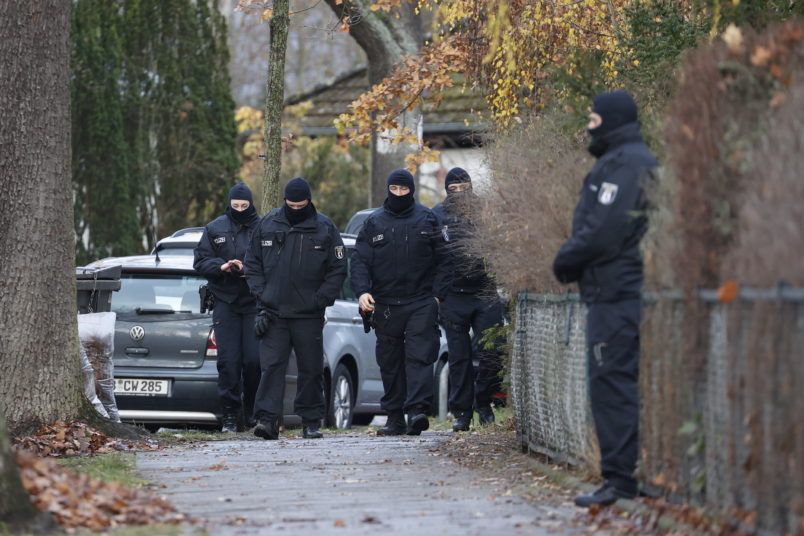
Special forces in Germany have broken up an alleged terrorist group that … get this … was plotting to overthrow the government because they believed “Germany is currently ruled by members of a so-called deep state.”
- The heavily armed group, which formed in late 2021 and included former police and military personnel, was allegedly planning an armed attack on the Reichstag.
- 25 people were arrested in 130 early morning raids across Germany involving some 3,000 police and Special Forces officers. A total of 52 people are reportedly under investigation.
- A 71-year-old minor aristocrat was allegedly one of the ringleaders of the plot and was to be installed as Germany’s new leader.
- Prosecutors alleged the group was inspired by QAnon and a right-wing German conspiracy group: “Citizens of the Reich … believes that Germany’s post-World War II republic is not a sovereign country but a corporation set up by the victorious Allies,” the NYT reported.
ICYMI
Two stray items from this week:
Daily Beast: “Right-wing undercover operative James O’Keefe has launched holiday-season layoffs at his nonprofit amid an FBI investigation and a series of other legal problems facing the group.”
WaPo: Rupert Murdoch to be deposed next week in Dominion Voting System’s $1.6 billion defamation case against Fox.
Ominous
Alaska’s northernmost city posted its warmest winter temperature on record.
Biggs Steps Up To Challenge McCarthy … Again
Rep. Andy Biggs (R-AZ) plans to put himself forward as an alternative to GOP leader Kevin McCarthy (R-CA) in next month’s floor vote for House speaker. Biggs, who lost in the GOP conference’s vote for leader last month, won’t win, but he is trying to deny McCarthy enough votes to capture a majority of the House, complicating McCarthy’s path to the speakership and giving Biggs’ fellow right-wing members more leverage.
RELATED: TPM’s Emine Yücel on how much McCarthy has had to promise to try to win over his right flank.
Jan. 6 Hero Heckled By Fellow Cops
Former DC Police Officer Michael Fanone, an outspoken hero of the Jan. 6 attack, says he was heckled by fellow officers at the Capitol Tuesday. Fanone was attending an awards ceremony for the officers who defended Congress:
I was heckled by members of my own department. They called me a piece of s— and mockingly called me a great f—— hero while clapping.
McConnell and McCarthy Snubbed
Family members of Brian Sicknick, the Capitol Police officer who died after the Jan. 6 attack, refused to shake hands with the Sen. Mitch McConnell (R-KY) and Rep. Kevin McCarthy (R-CA) at the awards ceremony Tuesday. Brutally awkward:
Do you like Morning Memo? Let us know!
Wow
I’m a bit of a broken record on this. But it’s true enough to bear some repeating. Raphael Warnock and Mark Kelly are two incredibly able politicians. Until 2018 and 2020, Democrats hadn’t been elected to Senate seats in Arizona and Georgia for decades. They’ve now both done it twice, in two consecutive cycles and under dramatically different political conditions. Of course, these aren’t feats of superhuman political powers. This is the direction of these states. But they are only on the cusp of being purple states. To chalk up two consecutive wins you need to be doing everything right. And both of them did.
Georgia Settles The Final Senate Race Of The Midterms
Once again, all eyes are on Georgia as Peach State voters choose between Sen. Raphael Warnock (D-GA) and Herschel Walker to represent them in the Senate.
Continue reading “Georgia Settles The Final Senate Race Of The Midterms”Warnock Secures Reelection In Second Straight Runoff Win
Sen. Raphael Warnock (D-GA) has won reelection, and his first full term, in a runoff victory just two years after his last one.
Continue reading “Warnock Secures Reelection In Second Straight Runoff Win”Georgia Live Blogging #2
9:36 PM: Okay, the man has spoken. Dave Wasserman of The Cook Report says it’s done: Warnock defeats Walker.
9:29 PM: I think Warnock continues to have the inside track. The uncertainty is that we don’t know precisely the makeup of the votes in those blue counties where lots of votes are left. Those could be heavily same day and actually lean to Walker. So there’s still some uncertainty. But it’s a significant uncertainty in an overall context where signs really point to a Walker win. In North Georgia Walker has put up numbers he needs to win. But in the rest of the state the pattern is Warnock making modest but consistent gains on his November totals. It would be a surprise if that pattern didn’t continue in metro Atlanta. But who knows?
9:06 PM: Not clear to me how much visibility there is into these early counts out of the Atlanta area counties into what’s election day and early. You could speculate that they’ve only counted the Warnock-leaning earlies so far and next up is Walker. But I kinda doubt that. I think this is Warnock’s unless something wildly unexpected happens.
9:01 PM: We finally got a big chunk of the vote in in DeKalb County. Still only around ~50% reporting. But starting to show the numbers that put Warnock ahead. At this point this is where the remaining votes are, this and similar counties. So even though Warnock’s overall lead is razor thin it should grow.
8:37 PM: Have said it over and over. But it’s still the same. Warnock probably wins tonight. But we don’t have the votes in metro Atlanta. That will tell the story. Walker needs a strong showing in metro Atlanta, relative to expectations. Doesn’t seem likely. But run-offs are unpredictable. Just to give a sense 5% of the vote in in DeKalb, 55% in Fulton, 53% in Gwinnett, in Cobb 23%.
Georgia Live Blogging
8:32 PM: One of the people I follow just put together the numbers and found that in all five counties with more than 10k total votes Warnock is bettering his November margins. That’s a clear indicator.
8:27 PM: It’s hard to do a methodical analysis in real time. But I keep seeing completed red-rural counties where Walker is falling off his margins from November. The differences are quite small, a percentage point or two. But remember, he came in second in November. So falling back is bad. That’s not the story in every county. But it’s more than not from what I can see. The picture seems to be crystallizing in Warnock’s direction. That’s my read at least. Definitely need to see the big metros to be on firm ground.
8:16 PM: Same picture. Basically a re-run of November 8th but with Walker seeming to be very slightly underperforming his November numbers in the now completed red rural counties. Advantage Warnock but far from done. If you’re the Walker campaign you have to be hoping that Warnock underperforms on his home turf in metro Atlanta. That’s not what you’d expect. But run-off turnout is unpredictable. So by no means can you rule it out.
7:58 PM: Gist so far seems to be this: There was some thought that demoralization on Walker side might lead to the bottom dropping out and a solid win for Warnock. That’s now what we’re seeing so far. It’s very close, based on what we’re seeing so far. In the completed counties, which are almost all red rural counties, Warnock’s is very slightly improving his margins. That sounds like he’s on the road to another close victory. But the big metros are still an open question. And surprises there in either direction could change things substantially. The thing to remember is that Walker was ahead by a tiny margin in November. So broadly speaking percentages that are a replay of last month are good for him.
7:46 PM: We’re in the early numbers and all the vagaries of early voting and election day voting makes it hard to make sense of early numbers. That makes you reliant on the few completed or near completed counties. That removes questions about different kinds of voting from the equation. So far that’s only small red counties. They’re showing a tight race but in most cases Warnock very, very slightly improving his margins from November 8th. Given that he was ahead of Walker in round one (but under 50%) that’s obviously a positive for Warnock. Still early though and there’s a lot we don’t know about election day in the more populous counties.
What Trump Did In The Counties That The Special Counsel Subpoenaed
What distinguishes the five counties known to have been subpoenaed by special counsel Jack Smith is that former President Trump and his campaign filed lawsuits to invalidate the 2020 election results in all of them.
Continue reading “What Trump Did In The Counties That The Special Counsel Subpoenaed”