

Donald Trump is leaning in hard on the classics to deflect responsibility for the charges against him in the Mar-a-Lago classified documents case, and especially so in the wake of new, seemingly incriminating tapes of him admitting to aspects of the charges he currently faces. His latest remarks to Fox News are a pivot back to a vintage yet reliable genre of Trumpism, using “stable genius” energy and “fake news” schoolyard bullying to shrug off the fact that the audio recording CNN published this week features him admitting he shouldn’t have the classified documents he’s flinging around for all to see.
Continue reading “Where Things Stand: He’s Dealing With These Criming Tapes The Same Way He Dealt With All The Other Tapes”Miami Mayor And GOP 2024 Candidate Backtracks, Claims He Actually Does Know About The Uyghurs
Miami Mayor and 2024 presidential candidate Francis Suarez stumbled during a Tuesday morning interview when asked about human rights abuses against Uyghurs, a predominantly Muslim minority ethnic group in China’s western region.
Continue reading “Miami Mayor And GOP 2024 Candidate Backtracks, Claims He Actually Does Know About The Uyghurs”Protesting Too Much
If you haven’t read it yet, I want to make sure you saw Josh Kovensky’s look at key questions surrounding the Wagner Mutiny. Josh is both a Russian speaker and worked for about three years as a reporter in Ukraine. So, as usual, he brings a wealth of contextual knowledge and insight to making sense of these developments. I wanted to add a few observations to my Sunday afternoon piece on the emerging after-action reports about the Mutiny.
First, in that post I highlighted accounts from two expert observers — Michael Kofman and Tatiana Stanovaya. Both accounts have generally been confirmed, at least in their outlines. But one point that seemed a bit off in Stanovaya’s analysis was the certainty that Prigozhin and his mercenaries would be annihilated when they arrived in Moscow. That didn’t seem quite right, or even entirely consistent with the rest of her analysis. It certainly seems like one likely outcome. But it didn’t seem to comport with the uncertainty of the situation.
Continue reading “Protesting Too Much”Even Some Of The Court’s Independent State Legislature Theory Fans Shied Away In The End
Over the many months that Moore v. Harper, the independent state legislature case, unrolled, those guided by the paper trail the justices have left on the issue did not have much confidence that the radical theory would be rejected.
Continue reading “Even Some Of The Court’s Independent State Legislature Theory Fans Shied Away In The End”Please Give Me Two Minutes
We are almost three weeks into this year’s TPM Journalism Fund drive. We’ve done well so far: We’re at $363,347. But we are at the point in the drive when we need to convert “doing well so far” into actually hitting our goal. And we only have a bit more than a week left to do it. Our goal of $500,000 this year isn’t aspirational or a number pulled out of the air. It’s really necessary to keep us on track this year and into next year. Also, let me remind you that for every contribution, we create community subscriptions for readers who lack financial means or who are registered students. If you’ve been considering it, please take a moment to make a contribution today. I’m ready to get back to just posting about the news and I’m sure you are ready for me to do that too. But first we need to get to our goal to get back to doing what we do and want to do more of. Thank you. Here’s the link.
Wagner’s Mutiny Punctured Putin’s ‘Strongman’ Image And Exposed Cracks In His Rule
This article is part of TPM Cafe, TPM’s home for opinion and news analysis. It was originally published at The Conversation.
Less than 24 hours after the mutiny began, it was over.
As the rebelling Wagner column bore down on Moscow, Belarusian President Alexander Lukashenko brokered a deal under which Russian President Vladimir Putin promised to drop criminal charges against the mercenary leader Yevgeny Prigozhin and allow him to seek asylum in Belarus. The departing Wagner troops were given a heroes’ send-off by some residents of Rostov-on-Don — the southern Russian town they had taken control over without firing a shot earlier in the day.
Prigozhin gambled and lost. But he lives to fight another day — for now at least.
The events of June 24, 2023, had observers searching for the right term to describe what was going on: Was this a coup attempt, a mutiny, an insurrection?
Did Prigozhin seriously think that he would be able to enter Moscow? Perhaps he genuinely believed that Putin would accede to his demand to fire Defense Minister Sergei Shoigu and Chief of General Staff Valery Gerasimov — two men that the Wagner group head has previously harshly criticized for their conduct of the war.
More radically, Prigozhin may have hoped that he would receive support from elements in the Russian military. Indeed, that seemed to be the case — his group encountered no resistance in taking over Rostov-on-Don or heading north for some 350 miles (600 kilometers) through Voronezh and Lipetsk provinces — though they were reportedly attacked by a helicopter gunship, which they shot down. Prigozhin claimed to command 25,000 troops, though the actual number may be half that figure.
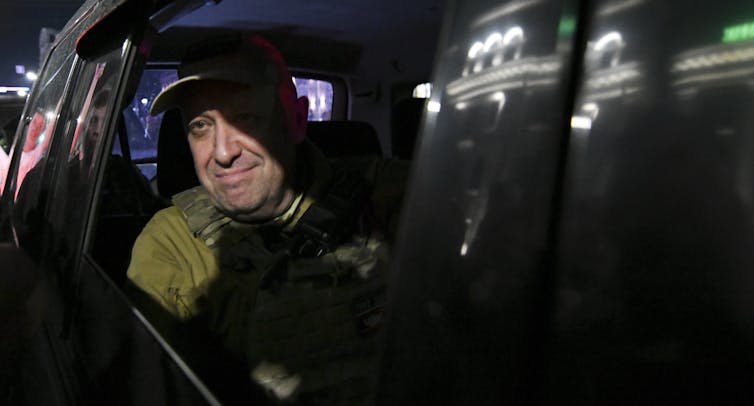
But while the mutiny was short-lived and its goals unclear, it will have lasting effects — exposing the fragility of Putin’s grip on power and his ability to lead Russia to victory over Ukraine.
Putin’s impotence
Prigozhin’s abortive insurrection has punctured the “strongman” image of Putin, both for world leaders and for ordinary Russians.
He was unable to do anything to stop Prigozhin’s rogue military unit as it seized Rostov-on-Don — where the Russian Southern Military Command is headquartered — and then sent a column of armored vehicles up the M4 highway toward Moscow. Putin was forced to make a televised address at 10 a.m. local time on June 24 describing the revolt as a “stab in the back” and calling for harsh punishment of the mutineers. But it was the intervention of Belarus President Lukashenko that brought about an end to the mutiny, not any words or actions from Putin. Somewhat uncharacteristically, both Prigozhin and Putin exercised restraint and stepped back from the brink of civil war by agreeing on the compromise deal that allowed Prigozhin to escape punishment.
Exiled Russian political scientist Kirill Rogov has argued that the most challenging development to Russia’s leaders may not be the mutiny itself, but the rhetoric that Prigozhin used to justify his actions. In an interview released on social media a day before taking control of Rostov-on-Don, Prigozhin argued that the Ukraine war was a mistake from the beginning, launched to benefit the personal interests of Defense Minister Shoigu and an inner circle of oligarchs. Prigozhin brushed aside all the ideological claims Putin has made about the war — the need to denazify Ukraine, the threat of NATO expansion — as just cover for self-interest. “Our holy war has turned into a racket,” he said.
Prigozhin’s words and actions have exposed the vulnerability of Putin’s grip on power and the hollowness of his ideological framing of the war in Ukraine and Russia’s place in the world.
Nationalist discontent
Putin’s constant refrain is that any opposition to his rule — whether it be from the Kyiv government or from protesters at home — is part of a Western plot to weaken Russia. It is hard to imagine that his propagandists will be able to argue that Prigozhin is also a tool of the West.
Over the past 10 years, and especially since the February 2022 invasion of Ukraine, Putin has ruthlessly deployed the coercive apparatus of the state to crush any liberal opposition. At the same time, radical ultra-nationalists — not only Prigozhin but also the military bloggers and correspondents reporting from the war zone — have been given a relatively free hand.
For the most part, they were kept out of state-controlled television broadcasts, but they have reached a wider Russian audience through social media channels such as Telegram, VKontakte and YouTube.
Prigozhin, a former convict who went on to provide catering for the Kremlin before founding the Wagner group, has seen his profile and popularity in Russia rise during the war in Ukraine. In May 2023 polling, he was cited among the top 10 trusted political figures.
It is unclear why Putin was tolerating the nationalists, Prigozhin included, as they increasingly questioned Russia’s war performance. It may be because the Russian president is ideologically aligned with them, or saw them as useful in balancing the power of the generals. Perhaps, also, Putin had come to believe his own propaganda — that nobody could be more nationalist than Putin himself and that Russia and Putin were one and the same thing — echoing presidential aide Vyacheslav Volodin’s 2014 comment: “No Putin, no Russia”.
Certainly prior to the Wagner mutiny, there were growing winds of discontent among nationalists. On April 1, 2023, one group of prominent bloggers, including Igor Girkin and Pavel Gubarev, announced the formation of a “Club of Angry Patriots.” As Wagner soldiers marched toward Moscow on June 24, the club issued a statement of indirect support for Prigozhin.
Prigozhin might now be in the Belarusian capital, Minsk, where — theoretically at least — he can do less damage to Putin. But there are other discontents still in Moscow, and politically active.
Security services in Russia have begun raiding Wagner group offices, but it remains unclear what will happen to Prigozhin’s extensive business operations around the world. Wagner soldiers will be offered the chance to sign contracts with the defense ministry — if they did not take direct part in the insurrection.
A lame-duck president?
Putin has no one to blame but himself for the crisis. Prigozhin’s Wagner group was created with his blessing and promoted by the Russian president. It was a tool that Putin could use to further Russia’s military and economic objectives without direct political or legal accountability — initially in the Donbas in eastern Ukraine in 2014, then in Syria, Libya and elsewhere in Africa.
It was not until July 2022 that Wagner was officially acknowledged to be fighting in the Ukraine war. But over the past six months, they have played an increasingly prominent role and have been rewarded with praise in the Russian media.
But as his prestige grew, so too did Prigozhin’s criticism of those around Putin. Starting in December 2022, he began openly challenging Shoigu. He avoided direct criticism of Putin, though in an expletive-laced tirade on May 9 — the day Russia commemorates the end of World War II — he complained about the lack of ammunition for Wagner fighters and talked about “a happy asshole Grandfather,” in what has been taken to be a clear reference to Putin.
It remains a mystery why Putin did not move to get rid of Prigozhin before now — one of the many mysteries of Russian politics over the past century.
Prigozhin has inflicted significant damage on his once all-powerful benefactor. Exiled Russian journalist Mikhail Zygar goes so far as to argue that the failed mutiny has exposed Putin as a “lame-duck” president; likewise, sociologist Vladislav Inozemtsev asserts that “Putin is finished.”
Such definitive judgments are premature, I feel. Putin is a tough and resilient politician who has faced down the most serious challenge to his authority since he came to power in 2000. But there can be no doubt that the aborted mutiny has exposed profound structural flaws in the Russian system of rule.
This article is republished from The Conversation under a Creative Commons license. Read the original article.

McCarthy Is Betting GOP Can Hold The House In 2024 Without Santos
House Speaker Kevin McCarthy (R-CA) said on Monday he doesn’t think embattled Rep. George Santos (R-NY) should run for reelection.
Continue reading “McCarthy Is Betting GOP Can Hold The House In 2024 Without Santos”RIP ISLT
By a 6-3 vote, the Supreme Court has lanced the boil that was the independent state legislature theory. The majority opinion was authored by Chief Justice John Roberts.
Supreme Court Rejects Right-Wing ‘Theory’ That Would Have Upended American Elections
The Supreme Court rejected the independent state legislature theory in a bombshell decision Tuesday, turning back a right-wing attempt to vest the sole power in administering federal elections with state legislatures.
Continue reading “Supreme Court Rejects Right-Wing ‘Theory’ That Would Have Upended American Elections”Behind the Scenes of Justice Alito’s Unprecedented Wall Street Journal Prebuttal
This story first appeared at ProPublica. ProPublica is a Pulitzer Prize-winning investigative newsroom. Sign up for The Big Story newsletter to receive stories like this one in your inbox.
Around midday on Friday, June 16, ProPublica reporters Justin Elliott and Josh Kaplan sent an email to Patricia McCabe, the Supreme Court’s spokesperson, with questions for Justice Samuel Alito about a forthcoming story on his fishing trip to Alaska with a hedge fund billionaire.
We set a deadline of the following Tuesday at noon for a response.
Fifteen minutes later, McCabe called the reporters. It was an unusual moment in our dealings with the high court’s press office, the first time any of its public information officers had spoken directly with the ProPublica journalists in the many months we have spent looking into the justices’ ethics and conduct. When we sent detailed questions to the court for our stories on Justice Clarence Thomas, McCabe responded with an email that said they had been passed on to the justice. There was no further word from her before those stories appeared, not even a statement that Thomas would have no comment.
The conversation about Alito was brisk and professional. McCabe said she had noticed a formatting issue with an email, and the reporters agreed to resend the 18 questions in a Word document. Kaplan and Elliott told McCabe they understood that this was a busy time at the court and that they were willing to extend the deadline if Alito needed more time.
Monday was a federal holiday, Juneteenth. On Tuesday, McCabe called the reporters to tell them Alito would not respond to our requests for comment but said we should not write that he declined to comment. (In the story, we wrote that she told us he “would not be commenting.”)
She asked when the story was likely to be published. Certainly not today, the reporters replied. Perhaps as soon as Wednesday.
Six hours later, The Wall Street Journal editorial page posted an essay by Alito in which he used our questions to guess at the points in our unpublished story and rebut them in advance. His piece, headlined “Justice Samuel Alito: ProPublica Misleads Readers,” was hard to follow for anyone outside ProPublica since it shot down allegations (notably the purported consumption of expensive wine) that had not yet been made.
In the hours after Alito’s response appeared, editors and reporters worked quickly to complete work on our investigative story. We did additional reporting to put Alito’s claims in context. The justice wrote in the Journal, “My recollection is that I have spoken to Mr. Singer on no more than a handful of occasions,” and that none of those conversations involved “any case or issue before the Court.” He said he did not know of Singer’s involvement in a case about a long-standing dispute involving Argentina because the fund that was a party to the suit was called NML Capital and the billionaire’s name did not appear in Supreme Court briefs.
Alex Mierjeski, another reporter on the team, quickly pulled together a long list of prominent stories from the Journal, The New York Times and The Financial Times that identified Singer as the head of the hedge fund seeking to earn handsome profits by suing Argentina in U.S. courts. (The Supreme Court, with Alito joining the 7-1 majority, backed Singer’s arguments on a key legal issue, and Argentina ultimately paid the hedge fund $2.4 billion to settle the dispute.)
It does not appear that the editors at the Journal made much of an effort to fact-check Alito’s assertions.
If Alito had sent his response to us, we’d have asked some more questions. For example, Alito wrote that Supreme Court justices “commonly interpreted” the requirement to disclose gifts as not applying to “accommodations and transportation for social events.” We would have asked whether he meant to say it was common practice for justices to accept free vacations and private jet flights without disclosing them.
We also would have asked Alito more about his interpretation of the Watergate-era disclosure law that requires justices and many other federal officials to publicly report most gifts. The statute has a narrow “personal hospitality” exemption that allows federal officials to avoid disclosing “food, lodging, or entertainment” provided by a host on his own property. Seven ethics law experts, including former government ethics lawyers from both Republican and Democratic administrations, have told ProPublica that the exemption does not apply to private jet flights — and never has. Such flights, they said, are clearly not forms of food, lodging or entertainment. We had already combed through judicial disclosures, so we knew that several federal judges have disclosed gifts of private jet flights.
We might also have sent Alito some of the contemporaneous stories about Singer’s dispute with Argentina that were readily available online. Given Alito’s previous ties to the Journal’s editorial page — he granted it an exclusive interview this year complaining about negative coverage of the court — it’s probable that the stories we sent him would have included the page’s 2013 piece titled “Deadbeats Down South” that approvingly noted that “a subsidiary of Paul Singer’s Elliott Management” was holding out for a better deal from Argentina. We would have asked how his office checks for conflicts and whether he is concerned it didn’t catch Singer’s widely publicized connection to the case.
The Journal’s editorial page is entirely separate from its newsroom. Journalists were nonetheless sharply critical of the decision to help the subject of another news organization’s investigation “pre-but” the findings.
“This is a terrible look for @WSJ,” tweeted John Carreyrou, a former investigative reporter at the Journal whose award-winning articles on Theranos lead to the indictment and criminal conviction of its founder, Elizabeth Holmes. “Let’s see how it feels when another news organization front runs a sensitive story it’s working on with a preemptive comment from the story subject.”
Bill Grueskin, a former senior editor at the Journal and a professor of journalism at Columbia, told the Times that “Justice Alito could have issued this as a statement on the SCOTUS website. But the fact that he chose The Journal — and that the editorial page was willing to serve as his loyal factotum — says a great deal about the relationship between the two parties.”
Even Fox News got in the game. “Alito must be congratulating himself on his preemptive strike, but given that the nonprofit news agency sent him questions last week, was that really fair? And should the Journal, which has criticized ProPublica as a left-wing outfit, have played along with this? The paper included an editor’s note that ProPublica had sent the justice the questions, but did not mention that its story had not yet run,” the cable news outfit’s media watcher Howard Kurtz wrote.
There are lessons for ProPublica in this experience. Our reporters are likely to be a bit more skeptical when a spokesperson asks about the timing of a story’s publication.
But one thing is not changing. Regardless of the consequences, we will continue to give everyone mentioned in our stories a chance to respond before publication to what we’re planning to say about them.
Our practice, known internally as “no surprises,” is a matter of both accuracy and fairness. As editors, we have seen numerous instances over the years in which responses to our detailed questions have changed stories. Some have been substantially rewritten and rethought in light of the new information provided by subjects of stories. On rare occasions, we’ve killed stories after learning new facts.
We leave it to the PR professionals to assess whether pre-buttals are an effective strategy. Alito’s assertion that the private flight to Alaska was of no value because the seat was empty anyway became the subject of considerable online amusement.
And the readership of our story has been robust: 2 million page views and counting. It’s possible that Alito has won the argument with the audience he cares the most about. But it seems equally plausible that he drew even more attention to the very story he was trying to knock down.
Alito’s behavior underscores that the “no surprises” approach involves taking a risk, allowing subjects to “spit in our soup,” as Paul Steiger, the former Journal editor who founded ProPublica, liked to say.
Nevertheless, following our practice, we asked the Journal editorial page, Alito and McCabe for comment before this column appeared. We did not immediately hear back from them.