The Russian Federal Air Transport Agency confirmed that Prigozhin, who had led a brief rebellion again the Russian military two months earlier, was among the dead. However, Prigozhin was believed to have numerous passports, and he would compel others to travel under his name to protect him from possible attacks.
National security scholar Gregory F. Treverton, a former chairman of the National Intelligence Council in the Obama administration, explains what Prigozhin’s death would signify.
This article is part of TPM Cafe, TPM’s home for opinion and news analysis. It was originally published at The Conversation.
More than 323,000 workers — including nurses, actors, screenwriters, hotel cleaners and restaurant servers — walked off their jobs during the first eight months of 2023. Hundreds of thousands of the employees of delivery giant UPS would have gone on strike, too, had they not reached a last-minute agreement. And nearly 150,000 autoworkers may go on a strike of historic proportions in mid-September if the United Autoworkers Union and General Motors, Ford and Stellantis — the company that includes Chrysler — don’t agree on a new contract soon.
This crescendo of labor actions follows a relative lull in U.S. strikes and a decline in union membership that began in the 1970s. Today’s strikes may seem unprecedented, especially if you’re under 50. While this wave constitutes a significant change following decades of unions’ losing ground, it’s far from unprecedented.
We see the rising number of strikes today as a sign that the balance of power between workers and employers, which has been tilted toward employers for nearly a half-century, is beginning to shift.
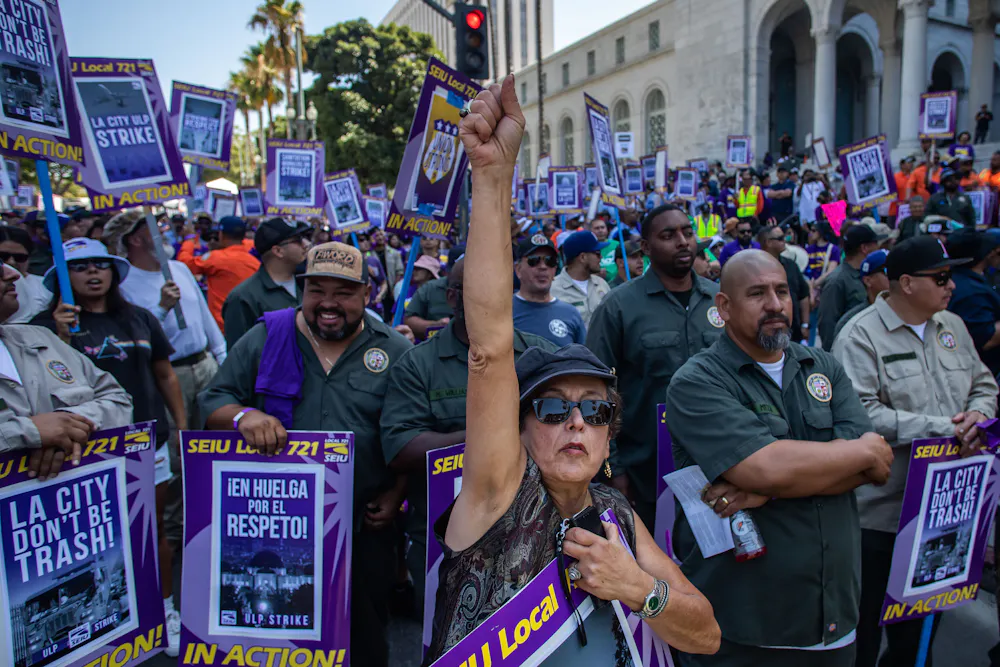
Maryam Rouillard puts her fist in the air on Aug. 8, 2023, while taking part in a one-day strike by Los Angeles municipal workers to protest contract negotiations. Apu Gomes/Getty Images
Millions on strike
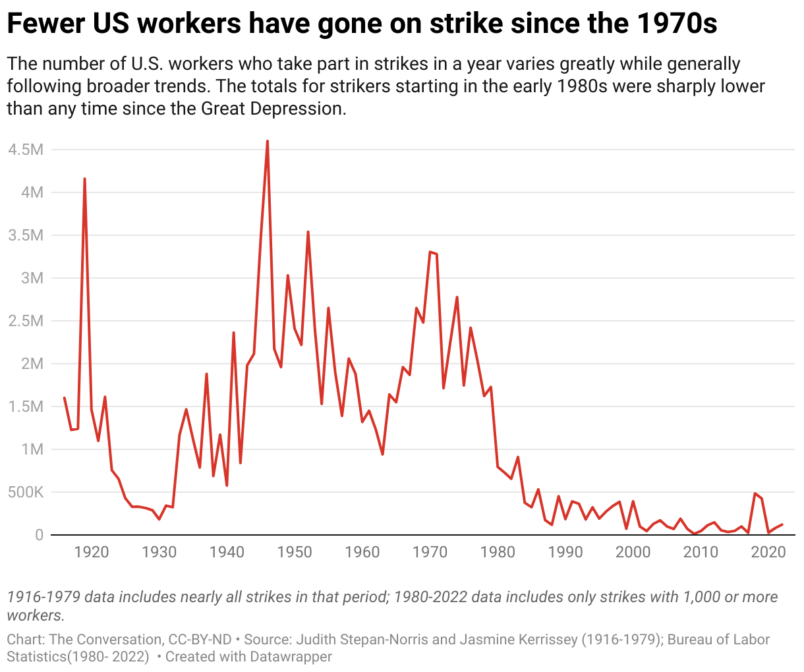
The number of U.S. workers who go on strike in a given year varies greatly but generally follows broader trends. After World War II ended, through 1981, between 1 million and 4 million Americans went on strike annually. By 1990, that number had plummeted. In some years, it fell below 100,000.
Workers by that point were clearly on the defensive for several reasons.
One dramatic turning point was the showdown between President Ronald Reagan and the country’s air traffic controllers, which culminated in a 1981 strike by their union — the Professional Air Traffic Controllers Organization. Like many public workers, air traffic controllers did not have the right to strike, but they called one anyway because of safety concerns and other reasons. Reagan depicted the union as disloyal and ordered that all of PATCO’s striking members be fired. The government turned to supervisors and military controllers as their replacements and decertified the union.
That episode sent a strong message to employers that permanently replacing striking workers in certain situations would be tolerated.
There were also many court rulings and new laws that favored big business over labor rights. These included the passage of so-called right-to-work laws that provide union representation to nonunion members in union workplaces — without requiring the payment of union dues. Many conservative states, like South Dakota and Mississippi, have these laws on the books, along with states with more liberal voters — such as Wisconsin.
Wages kept up with productivity gains when unions were stronger than they are today. Wages increased 91.3% as productivity grew by 96.7% between 1948 and 1973. That changed once union membership began to tumble. Wages stagnated from 1973 to 2013, rising only 9.2% even as productivity grew by 74.4%.
When there are fewer candidates available for every open job and prices are rising, workers become bolder in their demands for higher wages and benefits.
In the 1930s, President Franklin D. Roosevelt’s New Deal enhanced unions’ ability to organize. During World War II, unions agreed to a no-strike pledge — although some workers continued to go on strike.
The number of U.S. workers who went on strike peaked in 1946, a year after the war ended. Conditions were ripe for labor actions at that point for several reasons. The economy was no longer so dedicated to supplying the military, pro-union New Deal legislation was still intact and wartime strike restrictions were lifted.
In contrast, Reagan’s crushing of the PATCO strike gave employers a green light to permanently replace striking workers in situations in which doing that was legal.
Likewise, as we describe in our book, employers can take many steps to discourage strikes. But labor organizers can sometimes overcome management’s resistance with creative strategies.
The “great resignation,” a surge in the number of workers quitting their jobs during the pandemic, now seems to be over, or at least cooling down. The number of unemployed people for every job opening reached 4.9 in April 2020, plummeted to 0.5 in December 2021, and has remained low ever since.
Technological breakthroughs that leave workers behind are also contributing to today’s strikes, as they did in other periods.
We’ve studied the role technology played in the printers’ strikes of the 1890s following the introduction of the linotype machine, which reduced the need for skilled workers, and the longshoremen strike of 1971, which was spurred by a drastic workforce reduction brought about by the introduction of shipping containers to transport cargo.
Time and again, when the conditions have been right, U.S. workers have gone on strike and won. Sometimes more strikes have followed, in waves that can transform workers’ lives. But it’s too early to know how big this wave will become.
Tennessee state Reps. Justin Pearson of Memphis and Justin Jones of Nashville were back on the House floor this week for a special session — focused on guns and public safety laws — Gov. Bill Lee (R) requested back in April.
There’s a new poll out from Politico Magazine/Ipsos the results of which are straight out of Obviousville. But surprisingly few people ever go to Obviousville. So those results are worth discussing. The central finding is that the parade of criminal charges against Donald Trump are not in fact good news, politically or individually, for Donald Trump. More specifically, majorities (albeit bare ones) of Americans want his trials to be held before the election (61%), believe he’s guilty (51%) and believe he should go to prison if convicted (50%).
Critically, Politico notes that a substantial minority of the population (between a quarter and a third) says they’re not that familiar with the charges against Trump. Since the charges – especially those in the Mar-a-Lago case – are quite strong as an evidentiary matter that suggests there’s plenty of room for things to get worse for Trump.
Supporters of the major upcoming Ohio abortion amendment, which would enshrine a right to the procedure in the state’s constitution, thought they were out of the woods.
Earlier this month, they defeated a state Republican-led attempt to raise the threshold for citizen-initiated ballot proposals to 60 percent — which would have included the abortion one in November — in decisive fashion, despite the election being held in sleepy August.
But Republicans’ efforts to rig the game in their favor continues.
How did we get here? How did we not get here? By which I mean how many were the overlapping layers of bad acts, transgressions, crimes, lies that got us here? Looking back over the span of Trump’s presidency and post-presidency it’s not just one stream of actions building to this moment. There are so many, each of which might have gotten us here. It is almost as if — and perhaps this is the best way to look at the matter — Trump was determined to get us here even as we collectively, as Americans, resisted it.
Numerous American presidents have lost power at the ballot box. Every American president, save the eight who died in office, has voluntarily ceded power to his successor. There is no evidence that it so much as occurred to any of them not to do so.
He still looks like a pro wrestling supervillain. (Not as villainous as this guy but come on: It’s hard for central casting to crank out someone who can look both ex-presidential and demonic.)
Former U.S. Attorney Joyce Vance mulls the Trump mugshot:
Over his first three indictments, Trump’s well-orchestrated public appearances looked more like a royal progress than bookings in criminal cases, complete with deferential Secret Service agents opening doors and calling him sir. But not any longer. A mug shot. Fingerprints. An appearance in a county jail that is under federal investigation over its despicable conditions.
Here’s the first real indication, not just for us, but for Trump, too, that he is a mere mortal. He’s no longer in control. His status is now captured forever in a mug shot—something Jack Smith deferred to Trump on and didn’t make him submit to.
Trump co-defendant Ken Chesebro perhaps thought he could force Atlanta DA Fani Willis’ hand by exercising his right under Georgia law to a speedy trial within a matter of weeks.
You want a trial by November? Let’s make it October!
The judge in the case quickly set a trial date of Oct. 23, 2023. (I’m including the year on trial dates for the sake of clarity because we already have some tentatively scheduled in 2024 and because one bozo in particular has proposed trial dates as far out as 2026.)
The effect of Chesebro’s maneuvering and Willis’ aggressive “I’m ready now, b****” response was to force Donald Trump’s hand. Trump’s newest attorney dashed off a notice to the court that Trump was most emphatically not seeking a speedy trial and would seek to sever his case from Chesebro’s and anyone else’s who sought a fast-track to trial.
All that being said, will Chesebro or any other defendant really make it to trial in eight weeks? There’s reason to be skeptical.
Stable Genius Move: Another shakeup to Trump’s legal team. Out is Atlanta attorney Drew Findling. In is veteran Georgia criminal defense attorney Steve Sadow.
Surrenders: The two main holdouts – Mark Meadows and Jeff Clark, who failed in their federal court bids to avoid arrest – have surrendered. Clark was among five defendants who surrendered overnight, leaving Trevian Kutti and Stephen Cliffgard Lee as the only Georgia defendants not yet booked.
Jailed: Defendant Harrison Floyd, separately charged in Maryland with allegedly assaulting a FBI agent, apparently did not have a pre-arranged bond agreement with Fani Willis so he was jailed until a court can hold a bond hearing.
Subpoenas: Fani Willis has subpoenaed a former investigator for the Georgia secretary of state to appear for Monday’s federal court hearing on whether Mark Meadows can remove his racketeering case from state court.
Removals: State Sen. Shawn Still (R-GA), a fake Trump elector indicted in the racketeering case, is now seeking removal to federal court.
TPM’s Kate Riga on what the first GOP president debate revealed about the party’s mad scramble to adapt to the abortion politics of the brave new post-Dobbs world.
More GOP In Disarray
The Heritage Foundation’s Thomas Spoehr, a hawkish defense expert, has reportedly submitted his resignation as the old-line conservative think tank ramps up its opposition to U.S. aid to Ukraine, dishonestly framing such funding as competing with domestic disaster dollars.
Grim
Officials released a list of the names of 388 people still unaccounted for after the Maui fire.
We’re still going to have to stomach Vivek Ramaswamy’s slickly delivered anti-trans hate, Nikki Haley’s nauseating appeals to her bonafides and Mike Pence’s haircut during the next GOP primary debate in a month, but a couple of the candidates on stage last night may not qualify for the second Fox News ratings boost event of the season.
Even during Congress’ August recess, House Judiciary Committee Chair Jim Jordan (R-OH) and House Republicans are using their slim majority to defend former President Donald Trump amid his mounting legal troubles by trying to publicly poke holes in prosecutors’ credibility.