For anyone in the path of totality, the solar eclipse can be an exciting moment to get a front-row seat to one of astronomy’s most incredible coincidences. Every year or two the moon passes directly between Earth and the sun, casting a shadow and completely blocking the sun from a swath of the planet. These events draws people from around the world to the path of totality, hoping to witness the magical moment when the world goes dark.
If you weren’t one of those people this time — or maybe didn’t have the right protective eyewear — you can still get a good look at the eclipse. From Mexico to Maine photographers documented this year’s solar event and it’s probably better than what you would see in person.
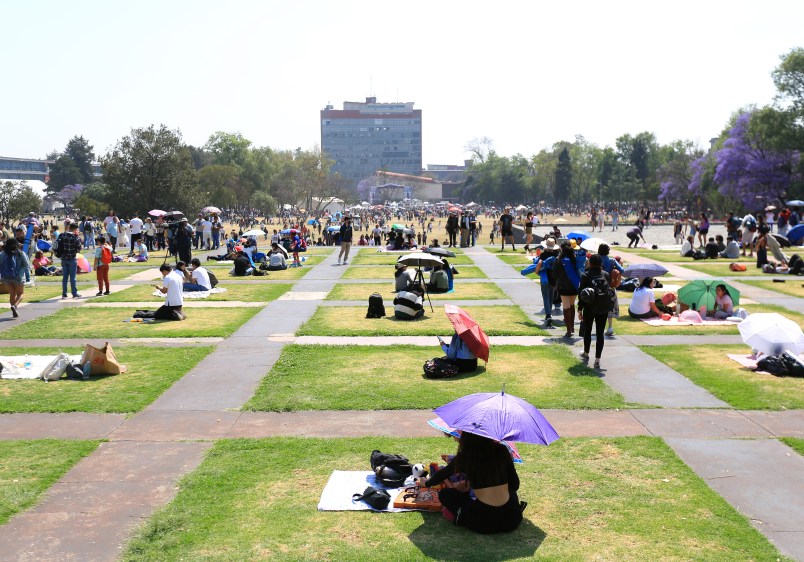
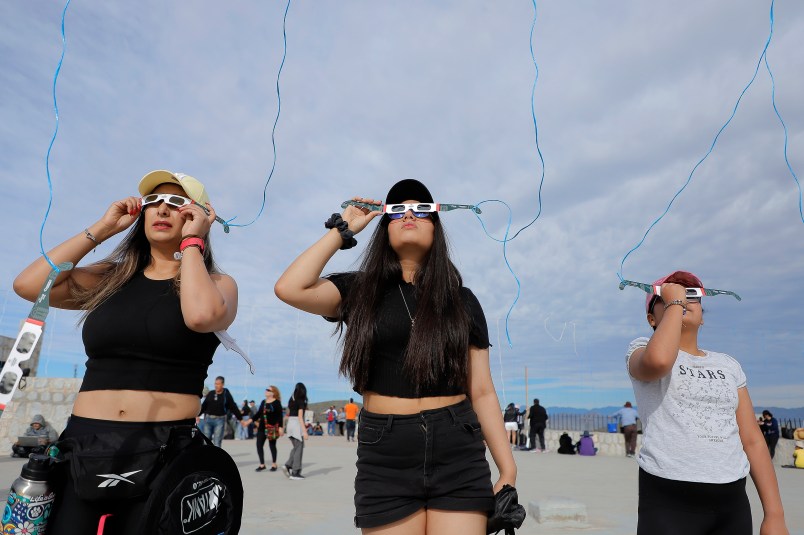
People gather to watch the eclipse in Mexico City
People gather to watch the partial eclipse at the campus of the Universidad Autónoma de México “Las Islas” on April 08, 2024 in Mexico City, Mexico. Millions of people have flocked to areas across North America that are in the “path of totality” in order to experience a total solar eclipse. During the event, the moon will pass in between the sun and the Earth, appearing to block the sun. (Photo by Fernando de Dios/Getty Images)
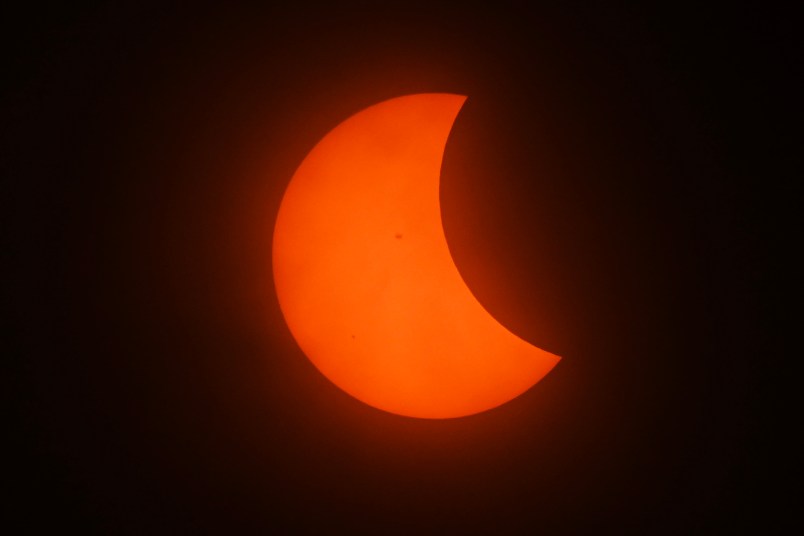
Moon begins to eclipse the sun, seen in Mazatlan, Mexico
The moon begins to eclipse the sun during the total solar eclipse in Mazatlan, Sinaloa state, Mexico on April 8, 2024. This year’s path of totality is 115 miles (185 kilometers) wide and home to nearly 32 million Americans, with an additional 150 million living less than 200 miles from the strip. The next total solar eclipse that can be seen from a large part of North America won’t come around until 2044. (Photo by MARIO VAZQUEZ/AFP via Getty Images)
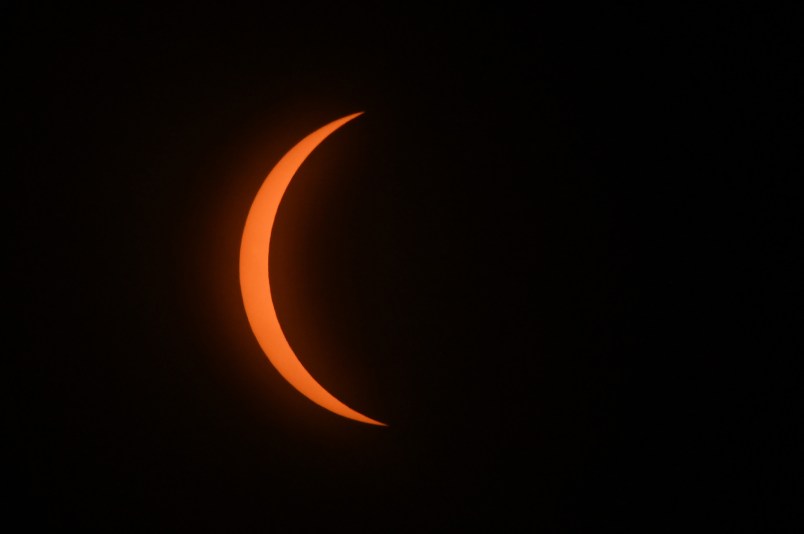
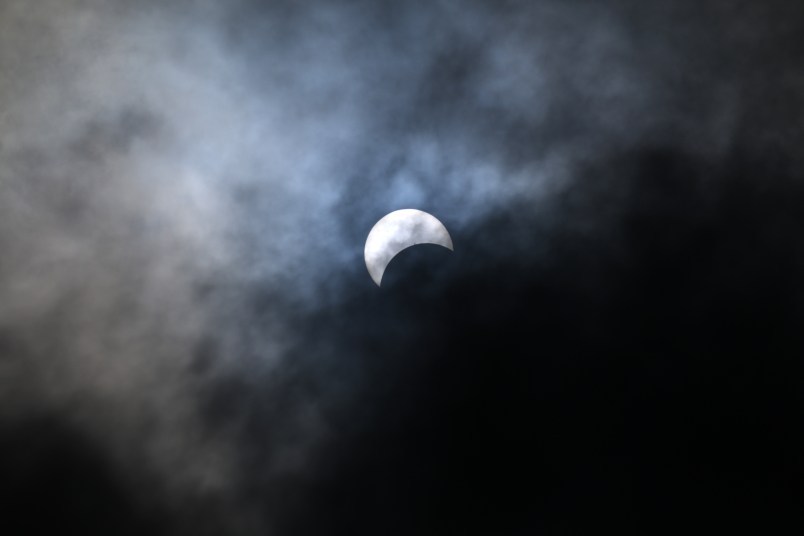
Moon almost fully eclipsing the sun, seen in Mazatlan, Mexico
The moon begins to eclipse the sun during the total solar eclipse in Mazatlan, Sinaloa state, Mexico on April 8, 2024. This year’s path of totality is 115 miles (185 kilometers) wide and home to nearly 32 million Americans, with an additional 150 million living less than 200 miles from the strip. The next total solar eclipse that can be seen from a large part of North America won’t come around until 2044. (Photo by MARIO VAZQUEZ/AFP via Getty Images)
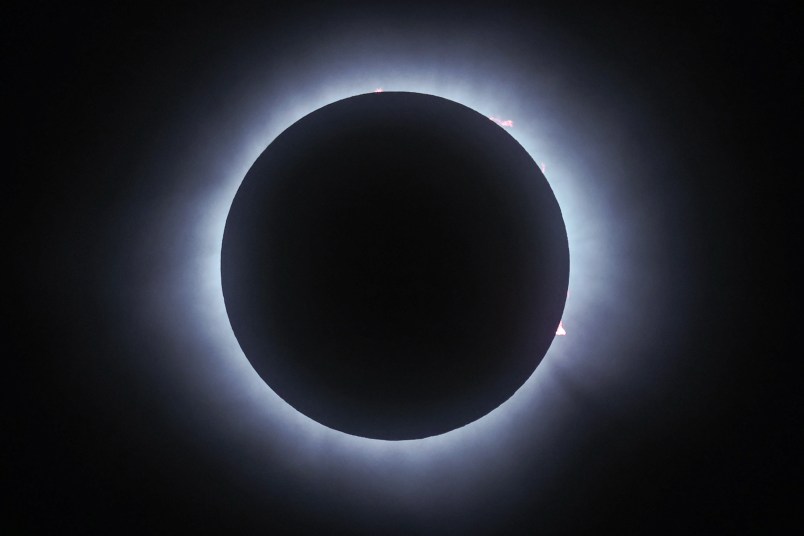
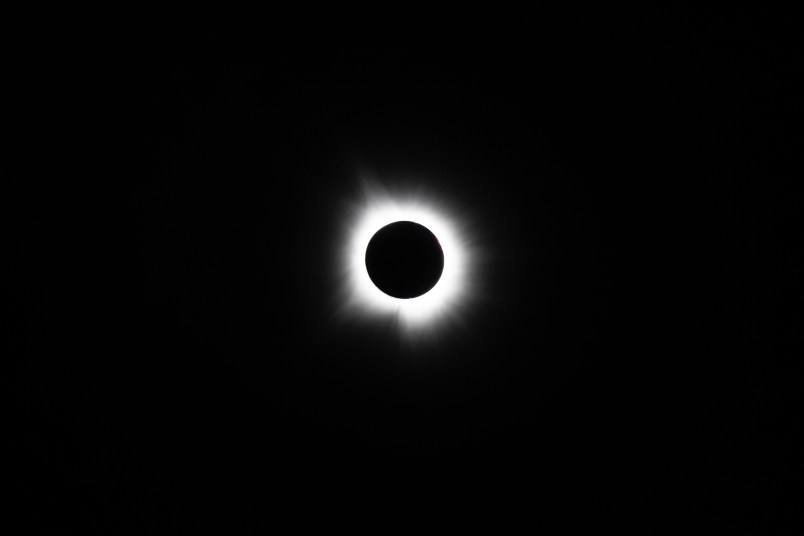
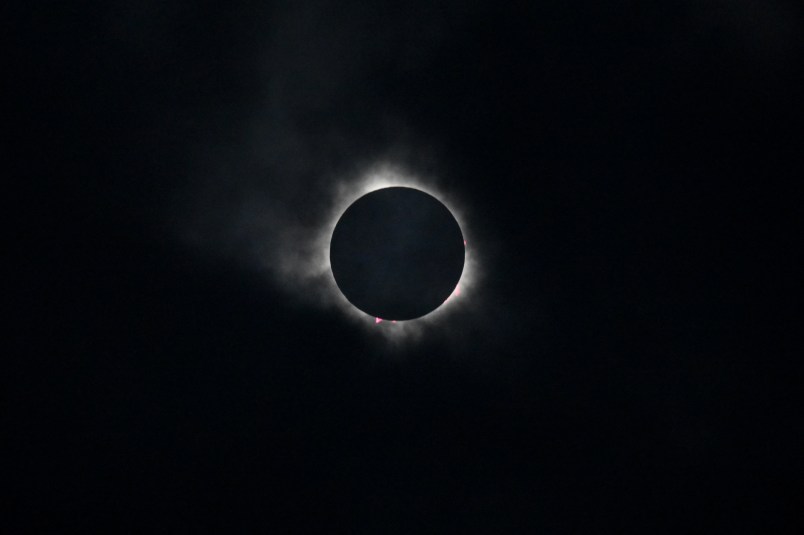
Total eclipse, seen from Mazatlan, Mexico
The sun disappears behind the moon during the Great North American Eclipse on April 08, 2024 in Mazatlan, Mexico. Millions of people have flocked to areas across North America that are in the “path of totality” in order to experience a total solar eclipse. During the event, the moon will pass in between the sun and the Earth, appearing to block the sun. (Photo by Hector Vivas/Getty Images)
People watch the total eclipse in Torreon, Mexico
People watch the total eclipse at Cristo de Las Noas on April 08, 2024 in Torreon, Mexico. Millions of people have flocked to areas across North America that are in the “path of totality” in order to experience a total solar eclipse. During the event, the moon will pass in between the sun and the Earth, appearing to block the sun. (Photo by Saul Perales/Getty Images)
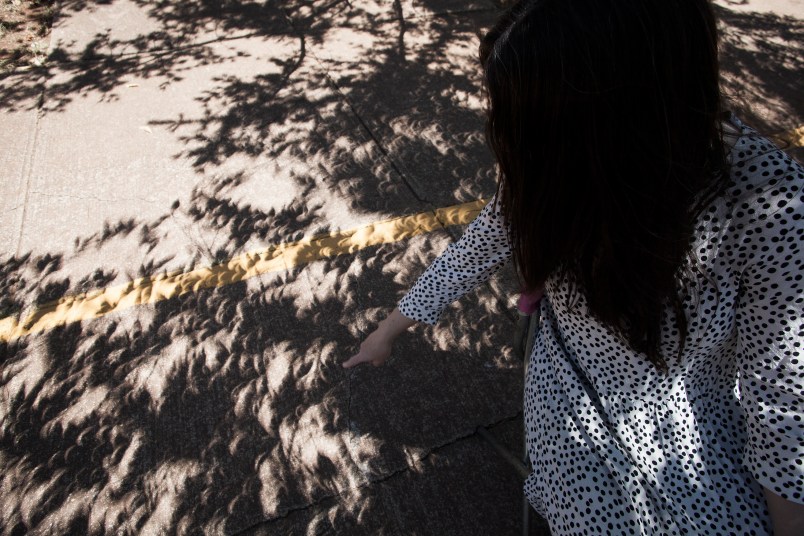
Shadows of the eclipse seen in Guadalajara, Mexico
A woman observes the shadows of the eclipse on the trees on April 8, 2024 in Guadalajara, Mexico. Millions of people have flocked to areas across North America that are in the “path of totality” in order to experience a total solar eclipse. During the event, the moon will pass in between the sun and the Earth, appearing to block the sun. (Photo by Leonardo Alvarez Hernandez/Getty Images)
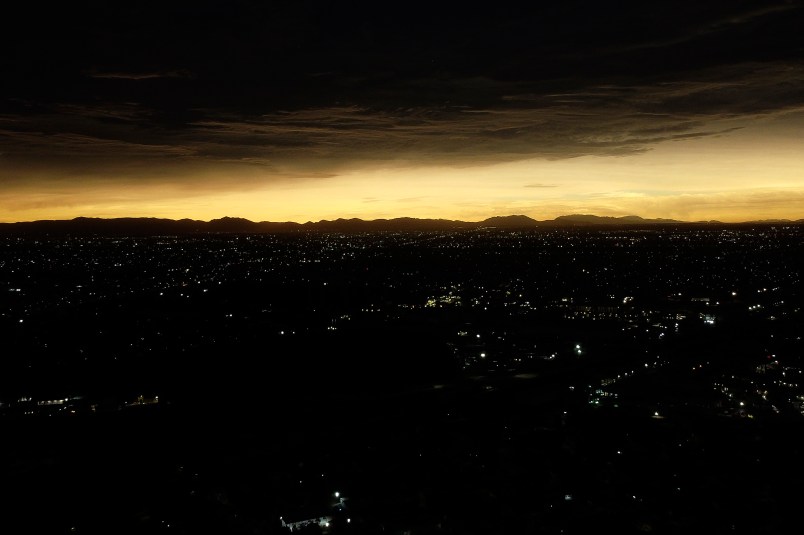
The sky over Torreon, Mexico during the eclipse
Aerial view Torreón from Cristo de las Noas during the eclipse on April 08, 2024 in Torreon, Mexico. Millions of people have flocked to areas across North America that are in the “path of totality” in order to experience a total solar eclipse. During the event, the moon will pass in between the sun and the Earth, appearing to block the sun. (Photo by Saul Perales/Getty Images)
A man wears a mask to watch the eclipse in Mexico City
A man wears a mask to watch the eclipse at the campus of the Universidad Autónoma de México “Las Islas” on April 08, 2024 in Mexico City, Mexico. Millions of people have flocked to areas across North America that are in the “path of totality” in order to experience a total solar eclipse. During the event, the moon will pass in between the sun and the Earth, appearing to block the sun. (Photo by Fernando de Dios/Getty Images)
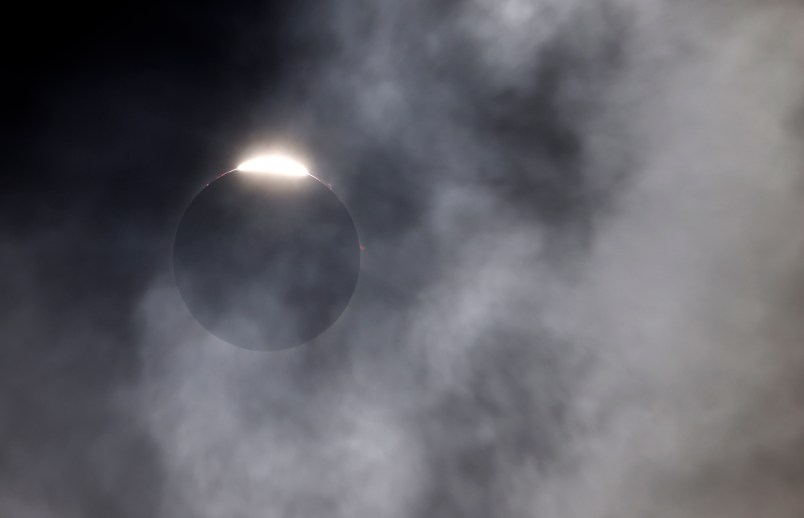
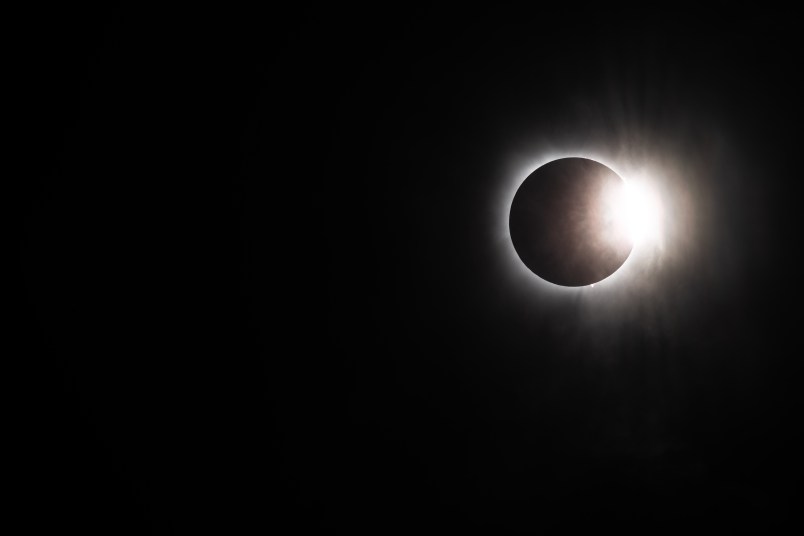
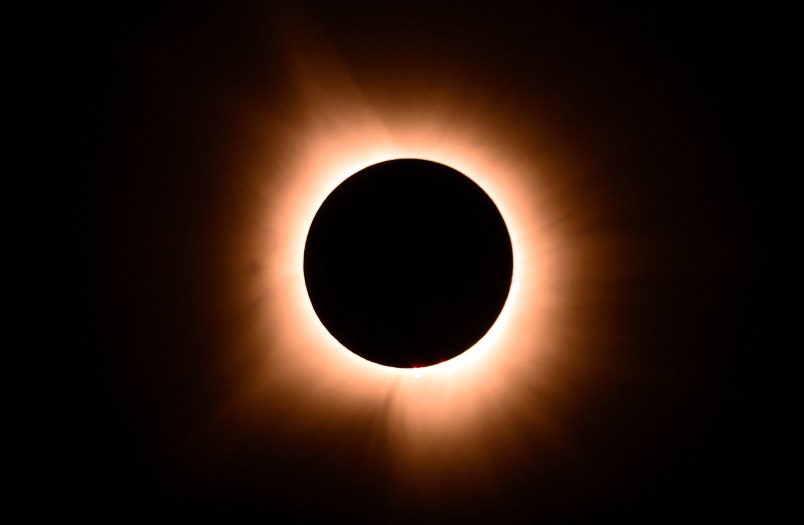
The diamond-ring effect is seen in Fort Worth, Texas
The diamond ring effect is seen as the moon eclipses the sun on April 8, 2024 in Fort Worth, Texas. Millions of people have flocked to areas across North America that are in the “path of totality” in order to experience a total solar eclipse. During the event, the moon will pass in between the sun and the Earth, appearing to block the sun. (Photo by Ron Jenkins/Getty Images)
Total solar eclipse, seen from Brady, Texas
The moon fully passes over the sun’s horizon during a Total eclipse on April 08, 2024 in Brady, Texas. Millions of people have flocked to areas across North America that are in the “path of totality” in order to experience the eclipse today. During the event, the moon will pass in between the Sun and the Earth, appearing to block the Sun. (Photo by Brandon Bell/Getty Images)
The moon begins its descent below the sun’s horizon, as seen from Brady, Texas
The moon begins its descent below the sun’s horizon during a total solar eclipse on April 08, 2024 in Brady, Texas. Millions of people have flocked to areas across North America that are in the “path of totality” in order to experience the eclipse today. During the event, the moon will pass in between the Sun and the Earth, appearing to block the Sun. (Photo by Brandon Bell/Getty Images)
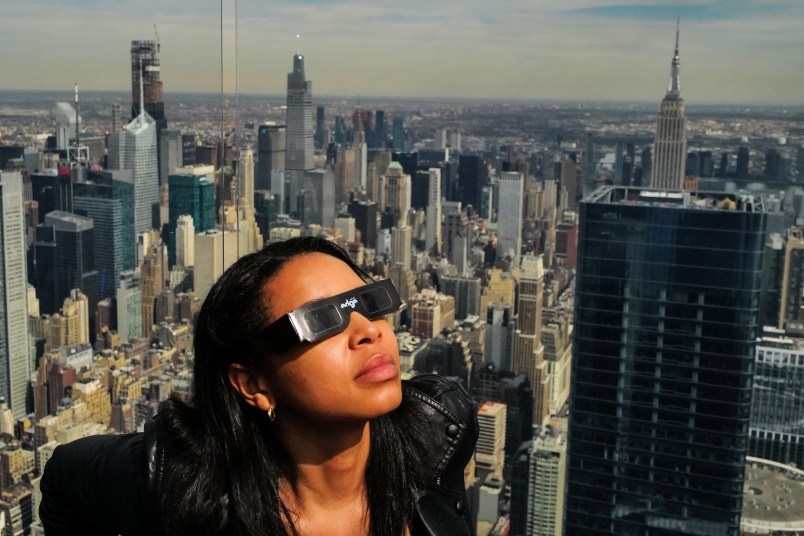
Watching the eclipse from a rooftop in New York City
A woman looks toward the sky at the ‘Edge at Hudson Yards’ observation deck ahead of a total solar eclipse across North America, in New York City on April 8, 2024. This year’s path of totality is 115 miles (185 kilometers) wide and home to nearly 32 million Americans, with an additional 150 million living less than 200 miles from the strip. The next total solar eclipse that can be seen from a large part of North America won’t come around until 2044. (Photo by CHARLY TRIBALLEAU/AFP via Getty Images)
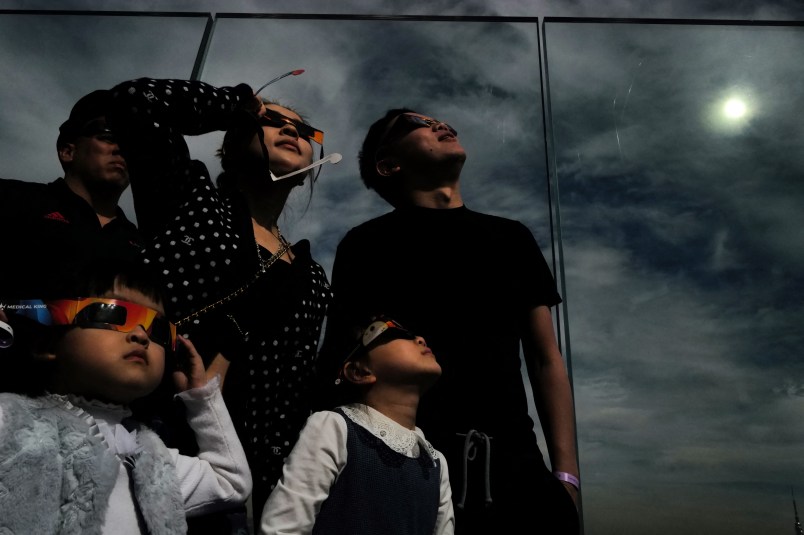
A family watches the eclipse in New York City
A woman looks toward the sky at the ‘Edge at Hudson Yards’ observation deck during a total solar eclipse across North America, in New York City on April 8, 2024. This year’s path of totality is 115 miles (185 kilometers) wide and home to nearly 32 million Americans, with an additional 150 million living less than 200 miles from the strip. The next total solar eclipse that can be seen from a large part of North America won’t come around until 2044. (Photo by CHARLY TRIBALLEAU/AFP via Getty Images)
Total solar eclipse seen from Niagra Falls, New York
The moon eclipses the sun during a total solar eclipse across North America, at Niagara Falls State Park in Niagara Falls, New York, on April 8, 2024. This year’s path of totality is 115 miles (185 kilometers) wide and home to nearly 32 million Americans, with an additional 150 million living less than 200 miles from the strip. The next total solar eclipse that can be seen from a large part of North America won’t come around until 2044. (Photo by ANGELA WEISS/AFP via Getty Images)
People watching the eclipse in Niagra Falls, New York
People look up at the sun during a total solar eclipse across North America, at Niagara Falls State Park in Niagara Falls, New York, on April 8, 2024. This year’s path of totality is 115 miles (185 kilometers) wide and home to nearly 32 million Americans, with an additional 150 million living less than 200 miles from the strip. The next total solar eclipse that can be seen from a large part of North America won’t come around until 2044. (Photo by ANGELA WEISS/AFP via Getty Images)
The moon begins to eclipse the sun in Niagra Falls, New York
The moon begins to eclipse the sun during a total solar eclipse across North America, at Niagara Falls State Park in Niagara Falls, New York, on April 8, 2024. This year’s path of totality is 115 miles (185 kilometers) wide and home to nearly 32 million Americans, with an additional 150 million living less than 200 miles from the strip. The next total solar eclipse that can be seen from a large part of North America won’t come around until 2044. (Photo by ANGELA WEISS/AFP via Getty Images)
Total solar eclipse, seen from Bloomington, Indiana
The moon eclipses the sun during a total solar eclipse across North America, in Bloomington, Indiana, on April 8, 2024. This year’s path of totality is 115 miles (185 kilometers) wide and home to nearly 32 million Americans, with an additional 150 million living less than 200 miles from the strip. The next total solar eclipse that can be seen from a large part of North America won’t come around until 2044. (Photo by JOSH EDELSON/AFP via Getty Images)
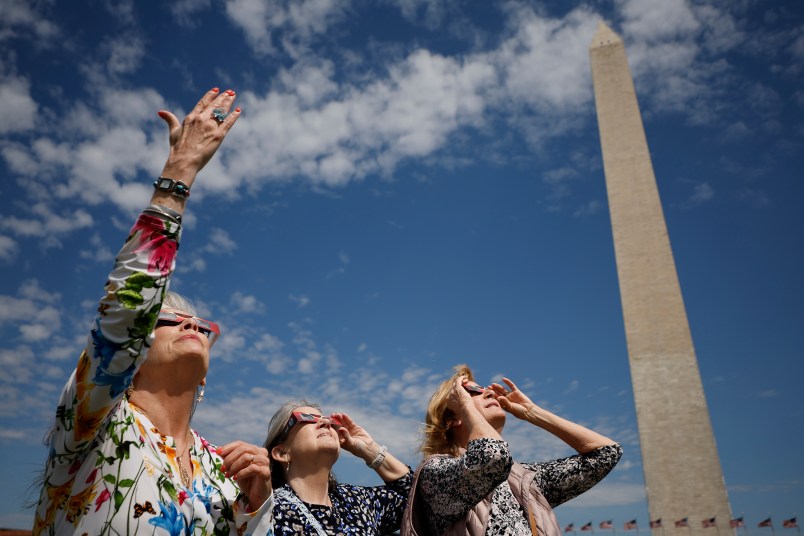
People watch the eclipse in Washington D.C.
Lori Darnell of Lincoln, California, Julie Plemmons and Denise Lonngren, both of San Diego, California look at the solar eclipse near the base of the Washington Monument on the National Mall on April 08, 2024 in Washington, DC. People have traveled to areas across North America that are in the “path of totality” in order to experience the eclipse today. The next total solar eclipse that can be seen from a large part of North America won’t happen until 2044. (Photo by Chip Somodevilla/Getty Images)
Patrons of the Masters Tournament watch the eclipse in Augusta, Georgia
Patrons use glasses to view the eclipse during a practice round prior to the 2024 Masters Tournament at Augusta National Golf Club on April 08, 2024 in Augusta, Georgia. (Photo by Andrew Redington/Getty Images)
As we documentedrepeatedly in the days and weeks after the Alabama Supreme Court found that embryos created as part of in-vitro fertility treatment are considered “children” and protected as such in wrongful death suits, Republicans stepped upon rake after rake, stumbling their way into a full faceplant on the issue. And for good reason: It’s cartoonishly hard to support the kind of fetal personhood ideology underlying the Alabama ruling while also supporting the procedure for what it is — a safe and widely supported way for couples experiencing fertility issues to conceive.
As I’ve told you a number of times over the last three weeks, we launched this year’s Annual TPM Membership Drive with an ambitious goal of signing up 1,000 new members. Today, a bit before noon, we hit our goal. It was even ahead of schedule. We truly appreciate it. We appreciate our members and especially those thousand new members. It’s a very important milestone for the company’s finances. But it is also a big shot in the arm for our whole team. Because this doesn’t happen by accident. We’re a small operation. And this is the product of every member of our team from editors and reporters to techs and designers and producers and publishing staff operating at their peak and operating as a very integrated and collaborative team. I really could not be prouder of every one of them.
Before I share a few other thoughts, two points: First, the drive was scheduled to run through the 15th. Since we’ve hit our goal I’m not going to be pushing you to sign up anymore in the Editors’ Blog. But the 40% discount we’ve been offering will continue to apply through the 15th.
Two things are undoubtedly true: Donald Trump has no “religious conviction” leading him to oppose abortion (The Bulwark’s Sarah Longwell says voters often assume that he’s paid for abortions in her focus groups), and he knows the Dobbs decision and everything stemming from it make for terrible electoral politics for his party.
Over the past month, I’ve been speaking with people who describe themselves as Christian nationalists, with Christians who are vehemently opposed to that movement, and with those who seem to agree with its overall aims but dislike the term.
This is one of the most amazing stories to come down the pike in I don’t know how long, published over the weekend in The Washington Post. The short version is that Tim Sheehy, probable Republican nominee for Senate in Montana, is a comical liar and is trying to cover up that lie with a story so preposterous that it’s kind of a joy to run through because it’s so hilariously bad.
This article is part of TPM Cafe, TPM’s home for opinion and news analysis.
Forum shopping: Every lawyer does it. Plaintiffs’ lawyers file cases in the courts where they think they’re most likely to win. Defendants try to get cases moved to more favorable places or dismissed altogether.
But judge shopping? Picking not just a court but the individual judge who hears the case?
Surely litigants aren’t allowed to do that.
Yet judge shopping is the norm in many federal courts throughout the country.
Lately, Republican state attorneys general and conservative activists have been exploiting quirks in rules about how cases are assigned to judges to challenge federal government policies on abortion, immigration, gun control, transgender rights, and more in front of hand-picked, sympathetic, Republican-appointed judges, primarily in Amarillo and Wichita Falls, Texas.
Last month, the Judicial Conference of the United States (a group of judges who oversee the operation of the federal courts), adopted a policy that was widelyreported as stopping the ability of plaintiffs to judge shop.
Predictably, the beneficiaries of judge shopping — namely, Republicans — decried the policy as politically motivated and urged district courts to ignore it. Democrats, for their part, demanded that the chief judge of the district encompassing Amarillo and Wichita Falls (the Northern District of Texas) adopt new case assignment rules right away.
But in a letter sent to Senate Democrats last week, the Northern District’s chief judge refused to make any changes, citing a “consensus” among the district’s judges to maintain the status quo. You may not be surprised to learn that Republican presidents appointed ten of those eleven judges.
In short, despite the fanfare surrounding the Judicial Conference’s policy on random case assignment, nothing has changed.
That’s unfortunate. There is no fairness or impartiality among the judges favored by Republicans.
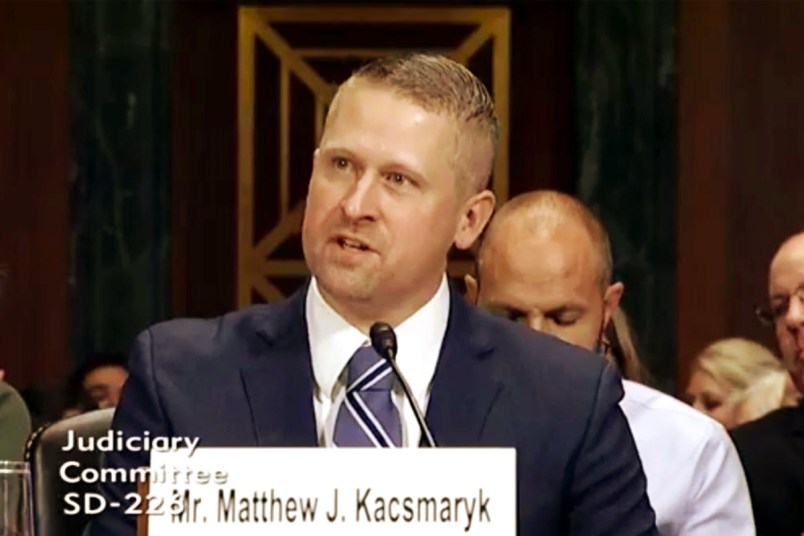
Judge Matthew Kacsmaryk. TPM Illustration/Senate Judiciary Committee
Judge Matthew Kacsmaryk in Amarillo — who, among other extremist rulings, struck down the FDA’s decades-old approval of the abortion drug mifepristone — was an anti-abortion activist before he was appointed by President Trump.
And Judge Reed O’Connor in Wichita Falls struck down the Affordable Care Act in 2018 — six years after the Supreme Court largely upheld that law. (Judge O’Connor’s 2018 ruling was reversed on appeal.)
But high-profile, politically charged cases are not the only cases in which judge shopping wreaks havoc. As we’ve shown in a series of law review articles, judge shopping happens all the time in the obscure but important field of patent law.
In the mid-2010s, for instance, over a thousand patent cases per year — a quarter of all patent cases nationwide — were filed before Judge Rodney Gilstrap in Marshall, Texas (population 23,000). More recently, Waco, Texas, has become the capital of U.S. patent litigation, with Judge Alan Albright receiving nearly one in four patent cases filed nationwide. Though the district encompassing Waco (the Western District of Texas) recently adopted rules that prevent shopping for Judge Albright, early indications are that judge-shopping patentees are heading back to Marshall and to Midland, Texas — both places where it’s possible for a plaintiff to pick their judge.
To bring cases in, the judges like Gilstrap and Albright slant procedures and rulings to blatantly favor patent owners. The patent owners filing cases in Texas are primarily nonpracticing entities (pejoratively, “patent trolls”) — entities that don’t make anything and exist only to assert patents.
And judges have ample incentives to bring patent cases into their courtrooms.
Being known as the judge in a specific area of law brings fame and notoriety. A large patent caseload brings economic benefits to local lawyers, the community, and even the judges themselves. And the “expert” reputation a judge develops can bring lucrative career opportunities when the judge retires from the bench.
The current situation is untenable. No one should be denied access to abortion medication or the opportunity to seek asylum or the entrance to the bathroom of their choice simply because a conservative activist got to pick the judge. Judge shopping in patent cases also harms us all: not only does it corrupt our court system, many patent cases wouldn’t be filed at all if judge shopping weren’t possible. The cost of that needless litigation is baked into everything we buy, from eye medicine to iPhones.
Ideally, the Judicial Conference would do more than adopt a policy suggesting that courts adopt case assignment systems that prevent judge shopping — it would adopt a rule requiring all cases to be randomly assigned among multiple judges.
Though this would be an easy fix, the Judicial Conference seems to doubt whether it can require district courts to do anything to stop judge shopping.
That’s too bad. The federal courts are facing a crisis of legitimacy. Ending judge shopping would restore some semblance of neutrality.
Like the infrastructure week of lore, Trump’s promise to finally take a position on what a post-Dobbs world should look like had all the makings of a kick the can down the road epic. That turned out to be both true and selling Trump a bit short. In a video released this morning, Trump seems to have made “kick the can” his official position.
He didn’t come out in favor of a 15-week ban. He didn’t come out for or against anything in particular, other than “winning.” His default position, he claimed, will be to leave it to the states. Some states may enact more liberal abortion laws and some may enact more conservative ones, and that’s okay with him, Trump said.
Trump telegraphed his “winning” equation in a weekend post:
This line from this morning’s video is for ages, an attempt at bombast followed by an immediate collapse into fecklessness: “Whatever they decide must be the LAW OF THE LAND, in this case the law of the state.”
But let’s not leave the misimpression that Trump spoke in coherent sentences or a logical structure. He threw out a few conceptual frameworks, like “life” and “babies” and “winning.” But he stopped short of endorsing a nationwide ban. To try to make up for it, he smeared Democrats with the false claim that they favor executing babies after birth. He literally said that.
The “let the states decide” position is in many ways the long-standing position of anti-Roe Republicans. At least ostensibly. It was in reality a thin veil of pseudo-federalism and a poor disguise for the true goal of outlawing abortions. Trump has now embraced that as a fallback position, but it placates no one and is strongly held only insofar as it serves his electoral ambitions.
Remember: Trump must win to avoid prison. He’s not going to let abortion politics foil his strategy to save himself.
All In a Day’s Work
Shot: Trump claims that violating the gag order in the hush-money case will make him a “modern day Nelson Mandela.”
Chaser: Trump tells donors he wants immigration from “nice countries,” like Denmark, Switzerland, and Norway.
Trump Pressured Nebraska Pol On Electoral Vote Change
Former President Donald Trump picked up a phone to pressure a Nebraska state senator to revive a winner-take-all system of awarding its Electoral College votes for president, sources told the Nebraska Examiner on Friday.
Trump, the sources said, called State Sen. Tom Brewer, who chairs the State Legislature’s Government, Military and Veterans Affairs Committee, and urged him to take action to get a winner-take-all bill up for debate in the waning days of the 2024 session. …
Brewer, the sources said, responded that it doesn’t work that way. … Trump then reportedly told Brewer, who is term-limited this year, that his political career was over.
Help Put Us Over The Top!
Dear Morning Memo regulars: As of this morning, we stand at 987 new members in our annual membership drive – just 13 short of the magic numbers: 1,000.
Been meaning to sign up, but haven’t gotten around to it? Intended to but got sidetracked? You can put us over the top this morning!
If you rely on us and have made us a regular part of your news diet, we are honored by that alone. If you take the next step and support us financially by joining, we are deeply humbled. Please give it serious consideration!
2024 Ephemera
MT-Sen: Former Navy SEAL Tim Sheehy, the leading GOP contender against Sen. Jon Tester (D-MT), claims he was shot while deployed in Afghanistan but covered it up for years, including lying to a Glacier National Park ranger that he had accidentally shot himself. Does this make zero sense to you? You are not alone!
TPM’s Kate Riga: This Election Will Prove If Florida Is Still Winnable For Democrats
Ukraine Is So Screwed If Trump Is Elected
Nothing about a Trump II foreign policy will be grounded in U.S. national interest, a coherent vision, or a particular school of thought. It will be transactional, self-serving, and highly steered by Russia, whether directly or indirectly, as a trio of weekend stories in the WaPo made clear:
At the December soiree, which was the New York Young Republican Club’s annual gala, multiple witnesses saw a server tell Boebert they would not bring her any more alcohol, with one witness telling CNN the server told the congresswoman they believed she had been overserved. Throughout the night, Boebert also kept attempting to snap selfies with Trump, who was sitting at the same table as her. Eventually, Trump’s security detail stepped in and asked Boebert to stop, according to the witnesses, who attended the event and saw the interaction take place.
A Prophet In Our Own Time
In case you missed the obvious signs of earth-shaking and sun-blotting, God sent Rep. Marjorie Taylor Greene (R-GA) to help fill in the blanks for you. He indeed works in mysterious ways:
God is sending America strong signs to tell us to repent.
Earthquakes and eclipses and many more things to come.
I pray that our country listens. 🙏
— Marjorie Taylor Greene 🇺🇸 (@mtgreenee) April 5, 2024
The Cutest
No one deserved to experience the surreality of an earthquake like the great John McPhee, whose 60-year nonfiction portfolio is anchored in geology writing. But for all his time in the field, the 93-year-old McPhee’s first quake came Friday in his native New Jersey, of all places:
According to the New Yorker newsletter, John McPhee finally experienced his first earthquake today. pic.twitter.com/p5lwDHqBCI
If you haven’t seen it yet, Donald Trump put out a video this morning in which he says a lot of gobbledegook, takes credit for overturning Roe v. Wade, and then says the abortion bans should be left up to individual states. We can draw the obvious intent: Republicans are terrified about the politics of abortion rights. He wants to take credit for overturning Roe and then say, essentially, my role is done now so leave me out of it. We will now see a lot of press tut-tutting toward anyone who points out the obvious point that Trump didn’t discuss the kind of blue-state abortion ban he has privately said he’ll support and sign if he’s reelected President. He avoids discussing plans to ban abortion drugs, which are now the primary way women get abortions in the country, or prevent them from being mailed to women in states with abortion bans.