

The basis for Justice Samuel Alito’s rejection of congressional Democrats’ request that he recuse himself from Supreme Court cases tied to Jan. 6 was literally a meme.
Continue reading “God Forbid Women Have Hobbies”First Day Of Jury Deliberation Ends With Request For Read Out Of Testimony From Pecker, Cohen
The first-ever criminal trial of a former president is drawing to a close. On Wednesday morning, Judge Juan Merchan read out his jury instructions, explaining how the panel is to apply the law. He then handed the case over to the jury.
The jury submitted notes Wednesday afternoon requesting a read out of certain parts of trial testimony from witnesses David Pecker and Michael Cohen, and also requesting to rehear the judge’s instructions before they were dismissed for the day.
Catch up on our live coverage below:
Ireland (and Spain and Norway) Were Right to Recognize Palestine
Yesterday Ireland, Spain and Norway formally recognized a Palestinian state. The U.S. and most other European governments continue to support a “two-state” solution but refuse to recognize a Palestinian state because they say such recognition and such a settlement must emerge from negotiations between the two parties. Meanwhile, numerous other countries throughout the world have already made a declaration similar to Ireland, Spain and Norway’s. Israel Prime Minister Benjamin Netanyahu says such recognition amounts to “a reward for terrorism.” Some offer a middle ground. British Foreign Secretary Cameron says the UK won’t recognize a Palestinian state as long as Hamas controls Gaza, etc. etc.
In practice such declarations have no real practical impact. The Palestinians most definitely do not have a state: that is their central grievance. Recognitions don’t change that. But is this actually a bad thing from the perspective of the United States? Or supporters of Israel? Or, really, anyone else?
It is not. It’s not a bad thing. In fact, it’s a good thing. Much more important than that, it is a necessary thing.
Continue reading “Ireland (and Spain and Norway) Were Right to Recognize Palestine”Justice
Before we get a verdict, it’s important to recognize that this is justice, regardless of whatever the verdict is. It is a billowing outrage that the three other cases against Donald Trump have been stymied to date by judicial corruption (certainly that’s the case in the two federal prosecutions; the Georgia case is more complicated). But those are different cases. This trial is in a different jurisdiction and about totally different facts and crimes. Both sides were allowed to make their case before a judge who did a good job of controlling the process. Now it’s in the hands of a jury.
I am certainly hoping for a conviction, mostly because the evidence is overwhelming and irrefutable. I’ve always thought this was essentially a jury nullification case. Trump’s only hope for an acquittal is for the jury to essentially say: we’ve heard what you say the law is and we’ve heard the evidence but we just don’t think this is a crime. More realistically, I think Trump’s real hope is a hung jury. Regardless, this is our system. Donald Trump deserves to have his fate in the hands of a jury. And now he does.
Live Blog
Follow along with our Trump trial live blog right here.
No Podcast This Week
Alas, our beloved co-host Kate is sick, so there will be no podcast this week. See you all next week with a new episode!
Aileen Cannon Threatens To Sanction MAL Prosecutors
A lot of things happened. Here are some of the things. This is TPM’s Morning Memo. Sign up for the email version.
Welp …
In the up-is-down world of the Mar-a-Lago classified documents case, prosecutors attempted to stanch Donald Trump’s vitriolic attacks on federal law enforcement – the kind of thing criminal defendants would not typically be allowed to engage in while on pre-trial release – and wound up themselves threatened with sanctions by the judge.
As Morning Memo recounted yesterday, the move by prosecutors to modify the terms of Trump’s pre-trial release came late Friday before the Memorial Day weekend and prompted a heated response from Trump.
U.S. District Judge Aileen Cannon weighed in Monday, denying the prosecution motion, chastising them for playing loose with the local court rules, and threatening to impose sanctions on them in the future. One small bright spot, if you can call it that, is that she didn’t accede to Trump’s request to sanction the prosecution team immediately. Cannon’s denial was without prejudice, meaning prosecutors can refile their motion:
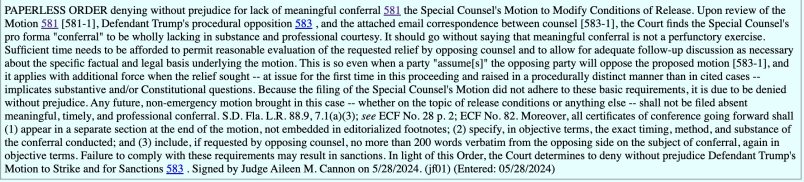
Cannon insisted that prosecutors had not sufficiently conferred with the defense team before filing and ordered that all future filings contain a statement of no more than 200 words by the opposing side of its position.
In a normal case, I’d applaud a judge keeping a tight leash on the prosecution team. But we’re in such uncharted territory here that you can’t attribute this to i-dotting or t-crossing by Cannon. Given any chance to chide the prosecution, she takes it. Given deplorable behavior by Trump that would normally never fly, she finds herself mute again and again.
The judge’s routine has become so predictable that even the analysis by legal observers bakes in a certain Cannon quotient: Anything that DOJ does that even arguably deviates from the rules leaves an opening that Cannon will take. So DOJ ends up graded on a weird Cannon curve while Trump’s dangerous and unprecedented conduct gets set to the side.
One pattern emerging with Cannon is that when prosecutors implore her to assert herself and take more control over the case like so many judges do, she retreats to treating everything as an adversarial contest that she merely referees. But when it’s a matter of importance to Trump, she regularly asserts herself, going so far as to raise issues on her own. It’s another way her handling of the case is imbalanced to Trump’s advantage.
The Hush Money Jury Finally Gets The Case!
With closing arguments in the hush money trial complete, we’re expecting the judge to spend about an hour instructing the jury on its duties before turning the case over to them to deliberate.
Let me caution again that predicting jury verdicts is not just a dangerous game, it’s damn near impossible. I would even go so far as to say that the rule of law has been honored here regardless of the verdict. The case was well tried, Trump had his day in court, his misdeeds weren’t swept under the carpet, and that all remains true regardless of how the jury comes down.
In oder to set your expectations a bit, I would say the most likely outcomes in descending order are: conviction -> hung jury -> acquittal. But a mix of outcomes – conviction on some but not all counts, hung jury on some counts, even acquittal on some counts – is defintely in play. Acquittal on all charges is I think very unlikely.
After a late night and early morning turnaround, TPM’s Josh Kovenky is back at it this morning. Follow his liveblog here.
The Alitos Are Quite A Pair
The NYT’s Jodi Kantor digs deeper into the neighborhood dispute that Supreme Court Justice Samuel Alito claims led his wife to fly the American flag upside down back in January 2021, sometime between the Capitol attack and Joe Biden’s inauguration.
What’s most striking is the sheer pettiness of the Alitos, but the one factual reveal is that the key confrontation that Alito said prompted his wife to raise the distress signal actually came after the flag at the Alitos was already taken down.
Not that it matters that much? Alito’s explanation never made sense. On what planet does your neighbor protesting a coup attempt require you to trot out pro-coup symbols? What else could it possibly mean?
A Sign Of Things To Come …
AJC: “A Republican member of the Fulton County elections board refuses to certify primary election results unless given access to detailed voting data, a move that Democrats worry could jeopardize certification of November’s general election results.”
DNC Comes Up With An Ohio Fix For Biden
The DNC will hold a virtual roll call of delegates to make Joe Biden its presidential nominee and beat the deadline to get Joe Biden on the Ohio ballot, resolving a mundane calendar issue that had bedeviled Democrats and the state’s GOP governor, who favored resolving the matter.
2024 Ephemera
- Rep. Tony Gonzales (R-TX), a more moderate Republican by today’s standard, barely fended off a primary challenge from far-right candidate Brandon Herrera, winning by about 400 votes.
- WSJ: Democrats Plan $100 Million Push on Abortion Rights to Win House
- Ron Brownstein: The unusual turnout dynamic that could decide the 2024 election
Abortion Watch
- NYT: The Untold Story of the Network That Took Down Roe v. Wade
- Politico: Trump says he won’t ‘ban’ birth control. Here’s what he may do instead
- NPR: Here’s where voters will decide abortion at the ballot box in November
Infallibility Is Hard
Pope Francis apologies for using gay slur in closed-door meeting with Italian bishops. `
Peering Into The Beyond
The European Space Agency last week released five new images from the Euclid space telescope, among them this unprecedented shot:

Do you like Morning Memo? Let us know!
Site Issues
I wanted to give you a brief update on the server outage we had off and on for much of Tuesday afternoon.
First, we apologize that this happened and especially on such a news-packed day. As members you pay for us to bring you the news and for the site to be online. We take that responsibility very seriously. Unfortunately, we do not yet know the precise cause of Tuesday’s outage. It appears to have originated on our server host’s side. So that left us for much of the day in the uncomfortable position of largely having to wait on their team to figure out and fix the problem. (If you had a problem accessing the site, believe me — it was extremely frustrating on our end too.) We ended the day making some triage changes to keep the site online until the underlying cause is determined.
My words here may seem lawyerly or overcautious. It’s not that. We just don’t want to say more than we know or speculate and have to correct the record later.
Once we know the precise cause we’ll report back to you.
Trump Trial Finale: Prosecutors Outline A Conspiracy, Defense Invents One Of Its Own
NEW YORK — The first-ever criminal trial of an American president barreled to a close on Tuesday in a marathon day at Manhattan Criminal Court — the last day of testimony before the case goes to the jury, and one to which both sides brought everything they had.
Continue reading “Trump Trial Finale: Prosecutors Outline A Conspiracy, Defense Invents One Of Its Own”So Much Would Have To Be Ignored To Find Trump Not Guilty, Prosecutors Argue
After weeks of testimony, lawyers for Donald Trump and Manhattan DA Alvin Bragg’s office are making their closing arguments to the jury in the first-ever criminal trial of a former president.
Continue reading “So Much Would Have To Be Ignored To Find Trump Not Guilty, Prosecutors Argue”