

We have our first arrest tied to the vigilante attacks on the UCLA Gaza encampment on April 30th. In some ways it illustrates how slow and incremental the process has been. The arrestee is an 18-year-old high schooler named Edan On. He appears to be either Israeli or Israeli-American. I base this in part on his name but more on the fact that his identity was originally uncovered in part by his mother’s boasting about his role in the attack in Hebrew on Facebook. (Many American Jews know some Hebrew, or even a lot of Hebrew. But they don’t tend to use it as a casual posting language on social media unless they’re from Israel or have a family background in Israel.)
Continue reading “First Arrest in UCLA Overnight Encampment Attack”Trump Turns WSJ Reporter Detained By Russia Into Re-Election Pawn
A lot of things happened. Here are some of the things. This is TPM’s Morning Memo. Sign up for the email version.
Russia, Russia, Russia
The challenge of the present moment is to continue to relentlessly observe, report, and document each of Donald Trump’s serial transgressions of democratic norms, the rule of law, and basic human decency. Challenging because the list is endless, the mind numbs, the body tires, and because the effort is not going to change his behavior or calm the fervor of his true believers. We do it not for him but for ourselves.
But even with Trump’s non-stop transgressiveness, certain episodes stand out as especially egregious, as the kind of thing no one, including the Republican Party, would have tolerated just a few years ago, and which no one should tolerate for a moment now.
Yesterday brought one such episode, when Trump baldly tied the release of WSJ reporter Evan Gershkovich, illegally detained by Russian, to his own re-election:
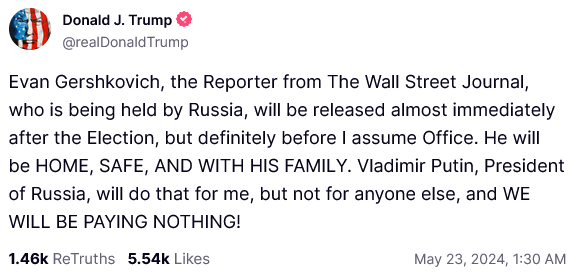
Where to start? It’s not just how bad it is but the myriad ways in which it is bad.
As to Gershkovich himself, Trump absolutely jeopardized his release. Why would Russia now do Trump the disservice of releasing Gershkovich any time before the November election? Why would Russia release Gershkovich after the election if Trump loses? In what way do Trump’s remarks do anything but harm the ongoing efforts to secure Gershkovich’s release?
As to the larger picture, Trump remains a toady of Putin, an easily played neophyte in geopolitics who can’t distinguish his personal and political interests from the national interest. The GOP nominee for president happily places himself in the thrall of Putin, which was bad enough in 2016 and 2020 but now comes after Putin invaded and continues to occupy U.S. ally Ukraine.
It was as reckless a move as anything Trump has done since being booted from office.
Reax To Trump Dangling Gershkovich’s Release
- Former U.S. Ambassador to Poland Daniel Fried: “Since former President Trump brought it up, the question might be whether he is in contact with Russian authorities about Evan Gershkovich and, if so, whether he has pushed for Evan’s immediate release or suggested that the Russians keep holding him, perhaps to Trump’s advantage.”
- TPM’s Josh Marshall: “Trump seems to be saying pretty clearly that he has an understanding with Putin that Gershkovich will under no circumstances be released until after he is elected and if he’s not elected, well, sucks to be him. Could this have anything to do w Manafort again working with Trump’s campaign?”
- Luppe Luppen, channeling Trump: “Russia, Russia, Russia is a hoax but also I’m expressly working hand-in-glove with Putin’s regime to keep an American imprisoned in Russia until I am restored to power. Not anyone else, mind you; it has to be me.”
- Former U.S. Marine Trevor Reed: “As a former wrongful detainee in Russia, I would just like to remind everyone that President Trump had the ability to get myself and Paul Whelan out of Russia for years and chose not to. I would be skeptical of any claims about getting Evan Gershkovich back in a day.”
Related: Trump Praises Authoritarians In Bronx Rally
With Trump comparing President Biden unfavorably to Vladimir Putin, Kim Jong Un, Xi Jinping, and Viktor Orban, it might be time for you to watch extended excerpts from Trump’s rally last night in the Bronx to stay familiar with how routinely he is fascisting.
Important Read
Greg Sargent on the Trump campaign’s “Unified Reich” video:
The Trump campaign’s initial story about this video may or may not prove true. But as we debate those specifics, let’s not lose sight of a larger point. Trump and his highest-profile allies have plainly embarked on a broader related project—one that seeks to acclimatize the American electorate to fascistic language and far-reaching authoritarian policy “solutions.” They are slowly edging the discourse deeper into that fraught territory, as if painstakingly testing how far they can take this without provoking too much public discomfort over it.
Unpacking Disinfo One Case At A Time
- Just Security: Anatomy of MAGA Conspiracy of Assassination Attempt Against Trump
- Juliette Kayyem: Trump’s Assassination Fantasy Has a Darker Purpose
Buckle Up For Tuesday
Closing arguments begin Tuesday after the three-day weekend in Donald Trump’s hush money case. In the meantime, TPM’s Josh Kovensky reports on the overt flattery of Trump that his lawyers and some witnesses engaged in during the trial itself.
Alito Watch
- U.S. District Court Judge Michael Ponsor: How Could Alito Have Been So Foolish?
- Philip Bump: The flags were redundant
- NYT: Lawmakers Dial Up Pressure on Alito to Recuse From Elections Cases
Alito Strikes Again
The top line of the Supreme Court majority opinion written by Justice Samuel Alito in the South Carolina redistricting case is that it’s now even harder to prove that states are discriminating against Black voters in how congressional district are drawn – but it’s how Alito got there, as explained in a withering dissent written by Justice Elena Kagan, that shows how determined the court’s conservative super-majority is to erode precedent.
RFK Jr. Watch
- David Corn: RFK Jr. Is Even Crazier Than You Might Think
- One-time Trump supporter and ex-con Angela Stanton King leaves the RFK Jr. campaign.
The Six Million Dollar Man
The Democratic operative indicted for allegedly using AI to impersonate President Biden in a robocall in New Hampshire is facing a proposed $6 million fine from the Federal Trade Commission over the incident.
2024 Ephemera
- NYT: Trump’s Pattern of Sowing Election Doubt Intensifies in 2024
- Ohio Gov. Mike DeWine (R) has called a special session of the legislature to put Joe Biden on the general election ballot after it wrapped up its regular session without addressing the issue: “Ohio is running out of time to get Joe Biden, the sitting president of the United States, on the ballot this fall. Failing to do so is simply not acceptable. This is a ridiculous — this is an absurd — situation,” DeWine said at a press conference.
- TPM’s Khaya Himmelman: Republicans’ About Face On Ballot Drop Boxes Is Particularly Cartoonish In Wisconsin
Signs Of Life From Senate Dems?
Exhibit A: Senate Democrats are probing whether the oil industry offered (or acquiesced) to a quid pro quo with Donald Trump during a chopped steak dinner at Mar-a-Lago: $1 billion in contributions to his 2024 campaign in return for industry-friendly policies if he is re-elected.
Exhibit B: Senate Majority Leader Chuck Schumer (D-NY) put Senate Republicans on the spot Thursday by forcing a floor vote on a bipartisan border deal that they have rejected at the urging of Donald Trump.
Abortion Watch
- Louisiana: Gov. Jeff Landry (R) is poised to sign a bill that would punish anyone in possession of abortion pills without a prescription with up to 10 years in prison (pregnant women in possession for their own use are exempted).
- TPM’s Emine Yücel: Trump May Have Back-Tracked But The GOP Has Supported Restricting Contraceptives For Years
Yikes
The Daily Beast discovered a pattern of outrageous spending by the 2022 Senate primary campaign of Royce White (R-MN), whom the Minnesota GOP just endorsed for Senate in 2024:
The Daily Beast reviewed White’s 2022 primary campaign reports and found numerous items that boggled legal experts. The unusual expenses include a total of more than $100,000 in mysterious wire transfers and checks reported as paid to the campaign; hefty tabs at spicy nightspots; getaways at posh hotels in at least seven states; thousands of dollars in limousine services; unexplained cash withdrawals; eye-popping purchases from electronics, sporting goods, clothing, and musical instrument retailers; and the DribbleUp smart basketball training app that White himself admitted might be personal use.
^That doesn’t include the $1,200 payment to a strip club in Miami.
Do you like Morning Memo? Let us know!
Senate Republicans Are Mad They Got Forced To Vote Down A Border Bill That They Like Again
The reason that Sen. James Lankford (R-OK) is mad today is very convoluted, so bear with me.
Continue reading “Senate Republicans Are Mad They Got Forced To Vote Down A Border Bill That They Like Again”They’ve Got a Plan?
Below I noted that one obvious way to steal the election for Republicans, if we have a 270-268 Biden win, is to reallocated Biden’s (probable) Nebraska elector to Trump. But TPM Readers ED and JP noted that when Republicans tried to change the law in advance, Maine Democrats made clear they’d do the same to even the score. I didn’t realize they’d been so public about it. But it’s very good that they did. Changing the law in advance is very different from illegally doing it after the fact. But this gives me some confidence that if Nebraska Republicans tried this and got SCOTUS to say it was okay then Maine would say “count us in too.” As they should. Still worth keeping an eye on. But this gives me a bit more peace of mind.
Big, Huge, Golf: How Trump’s Lawyers Used The Trial To Flatter Him
NEW YORK — Stormy Daniels was almost done testifying. She was showing signs exhaustion after hours of withering cross-examination from Trump attorney Susan Necheles, who prompted Daniels to describe her open hatred of Trump, her encounters with the paranormal, and her “Make America Horny Again” strip tour.
Continue reading “Big, Huge, Golf: How Trump’s Lawyers Used The Trial To Flatter Him”Republicans’ About Face On Ballot Drop Boxes Is Particularly Cartoonish In Wisconsin
The use of ballot drop boxes was the focal point of much election misinformation and chaos for election-denying Republicans following the 2020 election. But now they might be coming around to embracing it.
Continue reading “Republicans’ About Face On Ballot Drop Boxes Is Particularly Cartoonish In Wisconsin”Okay, This Is Worth Worrying About
I’ve had various readers tell me that I’m saying people shouldn’t be worried about the presidential election. That’s not true at all. I want people to have a realistic sense of the situation and I want people, for lack of a better word, to worry productively. But along these lines, I wanted to mention something that legit worries me. I think we all know that there’s a high likelihood of post-election shenanigans and potentially things much worse than shenanigans, especially if Joe Biden wins but wins narrowly. But there’s one scenario that particularly has my attention.
Let me walk you through it.
Continue reading “Okay, This Is Worth Worrying About”Cricket’s Poll Numbers Surge in South Dakota as Voters Give Noem Big Thumbs Down
Gov. Kristi Noem has reacted to most of the criticism she’s received for executing her dog Cricket and lying about a meeting with North Korea’s paramount leader Kim Jung Un by saying city folk just don’t know the rural folkways of South Dakota. But it turns out Noem’s dog murdering ways are taking a toll on her support in South Dakota too. A new poll shows her job approval has dipped significantly since the Cricket imbroglio, now only just over 50% (52.2%). That’s down from an April poll which had her at 59%. And her favorability rating — which looks at personal qualities rather than job performance — is clearly in negative territory. 48% unfavorable and only 38.6% favorable.
And then there’s the big question: Was Noem justified in shooting cricket in the face just because the dog was a bit of a spaz and didn’t turn in a good performance on her first hunting outing?
Continue reading “Cricket’s Poll Numbers Surge in South Dakota as Voters Give Noem Big Thumbs Down”Supreme Court Makes Racial Gerrymandering Even Harder To Prove In New Ruling
The Supreme Court threw up yet more impediments to protecting minority voters Thursday — one of the conservatives’ most successful crusades and one that has already become a legacy of the Roberts Court.
Justice Samuel Alito wrote the majority opinion, joined by all of his right-wing peers (except for Justice Clarence Thomas in one section). The three liberals dissented. The case — Alexander v. South Carolina State Conference of the NAACP — stems from a congressional map in South Carolina; the Court took so long in handing down a ruling that the state’s 2024 elections were already set to take place under the map that a district panel found to be racially gerrymandered.
Alito, as Justice Elena Kagan described in her dissent, “cherrypicked” evidence brought at trial to reverse engineer a conclusion that the map was really drawn to give Republicans a partisan advantage, not to disempower Black voters. Such a distinction means little in a region where race and partisan lean are often closely aligned, but the Supreme Court previously barred partisan gerrymandering claims from being heard in federal court.
The effect of the decision will be to make it even harder to win racial gerrymandering claims.
Throughout, Alito consistently expresses more concern about the feelings of South Carolina legislators than he does about their role in disenfranchising their own voters.
“When a federal court finds that race drove a legislature’s districting decisions, it is declaring that the legislature engaged in ‘offensive and demeaning’ conduct that ‘bears an uncomfortable resemblance to political apartheid,’” he wrote, quoting old cases. “We should not be quick to hurl such accusations at the political branches.”
Rather than worrying states will use the close relationship of partisan lean and racial makeup to get away with racial gerrymanders, Alito instead frets that challengers — usually voting rights groups and voters themselves — will successfully knock down partisan gerrymanders in federal court under that cover.
In her dissent, Kagan hammered Alito for appointing himself as an additional attorney to help South Carolina’s case.
“Such micro-management of a plaintiff ’s case is elsewhere unheard of in constitutional litigation,” she wrote.
That micromanagement carried into his assessment of the facts, she wrote, leading him to greenlight those that favored the state’s argument and to dismiss those that didn’t.
“This Court is not supposed to be so fearful of telling discriminators, including States, to stop discriminating,” she added.
She ended her dissent with a look to the future — where states simply have to raise the “possibility” that they drew their gerrymanders with criteria other than race in mind to get off scot-free.
“When racial classifications in voting are at issue, the majority says, every doubt must be resolved in favor of the State, lest (heaven forfend) it be ‘accus[ed]’ of ‘offensive and demeaning’ conduct,” she eyerolled.
Thomas, writing separately, mildly criticizes Alito for redoing the work of the district court before taking an extreme position: that redistricting questions shouldn’t be decided by federal courts at all. Full stop.
“In my view, the Court has no power to decide these types of claims,” he wrote. “Drawing political districts is a task for politicians, not federal judges. There are no judicially manageable standards for resolving claims about districting, and, regardless, the Constitution commits those issues exclusively to the political branches.”
Thomas’ positions, once fringe, have increasingly become the guiding light for this far-right Court.
Read the ruling here:
Correction: This case was brought under the 14th and 15th Amendments, not the Voting Rights Act. We regret the error.
Flag-Flying Alito Busted Again … Via Google Street View
A lot of things happened. Here are some of the things. This is TPM’s Morning Memo. Sign up for the email version.
Let Me Say That Again: Google Effing Street View!
The “Appeal to Heaven” flag flying at Samuel Alito’s Jersey shore beach house is right there in Google Street View, if you know where to look. Morning Memo isn’t in the habit of giving out the addresses of Supreme Court justices, but it took about 10 minutes to locate it (would have been faster with more than one cup of coffee under my belt).
It’s not the Google Street View of Alito’s beach house proper. It’s a shot from between two houses on an adjacent street, looking across a canal, toward the back of the Alito house, where the flagpole stands.
One of the NYT’s reporters on the story:
And thanks to the Google Street View car for driving by exactly at the right time. It hadn't been by since 2013 before this image. pic.twitter.com/gmgSCq9VFI
— Aric Toler (@AricToler) May 22, 2024
I want to be super clear though: Google Street View is a hilarious confirmation under the circumstances, but the NYT story almost certainly originated with tip(s) from neighbors and/or others who saw the earlier story about the upside down American flag at Alito’s Virginia home and shared what they’d seen at his New Jersey beach property. The story cites “accounts from a half-dozen neighbors and passers-by.”
I’ll leave the Times to provide you with the background and history of the flag and what it has come to represent. Pay particular attention to the role of Dutch Sheets in elevating the flag to prominence in right-wing religious circles.
Stop The Stealito!*
Let’s have some fun with this, shall we?
- John Collins: “Schoolhouse Rock never prepared us for this shit.”
- Jay Willis: “We’re at most 48 hours away from learning that Sam Alito has been the QAnon Shaman for Halloween for the last three years running.”
- Steve Vladeck: “I wonder what the neighbors did to provoke this one …”
- Chris Hayes:
- And this one:
*Credit for the subhead goes, as best as I can tell, to Leah Litman. Kudos.
On A More Serious Note …
Some of the more substantive reactions to the discovery of the second Alito flag:
- Joyce Vance: “Perhaps we will learn some feud with local aquatic life led Mrs. Alito to fly the flag. But sarcasm aside, when you’re a Supreme Court Justice, you’re supposed to avoid giving off even a whiff of partisan bias. Or religious favoritism. As a judge, and certainly, as a Supreme Court Justice, you have that duty. Justice Alito flunks the test and flunks it badly.”
- Law Dork Chris Geidner: “It’s been clear for some time that Justice Sam Alito was the Fox News (or an even further right-wing channel) justice on the U.S. Supreme Court bench. The past two weeks have helped to cement that into the public consciousness for those who don’t hear him at oral arguments or read his opinions — particularly his concurrences and dissents.”
- Dahlia Lithwick: “[R]ather than hurling ourselves headlong into the “Alito Must Recuse” brick wall of “yeah, no,” we need to dedicate the upcoming election cycle, and the attendant election news cycle, to a discussion of … what it means to have a Supreme Court that is functionally immune from political pressure, from internal norms of behavior, from judicial ethics and disclosure constraints, and from congressional oversight and why that is deeply dangerous.”
Aileen Cannon Actually Held A Hearing In MAL Case
The good news is U.S. District Judge Aileen Cannon held an actual hearing in the molasses-slow Mar-a-Lago case. The bad news is that it was to entertain a ridiculous claim of selective prosecution that most other judges would have rejected out of hand.
Cover Up?
Smartmatic is accusing Newsmax of destroying evidence to thwart the voting machine company’s defamation lawsuit over the 2020 Big Lie, NBC News reports:
Lawyers for Florida-based Smartmatic allege that Newsmax engaged in a “cover-up” by destroying texts and emails of key executives that would demonstrate the network’s knowledge that voting fraud claims being pushed by former President Donald Trump and his allies were untrue. Smartmatic says the deletions occurred after Newsmax had received notice to preserve evidence for the pending suit.
Newsmax denies the allegation.
2024 Ephemera
- Bloomberg: Half of Swing-State Voters Fear Violence Around US Election
- NBC News: “Steve Kramer, the political consultant who admitted to NBC News that he was behind a robocall impersonating Joe Biden’s voice, has been indicted in New Hampshire.”
- Nikki Haley commits to voting for Donald Trump again:
Abortion Watch
A new law scheduled to take effect this summer in Kansas would require abortion providers to ask their patients the following questions, compile the answers, and submit them to the state twice a year for inclusion in a public report, as Brandi Buchman reports:
- Would having a baby interfere with the patient’s education, employment or career?
- Was the patient able to provide for the child?
- Does the patient already have enough, or too many, children?
- Does the patient’s husband or partner want them to have an abortion?
- Does the patient lack enough child support from family or others to raise a child?
- Was the pregnancy the result of rape or incest?
- Does the pregnancy threaten the patient’s physical, mental or emotional health?
- Would the child have a disability?
When The Truth Hurts
House Republicans lost their minds yesterday when Rep. Jim McGovern (D-MA) went on the floor and listed the trials Donald Trump is currently facing. They moved to strike McGovern’s comments from the record and admonished him for making them. McGovern was dumbstruck:
The result of the admonishment was that McGovern was barred from speaking on the House floor for the rest of the day.
Do you like Morning Memo? Let us know!