

A new episode of The Josh Marshall Podcast is live! This week, Kate and Josh discuss the verdict and fallout for convicted felon Donald Trump.
You can listen to the new episode of The Josh Marshall Podcast here.
A new episode of The Josh Marshall Podcast is live! This week, Kate and Josh discuss the verdict and fallout for convicted felon Donald Trump.
You can listen to the new episode of The Josh Marshall Podcast here.
We’ve now got the brass’s take on the shake-up at The Washington Post via Dylan Byers at Puck. I subscribe to Puck, and some of the people there are extremely good. Others I read because I want to know what *those* people are thinking. Dylan Byers is in that category for me. He covers media but in a very corporate, rah-rah, mergery, no-actual-interest-in-journalism kind of way. William Cohan covers the titans for Puck too. But I always learn a lot from his reports. Byers is out now with his report on what happened. In his version of events, Buzbee, the departed executive editor, was a bit of a fuddy-duddy, the kind of serious and well-meaning editor you’d expect at the head of a dying institution. Indeed, she was so not a player that, in his account, she participated in the planning for the Post’s new direction, creating a “third newsroom” and such, without realizing until the last minute that it was in part an effort to ease her out. So not a player.
If you’re a subscriber, read his account and if you’re not I think you can read the article by, like, giving them your email. The are two points which suffuse his account and which he in various places states explicitly. The first is that the British newspaper execs have “swagger” and the current Post lacks “swagger” and needs it desperately. Buzbee is a fine editor but lacks “swagger.” She came from the AP, as he notes. How can you have less “swagger”? The second is that the Biden era is boring — “somnolent,” as he puts it — and lacks the “go-go” excitement of the Trump era.
Continue reading “The Brass’s Take on the Shake Up at WaPo”A lot of things happened. Here are some of the things. This is TPM’s Morning Memo. Sign up for the email version.
The slow-walking of the Trump prosecutions works in two different ways. The obvious one is to push his trials past the election in the hopes he will win and use the powers of the presidency to make this all go away. The other way, less obvious, is to do the slow-walking itself so slowly that no single moment or decision can be targeted for public scorn and derision. It has the effect of keeping the pressure from building by obscuring what is happening.
So it’s important to be very clear each time that U.S. District Judge Aileen Cannon stalls the case again. I can’t speak to her intent, but who needs to when her actions are so clear. This week alone she has:
(1) Taken the highly unusual step of allowing third parties not involved in the case, friends of the court in the parlance, to participate in upcoming arguments over whether the case against Trump should be dismissed. This is virtually unheard of in a criminal case or anywhere outside of oral arguments at the appeals level.
(2) Reshuffled the entire pre-trial schedule on her own yet again, giving extraordinary amounts of court time to hearings, including potential evidentiary hearings, on pre-trial matters that other judges would simply rule on based on the written filings.
(3) Delayed indefinitely – but promised to reschedule at some point in the future! – a highly unusual two-day evidentiary hearing on some of Trump’s most tendentious claims.
Don’t mistake what Cannon is doing as actually moving the case forward. She is still sitting on key pre-trial decisions that need to be made and should have been made weeks or months ago. This is rearranging of the deck chairs, a shell game, shuffling things around to disguise the sleight of hand.
As all this was happening in Florida, an appeals court in Georgia put a halt to the RICO case there while it considers the appeals of Trump and his co-defendants. That case was already doomed to go into 2025, so the immediate impact was minimal, but it had the effect of pushing it out even further into the future.
The NYT’s Adam Liptak on Trump’s promise to use the Justice Department to retaliate against his political foes: “But if he is already challenging bedrock norms about the justice system as a candidate, Mr. Trump, if he wins the presidency again, would gain immense authority to actually carry out the kinds of legal retribution he has been promoting.”
A federal judge will hear arguments today on whether MAGA diehard Steve Bannon should go to prison immediately for his contempt of Congress conviction for having stiffed the House Jan. 6 committee.
WaPo: Alito’s account of the upside-down flag doesn’t fully add up. Here’s why.
Speaker Mike Johnson (R-LA) has named two of the more extreme members of his conference – Reps. Scott Perry (R-PA) and Ronny Jackson (R-TX) – to the House Intel Committee.
Jackson you know as the former White House physician turned right-wing crackpot. Perry has been engaged in a long-running battle over the FBI’s access to his cellphone as part of its Jan. 6 investigation. From his new perch on the intel committee, Perry will now be overseeing the FBI counterintelligence operations.
Johnson’s appointment of these two whackos reportedly blindsided Intelligence Committee Chair Mike Turner (R-OH).
The most important news yesterday may have been New York Democratic Gov. Kathy Hochul’s intervention to block a new congestion pricing plan for vehicles in NYC.
Robinson Meyer at Heatmap News was unsparing in his assessment of the wrongheadedness of the move and the long-term implications for U.S. climate policy, calling it a “generational setback”:
It is one of the worst climate policy decisions made by a Democrat at any level of government in recent memory. …
It is so bad because it will set back the development of climate-friendly cities and rapid transit infrastructure in the United States for years if not decades. And it will deter other American cities from implementing the kind of time-saving, pollution-averting, anti-gridlock measure that the country desperately needs.
There is nothing good to be said for this decision. It is bad politics, bad economics, bad governance, and bad for the climate.
For additional coverage:
UPDATED: We have spent the past year way above climate norms, even by post-industrial standards. Global surface temperatures have now averaged 1.6 degree Celsius above pre-industrial levels for an entire year. The 2015 Paris Agreement set the target at no more than 1.5C of warming:

Do you like Morning Memo? Let us know!
Senate Republicans blocked the consideration of a bill that would’ve put senators on record on contraceptives during an election year when reproductive rights have taken center stage as a mobilizing issue among all voters.
Continue reading “Senate Republicans Annoyed By Their Own Inconsistency On Contraceptives”This article is part of TPM Cafe, TPM’s home for opinion and news analysis.
In the aftermath of last week’s jury verdict convicting Donald Trump on 34 felony counts, some commentators and reporters have been overthinking things, asking whether the guilty verdict might somehow help Trump in this November’s election. Let’s stop dancing around what is obvious. It would be stark, raving madness to elect a convicted felon as president.
It’s true that Trump could be elected — despite the guilty verdict and despite the pending criminal charges against him in three other jurisdictions. None of these legal stains on Trump’s record bar him from running for president. But it’s also true that people can run for president if they’ve been adjudged mentally incompetent and institutionalized. There’s no bar against electing someone who slips into a coma during the campaign. Voters are allowed to elect a candidate who pledges, once in office, to order the military to execute every inhabitant east of the Mississippi River. None of these scenarios would legally prevent a candidate from running — but I hope we can all see why it would be absurd to vote for any of these hypothetical candidates. It would be similarly preposterous to elect Trump.
Trump’s new status as a convicted felon should, by itself, disqualify him from consideration as a serious candidate. It’s essential, normal and eminently reasonable to hold presidential aspirants to very high standards. Refusing to elect a convicted felon isn’t a high standard — it’s the barest of minimums.
During the 2016 campaign, Hillary Clinton was under investigation for using a personal email system during her time as Secretary of State. She was never charged with any crime, much less convicted. Nevertheless, that investigation persisted as a central issue throughout the campaign. When then-FBI Director James Comey publicly announced that he was re-opening an investigation into Clinton’s emails just days before the 2016 election, a front-page New York Times story quoted Trump’s claim that this news “changes everything” and is “the biggest story since Watergate.” Critics were understandably outraged that Comey’s last-minute announcement may very well have delivered Trump the win in 2016, but Trump was right (putting Comey’s bumbling aside) that it was a big deal for a presidential candidate to be under investigation by the FBI. Trump then took things further. “If she wins, it would create an unprecedented constitutional crisis,” he speculated days before Election Day. “We could very well have a sitting president under felony indictment and, ultimately, a criminal trial. It would grind government to a halt.” If we hold Trump to the same standard he applied in 2016, his situation is far worse — unlike Clinton, he has actually been charged and then convicted of felonies. Trump should — as a practical matter — be disqualified as a serious candidate even though he is not legally barred from remaining in the campaign.
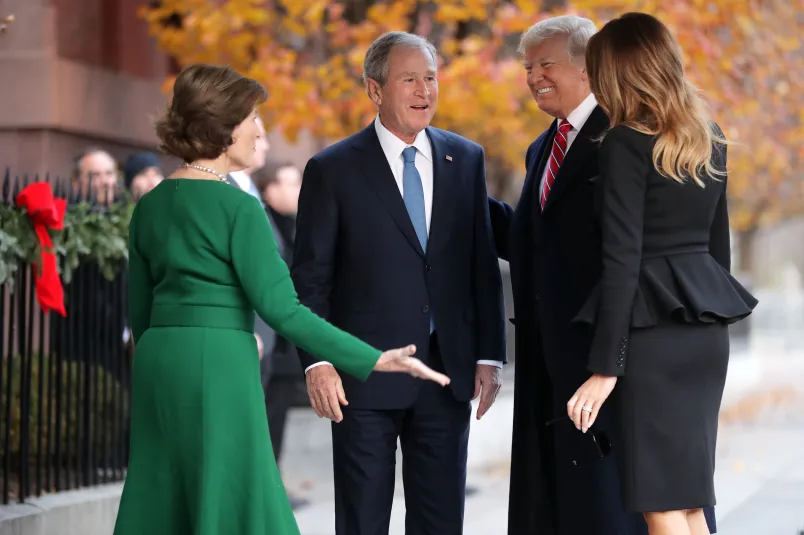
The problem, of course, is that voters can still choose Trump and it is certainly conceivable that he could win the election. The challenge for those of us who don’t want to see someone with a rap sheet take the highest office in the nation is how to prevent this from happening. It’s time to think creatively and make clear this is a matter that transcends ordinary partisan divisions. One way to drive this point home would be for prominent Republicans and conservatives — George W. Bush, Liz Cheney, John Kelly, and others — to publicly endorse President Biden while explaining that we cannot elect a convicted felon as president.
Former Congresswoman Cheney has made clear that she fully understands why Trump is a clear and present danger to democracy. John Kelly, who served as Chief of Staff during the Trump administration, has similarly warned about the threat Trump poses. Former President Bush has been quieter, but there is some indication that he recognizes Trump is not fit to serve. However, none of these well known Republicans has actually endorsed Biden. They all can and should. Other Trump critics — including officials who served in the Trump administration, witnessing firsthand his dangerous unfitness for office — should also endorse Biden. So far, former Georgia Lt. Governor Geoff Duncan is among the only high-profile Republicans to have publicly declared his support for Biden. Many more should follow his lead.
There is no guarantee that any of this would help keep Trump out of the White House, but it’s well worth trying. If prominent Republicans and conservatives endorse Biden, it will be harder for Trump — as well as media commentators — to paint Biden as an extremist, or as equally prone to abusing the rule of law as Trump. Biden would be presented as a reasonable, trusted choice — someone voters can confidently vote for in place of a convicted felon. In ordinary times, it wouldn’t be necessary to make this clear. But in today’s United States, where the Republican party has become a cult of personality built around one man, it is essential for sane Republicans and conservatives to speak up and do all they can to make sure a convicted felon does not occupy the same office once held by Washington, Lincoln, and Roosevelt.
When I was mulling the WaPo news last night, I noticed a link to an article in the Journal on President Biden’s purported cognitive decline. I glanced at it with a mix of emotions and in a moment I had a flash of clarity about the larger question of newspapers, Britishization and oligarchdom. I realized that in spite of myself I’ve stuck with an unmerited inertia to the idea that the Journal still maintains a high firewall between its news and editorial pages, even though I know, partly from inside accounts, how radically that changed after Murdoch purchased the Journal going on 20 years ago.
Continue reading “Breaking from the Journal: Kev McCarthy and Mike Johnson Say Biden’s WAY Old”A number of you have asked me to share my thoughts on abrupt shake-up at The Washington Post in which Executive Editor Sally Buzbee was abruptly forced out by turnaround CEO Will Lewis. I don’t know enough about the situation at the Post to add more than you’re hearing from other commentary. There are a lot of things that look bad and I’m fairly confident they are bad. But I don’t know the backstory or details well enough to do more than repeat widely shared impressions. But I have a few ancillary observations.
The first is a simple pattern, not terribly surprising, but still worth absorbing. We’ve seen a series of billionaires get into the news business by purchasing for-profit news entities with what seems like the implicit promise that their vast resources will allow them to focus on journalistic excellence even if that means running losses which the new owner can cover without much difficulty. This seemed like the Bezos concept. He bought the Post when it was seriously on the ropes and when its longtime family owners (the Graham family) simply didn’t have the resources to get the paper back to profitability or to secure its place as one of the 3-to-4 national U.S. newspapers.
Continue reading “The WaPo Blow-Up And the Ongoing Riddle of Newspaper Decline”A lot of things happened. Here are some of the things. This is TPM’s Morning Memo. Sign up for the email version.
We have a trio of stories this morning from mainstream news outlets warning of Donald Trump weaponizing the justice system in a second term to go after his perceived political enemies.
The promised retribution of a Trump II reign of revenge is so open, obvious, and direct that you begin to wonder who still needs to heed the warnings.
Is it low-info swing voters who missed the weaponization of the Trump DOJ the first time, haven’t paid attention to the new warnings yet, and are unlikely to see future ones?
Is it mainstream media editors and reporters who also missed the politicization of the DOJ in Trump I and keep falling into the same old lazy campaign and election coverage?
Is it that unicorn, the movable Trump voter who might be finally persuaded that things have gone too far?
Maybe at the margins the drumbeat of warnings will nudge elected officials, lawyers and judges, editors and reporters, bureaucrats and other gatekeepers toward greater vigilance and prepare them for the break-the-glass moments that may lie ahead.
Or are the warnings really just a way of acknowledging amongst ourselves that the threat is quite real, a way of keeping our sanity while Republicans lose theirs? I suspect there’s real and ongoing value in confirming for each other that we’re seeing the same thing, interpreting it the same way, and continuing to prepare for what a Trump victory would bring.
On the downside, the warnings themselves contain and reiterate the underlying threat, they rally and inspire the MAGA urge to intimidate and cause pain, and they give Trump and all the would-be Trumps a chance to preen. It’s not a sufficient downside to dispense with the warnings altogether, but it needs to be factored into the cost-benefit analysis.
The latest batch of stories are not perfect (lacking enough self-awareness to escape the grip of the horserace coverage paradigm), but taken together they are a remarkable portrait of where things stand a week after Trump was convicted and five months before the election is concluded:
The WSJ is leading today with a story titled “Behind Closed Doors, Biden Shows Signs of Slipping” that cites as leading evidence accounts of meetings with the president from notoriously reliable House Republicans Kevin McCarthy (CA) and Mike Johnson (LA).
A former colleague and I were lamenting the other day that Trump’s cooptation of Russia’s illegal detention of WSJ reporter Evan Gershkovich for his own electoral ends is a travesty that in another era would be the lead story for weeks and cripple any major party candidate. Instead, it was mostly crickets, and Trump has now re-upped his craven plea to vote for him because Putin will do him – and no one else – the favor of releasing Gershkovich:
TPM’s Josh Kovensky was, I believe, the first to obtain the charging documents filed yesterday in the Wisconsin fake electors probe, where Attorney Ken Chesebro, former state judge Jim Troupis, and GOP operative Mike Roman were each charged with one count of entering into a conspiracy to commit forgery.
TPM’s Emine Yücel: Uptick In Far-Right Ideology In Congress Contributed To Record Number Of Anti-Gov’t Extremist Groups In 2023
President Biden announced harsh new restrictions on asylum seekers.
On a day Hunter Biden’s wife was overheard at the courthouse calling a Trump ally a “Nazi piece of shit,” prosecutors began laying out their gun case against him.
WaPo: “Far-right conservatives are sowing misinformation that inaccurately characterizes IUDs, emergency contraception, even birth-control pills as causing abortions.”
Schiff: "That's the problem of all my Republican colleagues right now — they're about to nominate a convicted felon. And they don't know how to cope with that. They don't know how to cope with a justice system that in fact treats Donald Trump the same it would any other citizen" pic.twitter.com/ritb4VT0n4
— Aaron Rupar (@atrupar) June 4, 2024
I have to say I am pleased and a bit surprised to see the flag in this committee is still flying right side up …
Rep. Adam Schiff (D-CA), during Attorney General Merrick Garland’s testimony to the House Judiciary Committee
Do you like Morning Memo? Let us know!
Fox News Digital was first to report on yet another effort by House Speaker Mike Johnson (R-LA) to use his gavel to show Donald Trump that House Republicans are fighting his battles — regardless of whether or not Johnson’s razor-thin House majority is able to actually fight those battles.
Continue reading “Mike Johnson Again Offers Up The House As Trump’s Mouthpiece”Last year, there were more hate and anti-government extremist groups in the United States than ever before, according to Southern Poverty Law Center’s new report, “The Year In Hate and Extremism 2023.”
In 2023, SPLC documented a total of 1,430 hate and anti-government extremist groups in the U.S., according to the report. 835 of these were anti-government groups. That’s an increase of 133 or 19% from 2022.
The record numbers of active hate and extremist groups is undoubtedly associated with the rise and popularity of hard-right ideologies, the report’s authors said.
Continue reading “Uptick In Far-Right Ideology In Congress Contributed To Record Number Of Anti-Gov’t Extremist Groups In 2023”