

I wanted to flag to your attention another data point that suggests that reader of ours was on to something when he posited that Tom Crooks, 20 year old who tried to shoot Donald Trump, was more in the line of school shooters and mass shooters than political assassins as we’ve conventionally understood them. CNN now reports that Crooks had been googling information about Ethan Crumbley, a 2021 school shooter, who’s parents were later prosecuted over his murders. Indeed, the FBI seems to be quite literally moving toward this theory of Tom Crooks’ murders.
Continue reading “Mass Shooter/School Shooter Theory Gets Some New Proponents”Marianne Williamson Is Making A Play For Joe Biden’s DNC Delegates
Marianne Williamson wants to step into the void. With the future of President Joe Biden’s reelection campaign in doubt, Williamson’s emissaries have been reaching out to Democratic National Convention delegates to convince them to pull support from Biden and Vice President Kamala Harris.
Continue reading “Marianne Williamson Is Making A Play For Joe Biden’s DNC Delegates”Let’s Keep It Going
We’re now in our third day of this year’s TPM Journalism Fund drive. We hit our goal for yesterday which was to reach $150k. (I was a bit surprised and very relieved.) We have a much more modest one for today which to hit $175k by the end of today. We’re currently at $161k. These goals aren’t arbitrary. We’ve learned over the years where we have to get each day to hit our goal. Anyway, this annual drive is always really important to TPM’s vitality and future. So please consider making a contribution if you haven’t already. Just click right here. If you’re flush like so many others in the Biden economy make it big. But if not even a buck or two pushes us in the right direction. Please accept our appreciation in advance and thank you for being readers, members and contributors.
A Stretch Of Italian Beach Looks Like The Caribbean Thanks To Pollution
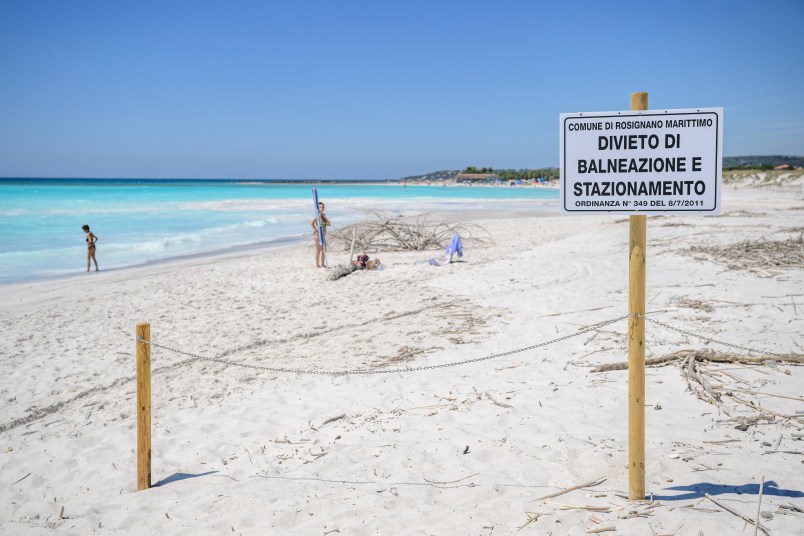
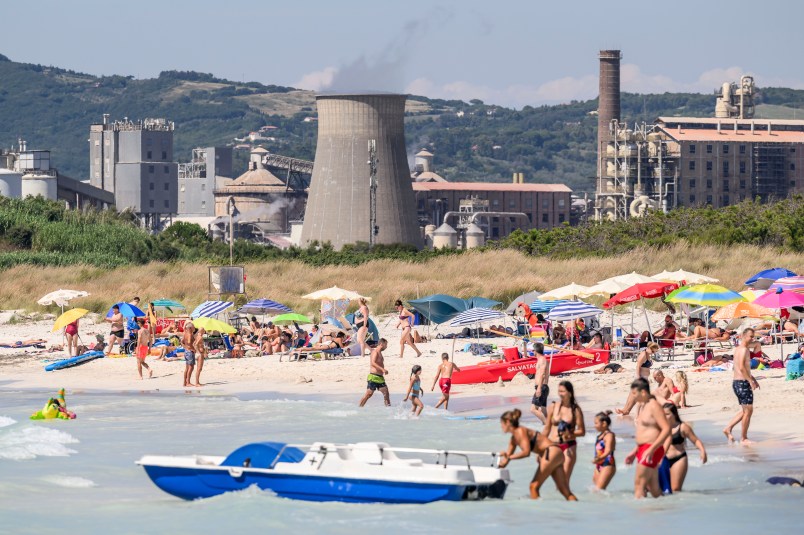
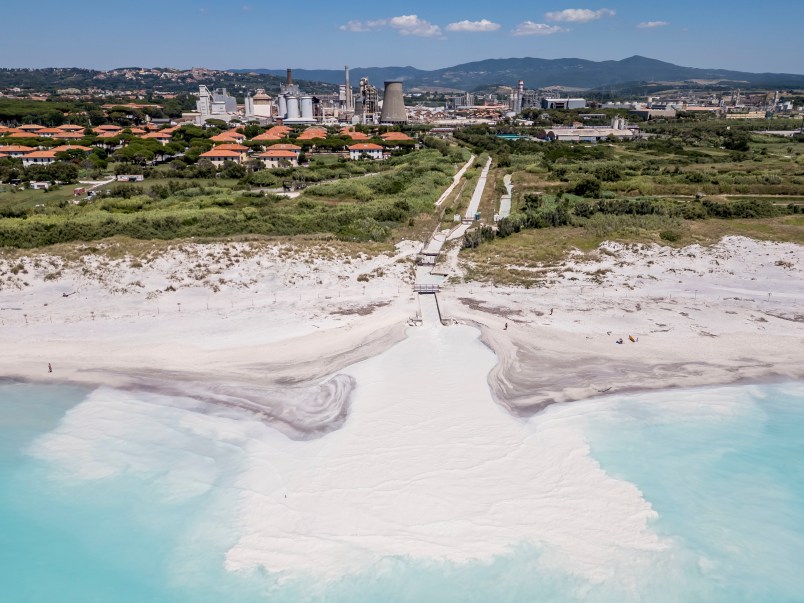
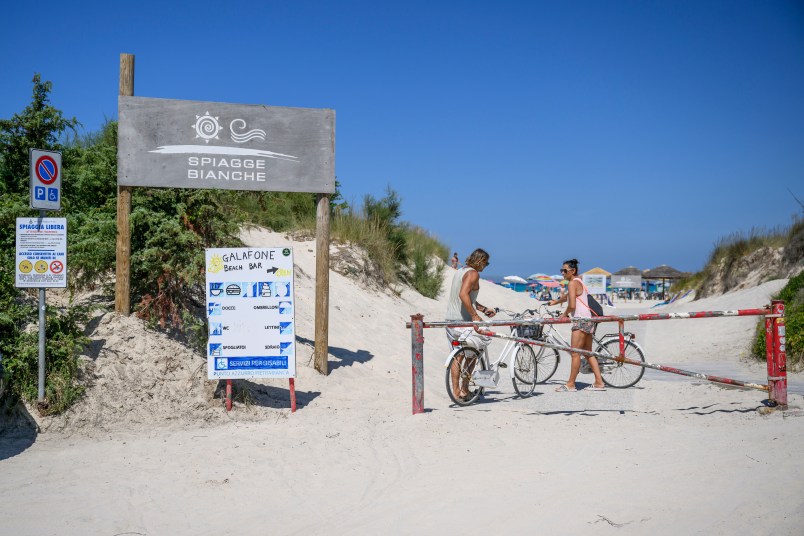
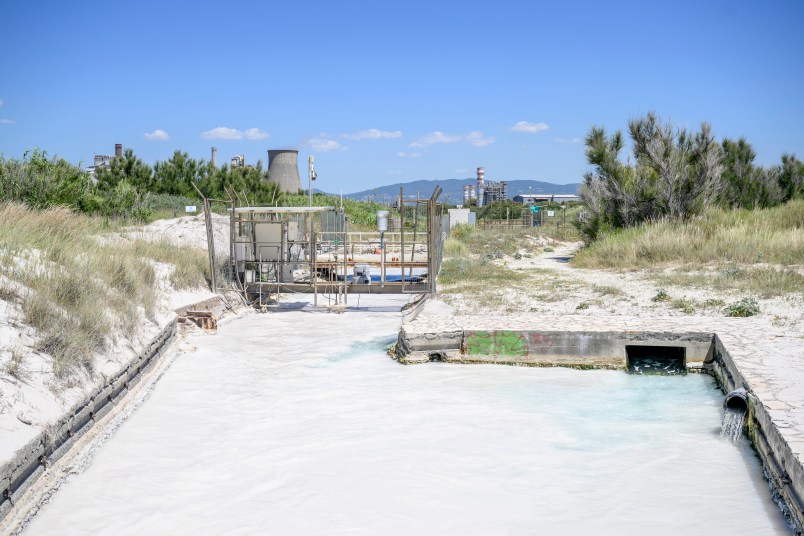
Most Italian beaches have the quintessential look of the Mediterranean: dark water and rocky beaches. However, there is a stretch of beach on the western coast of Italy, known as Spiagge Bianche (White Beaches), that looks bizarrely similar to the Caribbean, with white sand and light blue waters. Unfortunately, this seemingly beautiful beach is not a natural phenomenon. It is the result of a nearby chemical plant discharging thousands of tons of toxic wastewater every year into the Mediterranean Sea.
Belgian chemical industry Solvay has managed the site for over a century and although the dumping is legal and monitored, this activity still has considerable environmental and health implications. For this reason, you likely will not find these white beaches on any Italian tourist guides.
A sign warning ‘no bathing’ at Spiagge Bianche in front of the Solvay plant
People enjoy the beach with the Solvay soda ash plant in the distance
Tourists at Spiagge Bianche

A drainage canal carries industrial waste into the sea

The drainage canal coming from the Solvay soda ash plant
One of the entrances to Spiagge Bianche
Sunbathers set up on Spiagge Bianche in front of the industrial plant
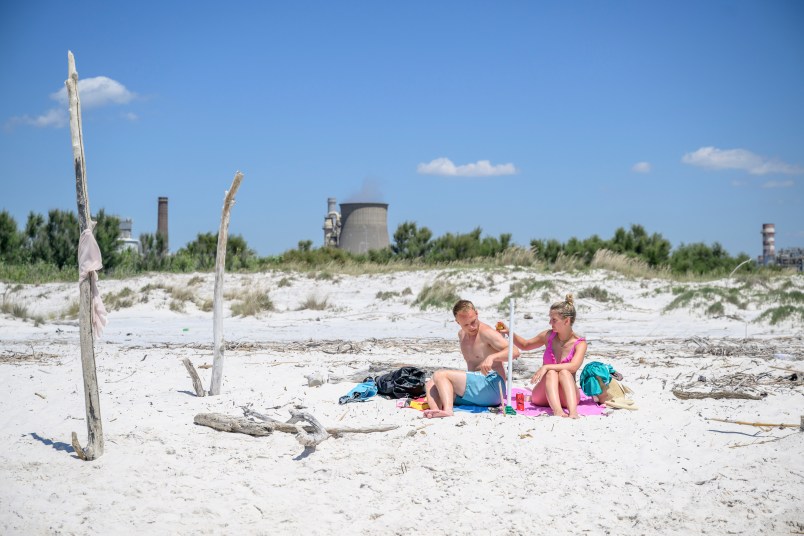
A stretch of artifically white, sandy beach in Rosignano Marittimo, Italy

The drainage canal with a smoke stack from the Solvay plant in the background
A close up of the ‘white sand’
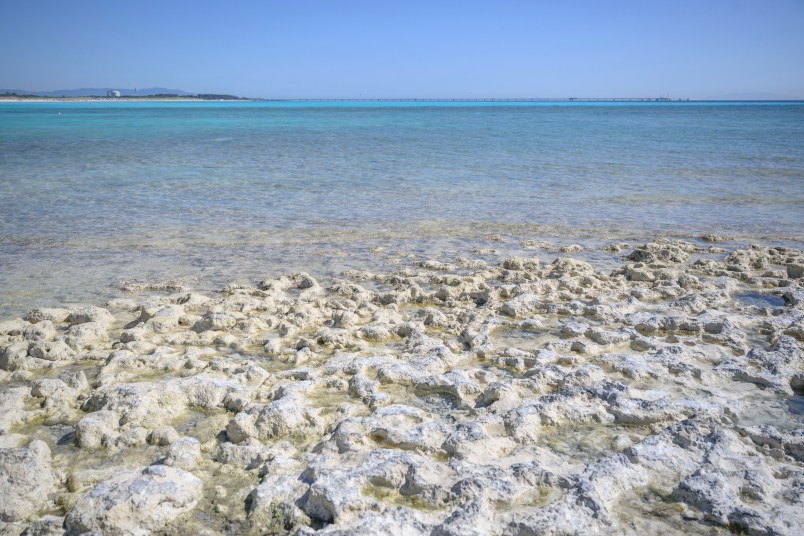
The water gets darker and the beaches less white as you look beyond Spiagge Bianche

Despite its dubious source, tourists come to Spiagge Bianche for a beach day

One Other Detail
Here’s a small update on the lack of any word from federal law enforcement or hospital officials on the what and how of the injury Donald Trump suffered last Saturday in western Pennsylvania when a 20-year-old gunman tried to shoot him. As I’ve noted, Pennsylvania State Police initially told reporters on the scene that Trump had been struck by shards of glass. Then Trump himself said he’d been hit with a bullet and that was the end of the matter. There’s small detail from a local news report from last Sunday that suggests it as at least plausible that the initial report was correct, that Trump was struck by some flying debris.
A report from local TV station WPXI at 4:50 PM Sunday said this (emphasis added) …
Continue reading “One Other Detail”The GOP As We Knew It Is Long Gone And May Never Return
A lot of things happened. Here are some of the things. This is TPM’s Morning Memo. Sign up for the email version.
A Historic Third Time
Last night, Donald Trump (2016, 2020, 2024) joined Richard Nixon (1960, 1968, 1972) as the only three-time presidential nominees in the history of the Republican Party. Once they find a good one, they sure can’t let go.
TPM’s Josh Kovensky watched last night’s TV spectacle so you didn’t have to:
- If you can’t take much of the melding of low culture and authoritarianism, here are his five takeaways.
- If you’re a glutton for punishment, you have the option of scrolling through his full Hulk Hogan-saturated live blog of the evening’s proceedings. Stay strong.
Credit where due: Much of the political reporting this week has acknowledged and engaged with the fact that the Republican Party is now fully captive to Donald Trump and his cult of personality to a degree it wasn’t in his two prior runs for the White House. That’s an important baseline from which to cover the rest of this campaign and a possible Trump II presidency.
What is perhaps less obvious (and I’ll admit is speculative) is that the chances of the Republican Party emerging intact after the Trump era have markedly declined. The hope that eventually Republicans of good faith who have battled Trumpism – people like Mitt Romney and Liz Cheney – would rise to the top again seems more far-fetched than ever. Likewise, the effort to create some sort of permission structure for conservatives to abandon Trump seems like a ship that has sailed.
It’s not just that the Republican Party will emerge from the Trump era with a brand so badly damaged that it will need to be scrapped, it’s that there is likely to be little left of it that is recognizable as a political party in a democratic and pluralistic society. Having become so cultish and thoroughly authoritarian, there won’t be the pieces to pick up again to reform it and restore it as a pro-democracy party. Trump has wrecked it. But as with so many Trump projects, the bright lights and gold leaf draw the eye away from the structural rot.
The GOP’s Rejection Of Democracy Requires A Strongman
Heather Cox Richardson on the GOP convention and the rot on full display: “Paul Manafort walking onto the floor of the Republican National Convention yesterday illustrated that the Republican Party under Trump has become thoroughly corrupted into an authoritarian party aligned with foreign dictators.”
Messiah Complex
Sarah Posner, TPM’s go-to expert on the Christian Right, catalogues the renewed effort since Saturday’s shooting to cast Donald Trump as beneficiary of divine providence and explains how that fits into the Christian nationalism suffusing the far right.
Eating Their Own
TPM’s Nicole Lafond: Usual Cast Of Far-Right Extremists Goes Into Racist Tailspin Over JD Vance’s Wife
Quote Of The Day
It’s not over on election day. It’s over on inauguration day.
Trump campaign senior advisor Chris LaCivita, portending a 2020 redux if Trump loses the election
GOP Still Thinks Registering New Voters Is Bad
TPM’s Khaya Himmelman: The RNC Is Suing Gretchen Whitmer To Make The Swing State’s Election System Seem Sketch
Biden’s Support Among Dem Electeds Further Erodes
No dramatic movement on the Biden front in the past 24 hours, but what movement there has been was all in the direction of trying to push the president out as the Democratic Party nominee:
- Sen. Jon Tester (D-MT), whose tough reelection campaign is among those most critical for Democratic hopes of holding their Senate majority, publicly called for President Biden to drop his own re-election bid.
- Rep. Jamie Raskin (D-MD) sent President Biden a letter earlier this month and newly obtained by the NYT urging him to withdraw his candidacy.
- Former Speaker Nancy Pelosi (D-CA) continues to keep the pressure on Biden mostly behind the scenes, telling “California Democrats and some members of House leadership that she thinks Biden is getting close to deciding to abandon his presidential bid,” the WaPo reports.
- Former President Obama does not appear to be trying to bail Biden out, but rather is expressing his own concerns privately and serving as a sounding board, according to the WaPo.
UPDATE: Trump Assassination Attempt Aftermath
- The Secret Service is encountering criticism from close-protection experts on how long it took for agents to get Donald Trump off the rally stage after shots were fired by a would-be assassin.
- Top Hill Republicans are demanding the resignation of Secret Service Director Kim Cheatle.
- ABC News tracks what Thomas Matthew Crooks was doing in the hours leading up to the shooting.
You’re Not Gonna Like This
Former TPMer Tierney Sneed talks to legal experts about the difficulties that Special Counsel Jack Smith will encounter in trying to remove U.S. District Judge Aileen Cannon from the Mar-a-Lago case, even at this late juncture with so many anomalous rulings, delays, and her preferential treatment of Trump.
Oh, Rudy
Rudy Giuliani is pushing the judge handling his bankruptcy case to the breaking point.
Totally On The Up And Up
Bloomberg: “The US Securities and Exchange Commission sued Patrick Orlando, the former chief executive of the blank-check firm that helped bring Donald Trump’s social media company public, for allegedly misleading investors about his firm’s plans for a merger.”
Global IT Outage
Massive worldwide disruption after a CrowdStrike software update apparently crippled many devices running Microsoft Windows.
Bob Newhart, 1929-2024
Bob Newhart was such a boss that not only did he have two long-running sitcoms – one in the 1970s and one in the 1980s— but when the one in the 1980s ended he styled the final episode as if the entire run of the second show had just been a crazy dream of his character in the first show. How boss a move is that?!?
To this day, Newhart is the only comedian to win Grammy Awards for best new artist and album of the year.
Do you like Morning Memo? Let us know!
Even When Big Cases Intersect With Their Families’ Interests, Many Judges Choose Not to Recuse
This article first appeared at ProPublica. ProPublica is a Pulitzer Prize-winning investigative newsroom. Sign up for The Big Story newsletter to receive stories like this one in your inbox.
Soon after longtime New Orleans attorney Wendy Vitter became a federal judge in the Eastern District of Louisiana, she heard a lawsuit against the local government in Plaquemines Parish, a peninsular province encompassing the final 70 miles of the Mississippi River, between New Orleans and the Gulf of Mexico.
A group of paramedics had sued the parish, seeking compensation for unpaid overtime. Vitter oversaw a pair of jury trials in 2019 and 2021, both resulting in wins for the parish. But an appeals court later ruled Vitter had erred in judgment and overturned her final order. That paved the way for the paramedics to be awarded more than $500,000 in compensation, plus hundreds of thousands more for their attorneys.
Throughout those proceedings, Plaquemines Parish leaders had a paid ally on their side: the judge’s husband, U.S. Sen.-turned-lobbyist David Vitter.
But there was no way for the parties in the case to easily know this. Wendy Vitter never told the EMTs’ attorneys. And they couldn’t have looked it up in any court records. While the law requires federal judges to report their spouses’ income on annual financial disclosures, Vitter listed her husband as a “self employed attorney” with the name of the payroll company, TriNet HR III, that cut his checks. In fact, he is a partner and lobbyist for powerhouse Washington firm Mercury Public Affairs.
ProPublica didn’t uncover evidence that David Vitter’s business relationships played a role in his wife’s rulings. But the American Bar Association recommends judges disclose such relationships to let the parties decide for themselves if they are significant enough to contest. Since it’s not required by federal code, however, judges seldom do it, ethics experts say.
In the Plaquemines case, Wendy Vitter should have voluntarily told paramedics’ attorneys about the potential conflict, five legal ethics experts told ProPublica. That would have allowed them to consider making motions for disqualification if she did not recuse herself.
Vitter wrote in a statement to ProPublica that she relied on guidance from the Judicial Conference Committee on Codes of Conduct that says recusal may not be necessary if a spouse’s client is not a direct party to the case.
Vitter said her husband was not working for the parish at the time of the trials. Public records show his contract with the parish expired in late 2018. But federal disclosures show he continued to work into 2024 for the Plaquemines Port, a political agency that is controlled by the parish’s nine council members and has identical borders to Plaquemines Parish.
David Vitter did not respond to ProPublica’s requests for comment but told news partners at ABC News he had “absolutely nothing to do with the lawsuit” before his wife and that the Plaquemines Port “is a different entity with a different governance structure than Plaquemines Parish.”
Wendy Vitter told ProPublica her husband’s income was “properly disclosed” on her financial reports, but she will start including details of his lobbying work in her disclosures moving forward.
Concerns that judges on the nation’s highest courts have not properly disclosed personal conflicts — and have failed to recuse when such issues arose — have been at the center of a recent national debate. Supreme Court Justices Clarence Thomas and Samuel Alito have faced calls to recuse themselves from cases due to their wives’ political activities. Chief Justice John Roberts’ wife has a high-powered job as a headhunter for law firms with Supreme Court practices.
Last year, ProPublica exposed how Thomas and Alito took trips funded by billionaires but failed to properly disclose them. In 2021, The Wall Street Journal found at least 131 judges broke the law by hearing cases in which they had a financial interest. And in 2020, Reuters identified thousands of judges who broke the law but remained on the bench.
A ProPublica analysis found a lack of transparency regarding conflicts plagues federal and state courts where loose rules, inconsistent enforcement and creative interpretations of guidelines routinely allow judges to withhold potential conflicts from the parties before them.
In an examination of more than 1,200 federal judges and state supreme court justices, ProPublica, in partnership with student journalists at Boston University, found dozens of judges, including both Republican and Democratic appointees, who chose not to recuse when facing potential appearances of impropriety involving familial financial connections. Ethics experts say that the judges’ interpretation of the rules may often lie within the letter of the law, but at the expense of its spirit.
In Florida, a state Supreme Court justice presided over a gambling case in which a Native American tribe sought to protect billions in betting revenue. During the proceedings, the tribe made an unusually large campaign contribution to the justice’s wife, a state legislator. The judge later helped form a court majority that struck down the constitutional challenge, protecting the tribe’s business.
In Minnesota, a federal judge heard an antitrust case against a corporation that was a major client of the public relations firm owned by his wife. He went on to dismiss the case, in the corporation’s favor.
And in both Ohio and North Carolina, state supreme court justices rejected calls from ethics watchdogs to recuse themselves from multiple cases involving a parent who is a powerful state politician.
Amid cratering confidence in the impartiality of both the federal and state judicial systems, experts worry that such failures to police conflicts of interest only further erode public confidence.
“We ignore it at our own peril,” said Robert Westley, professor of legal ethics and professional responsibility at Tulane University. “I really believe the entire system is at stake if we don’t get this right.”
The Duty to Disclose
Federal law requires judges to recuse themselves from any case in which a close relative has an interest in the result, or when the judge’s “impartiality might reasonably be questioned.”
While some judges go to great lengths to disclose potential conflicts and recuse scrupulously from those cases, the guidelines are ambiguous and the adherence is haphazard, according to experts.
In most cases, judges oversee their own decisions to recuse, raising concerns about the lack of checks and balances on judges’ judgment. The challenges posed by familial conflicts could be mitigated with more judicial transparency, experts say.
The American Bar Association guides judges to disclose any information potentially relevant to attorneys who might consider a motion for disqualification. But the guidance has not been codified by all states — or the federal judiciary. Without it, judges are under no obligation to inform a party appearing before them when a judge’s family member may be working on behalf of the party’s opposition.
Federal laws do require judges to report their spouses’ assets and income each year, but they generally don’t require judges to disclose their spouses’ clients. Calls from watchdogs in 2022 to close the client loophole failed to get traction in Congress.Making matters worse, U.S. courts have failed to comply with federal law in promptly posting disclosures online.
More than a dozen states don’t require judges to post any details at all about their family members’ income, and a majority of states don’t make disclosures easily available online, according to Fix the Court, a nonprofit advocating for more transparency and accountability in U.S. courts.
“People are as honest as their circumstances permit,” Westley said. “When circumstances allow them to be dishonest without being discovered, many people will choose to do that.
“The system is not working. But I think it can work when there is oversight.”
The Conundrum of Successful Couples
Familial conflict-of-interest decisions get more complicated when the spouse of a judge is a high-ranking state official, as is the case with Florida Supreme Court Justice Charles Canady and his wife, Republican state Rep. Jennifer Canady. Charles Canady was appointed to the state’s top court in 2008 by former Republican Gov. Charlie Crist; Jennifer Canady won her first legislative race in 2022.
In December, Charles Canady’s court received a legal brief from the Seminole Tribe of Florida, asking the seven-member body to reject a constitutional challenge to its exclusive sports betting deal with the state, worth billions. The tribe was not a party to the case but stood to benefit.
Five days later, the tribe then cut a $10,000 campaign check to Jennifer Canady’s political action committee. Of the more than 100 donations the Seminoles made to Florida legislators in 2023, a handful matched the size of but none were larger than Canady’s.
Charles Canady did not publicly disclose his wife’s connection to the tribe, and in early 2024, he voted to uphold the Seminoles’ deal.
“It’s a huge concern,” said Bob Jarvis, professor of law at Nova Southeastern University in Fort Lauderdale. “It’s the same social circles, particularly if you’re talking about a town like Tallahassee. It’s a very small town — everyone knows everyone else.”
Florida’s Supreme Court — unlike the federal judiciary — has adopted the ABA’s guidance regarding possible conflicts, requiring justices to disclose information that “the parties or their lawyers might consider relevant to the question of disqualification, even if the judge believes there is no real basis for disqualification.”
While the Seminole connection went unreported, Charles Canady faced a barrage of public calls for recusal last winter when another case closely connected to his wife reached Florida’s Supreme Court: a constitutional challenge to the state’s new law banning abortions after six weeks.
His wife was one of two co-sponsors of the controversial bill.
Charles Canady elected to stay on the case, making no public comments about his wife’s connection to it, and then helped the court form a majority in April that ruled his wife’s legislation constitutional. The law went into effect May 1.
“Justice Canady owes it to the public to be more transparent and more deferential to perception of bias,” Jarvis said.
Anthony Alfieri, professor of law and director of the University of Miami Center for Ethics and Public Service, said the justice “should err on the side of disqualification, whether or not there is a real basis for disqualification.”
ProPublica found no evidence the Seminole donation played a role in Charles Canady’s ruling. The justice declined multiple requests for comment. Representatives for Jennifer Canady did not respond to requests for comment, either, but the lawmaker — prior to winning office — told the News Service of Florida in 2021 that “around the dinner table, if something comes up about a pending or impending case, we don’t discuss it ever.”
A spokesperson for the Florida Supreme Court said “considerations of recusal are complex and nuanced — each justice gives careful deliberation to their responsibilities” in accordance with Florida Supreme Court rules and the Code of Judicial Conduct.
When asked for a list of cases Charles Canady has recused on, the spokesperson said no such list was available.
In a written statement, the Seminole Tribe of Florida said it “supports numerous candidates with diverse perspectives. It is also involved in multiple legal cases at various levels. Any connection here is purely coincidental.”
Experts caution the perception of bias is likely to be a recurring problem in Florida, with Jennifer Canady now in line to become House speaker in 2028. That would provide her a large role in crafting every major piece of legislation passing through the Florida House from now through the end of the decade — including controversial laws that will ultimately end up in her husband’s court.
She’s also expected to solicit sizable campaign contributions from the state’s largest corporations, some of which might have cases before the highest court in the state.
Charles Canady was among the dozens of federal and state supreme court judges ProPublica identified who were married to politicians, creating new challenges the country’s generations-old ethics rules haven’t yet caught up with.
“Decades ago, it wasn’t a problem because women didn’t work,” Jarvis said.
He added that “it comes down to the good faith of the couple” to “be aware, disclose and possibly recuse from cases.” The politicians could reject or return campaign checks from companies with business before the court.
“Grading Their Own Homework”
Senior Judge John Tunheim, serving the federal district of Minnesota, did not disclose when one of his wife’s biggest clients appeared on his docket in 2019.
Kathy Tunheim is the co-founder and CEO of a large Twin Cities public relations firm, Tunheim, which performed public relations work for the Cargill corporation for several years. During this time, a group of cattle ranchers brought a federal antitrust case against Cargill and other meat producers, alleging a scheme to fix beef prices.
The case was assigned to John Tunheim, who did not recuse.
His annual financial disclosures, obtained through the Free Law Project archive, also did not disclose his wife’s role as CEO of the Tunheim firm, instead describing her since 2006 as a “self-employed public relations consultant.” It’s a distinction the judge said was prescribed by the U.S. Courts’ Committee on Financial Disclosure, which says “self employed” is sufficient if the spouse’s income is from “a partnership of which the spouse is a member.” Experts say Tunheim’s interpretation of disclosure rules makes identifying possible conflicts challenging.
The judge threw out the cattle ranchers’ claims several times over the course of the litigation, which has continued into 2024. One former attorney on the case said a disclosure from Tunheim about his wife’s Cargill connection might not have resulted in a request for recusal, but it would have been welcomed, since attorneys cannot weigh those decisions without the information.
Tunheim also heard two Cargill cases in 2018.
Appointed to the federal bench by then-President Bill Clinton in 1995, Tunheim told ProPublica he considered recusing in Cargill cases but concluded it was not necessary based on the same 2009 advisory opinion cited by Wendy Vitter.
“I did a thorough evaluation of all the facts and applied the guidance from the Committee on Codes of Conduct in the advisory opinion concerning the business relationships of a judge’s spouse,” Tunheim said in an email statement.
The advisory opinion guides judges to consider factors such as the closeness of the spouse-client relationship and how involved the spouse is in the client work.
The Tunheim agency publicly touted its Cargill relationship for years and boasts online about Kathy Tunheim’s “active role in many of the agency’s client relationships.”
Kathy Tunheim declined to comment, but her firm scrubbed most references to Cargill from its website soon after ProPublica reached out.
The advisory opinion Vitter and Tunheim cited instructs judges to recuse themselves from any case in which an objective observer might reasonably question their impartiality. But in almost every example examined, the objective observer test was performed by that same judge.
Charles Gardner Geyh, distinguished professor of law at Indiana University, said federal law grants judges a “presumption of impartiality.” But even with case law suggesting judges should err “in favor of recusal,” some still cite conflicting case law to justify a decision to stay on a case.
Experts explain that some judges don’t care for the stigma that comes from a recusal. Judges can also fail to perceive either that they are biased or that they appear biased.
For as little oversight as there is regarding potential conflicts of interest on the federal bench, there’s even less for state supreme courts. Since they are the court of last resort at the state level, there’s no opportunity to review the recusal decisions of most states’ justices, short of the U.S. Supreme Court. But it almost never hears those cases.
Geyh said the lack of oversight compounds the “self-policing” problem since lawyers are typically wary of antagonizing judges by challenging their potential biases. When they do, he said appellate courts often defer back to the judges’ decision anyway.
Without the threat of discipline, Geyh said the “buck stops with the judge.”
“If you put those people in the position of grading their own homework — ruling on their own biases — then you have a problem.”
The Parent Trap
It’s not just spousal conflicts. In at least two states, the sons of powerful state politicians sit on the supreme court. In both cases, they’ve refused to recuse on consequential cases involving their parents.
In North Carolina, Supreme Court Justice Phil Berger Jr. has repeatedly heard cases in which his father, Senate President Pro Tem Phil Berger Sr., not only publicly lobbied for a specific result but also was a named party in the case.
The justice repeatedly sided with his father’s interests, including cases in which Phil Berger Sr. was a named defendant: a challenge to the constitutionality of a partisan redistricting plan and a challenge to a voter ID law spearheaded by Phil Berger Sr.
The justice had recused himself from the voter ID case while serving on the Court of Appeals but said he did not need to as Supreme Court justice because his father was a defendant only in his “official capacity.”
Watchdogs also criticized Ohio Supreme Court Justice Pat DeWine for what they say were hypocritical promises in 2018 to recuse from cases in which his father, Mike DeWine — then the state’s attorney general and now its governor — was “personally involved.”
But the younger DeWine chose to hear several high-profile cases in which his father was active in the litigation, including a series of impactful redistricting cases in which Pat DeWine helped cast a swing vote in a 4-3 decision that dismissed challenges to the controversial maps drawn by a Republican-led committee. Mike DeWine sat on that committee and publicly advocated for the constitutionality of its work.
Geyh, who filed an amicus brief in one of the Berger cases, said ethics laws are “pretty bloody explicit” when it comes to recusing from a case in which a parent is a named party.
Neither justice returned requests for comment.
The Fix Is Really Hard
Amid calls to bring conflict-of-interest laws into the 21st century, a bevy of Band-Aids have been proposed, but no comprehensive solutions.
Experts hesitate at the suggestion of tougher recusal rules, fearing mass disqualification could shut down the judiciary. Most also reject the idea of limiting judicial spouses’ careers or speech.
“As soon as you reform the system, you’re penalizing one spouse,” Jarvis said.
The Brennan Center for Justice at NYU School of Law proposed a series of reforms in 2016, including independent review of all motions for disqualification — at both the U.S. and state supreme courts — so judges don’t effectively serve as the final arbiters of their own biases. Brennan also advocated ending the common practice of judges keeping their reasons for recusal — or non-recusal — secret, which can stymie the appeals process and create a void in case law.
Critics have argued the reforms could slow the wheels of justice and allow political actors to weaponize recusal. Many advocates for reform see transparency measures as an achievable next step.
“The fix is really hard,” said Amanda Frost, professor of law at the University of Virginia. But “transparency would improve the process for everyone.”
To produce this story, ProPublica partnered with the Justice Media Computational Journalism co-Lab, a collaboration between Boston University’s College of Communication and the Faculty of Computing & Data Sciences’ BU Spark! program. Contributing students included Emilia Wisniewski, Serena Ata, Amisha Kumar and Amanda Bang.
Do you have any information regarding a state supreme court justice or federal judge failing to disclose a familial conflict of interest? Contact Noah Pransky confidentially via Signal at NoahPransky.55 or on any social media platform at @NoahPransky.
5 Takeaways From The Schtick-Filled, Very MAGA, Final Night Of The RNC
The final night of the Republican convention featured Trump’s first public speech since a gunman tried to assassinate him on Saturday, and saw extensive exaltation of the nominee from speakers who implied, and sometimes outright declared, that he was saved by, and chosen by, God himself.
Continue reading “5 Takeaways From The Schtick-Filled, Very MAGA, Final Night Of The RNC”Trump Addresses The RNC, With Pro-Wrestling Figures Amping Up The Crowd
In professional wrestling, there’s a concept called “kayfabe.” It’s what describes the staged fights and beefs between different performers. These staged fights are the lifeblood of the genre.
Continue reading “Trump Addresses The RNC, With Pro-Wrestling Figures Amping Up The Crowd”Usual Cast Of Far-Right Extremists Goes Into Racist Tailspin Over JD Vance’s Wife
While most Trump fans have spent the week fawning over Sen. JD Vance (R-OH) and his transformation from a never-Trump cable news star to a darling of the fever swamps, some denizens of the vilest corners of the right-wing internet have been criticizing the former president for his VP pick. Not because he isn’t anti-trans enough or anti-abortion enough, nor because he hasn’t done enough to display his undying fealty to Trump.
They don’t like his wife.
Continue reading “Usual Cast Of Far-Right Extremists Goes Into Racist Tailspin Over JD Vance’s Wife”