This article is part of TPM Cafe, TPM’s home for opinion and news analysis.
In the 24 hours after left-leaning incumbent Rep. Jamaal Bowman (D-NY) was defeated by the more centrist George Latimer, commentators rushed to interpret Bowman’s defeat as emblematic of some larger trend in the national mood, speculating about the vulnerability of other left-leaning House members, including those who make up the so-called Squad.
In a 6-3 decision, the Supreme Court on Friday ruled that forbidding people without housing from sleeping with a blanket outside — even when they have nowhere else to go — does not run afoul of the 8th Amendment’s prohibition of “cruel and unusual punishment.”
The Supreme Court on Friday narrowed an obstruction charge that had been used in the prosecution of hundreds of Jan. 6 insurrectionists — and in the pending case against Donald Trump — with an unusual configuration of justices.
Both Nancy Pelosi and Hakeem Jeffries discussed Biden’s performance last night and how he stacked up to Trump in a way I can only call fairly equivocal.
These are both quotes from impromptu conversations this morning posted by credentialed reporters on Twitter.
A special edition of Morning Memo focused exclusively on last night’s presidential debate. Sign up for the email version.
Say It Ain’t So, Joe
I loathe theater criticism-style debate coverage, but by any standard it was a disastrous performance by President Biden. But for all the mumbled answers, muffed one-liners, and inability to seize control of the tempo, volume, and direction of the debate, his physical presentation was more damaging than anything he said or failed to say.
All of the signs of aging were there: the stiff-legged gait, the blank stares into the middle distance, the frozen expression on his face, and the slow reaction times.
Biden’s right-wing foes have been spinning out cheap fakes for weeks, selectively editing videos to cast him in the most decrepit, senile light possible. Last night, Biden embodied those videos, breathing life into them in a way that confirmed the worst attacks of his detractors and left his supporters in something approaching shock.
A Strategic Blunder
What makes this probably the worst presidential debate performance ever wasn’t the presentation itself, it was that Biden sought this debate, forced it on Trump, agreed to its terms, and then fell on his face. It was a strategic move to try to change the course of the campaign, put to rest the concerns about his age and vitality, and put Trump — fresh off his criminal conviction — back on his heels. This is what it looks like to swing for the fences and miss. You can’t blame the man for being old, but you can blame him for failing to seize the opportunity that he went out of his way to create for himself.
Original caption: Photo shows Republican Vice-President, Richard Nixon Speaking during the Presidential debate with John Kennedy (Not shown). Nixon is shown in this close -up during their first meeting in the nationally televised series of “Great Debates.” (Getty Images)
You can carp about CNN’s debate moderators abdicating any fact-checking responsibilities. You can bemoan Trump’s fountain of lies or the difficulty of debating a narcissistic sociopath on live TV. But Biden asked for this. He agreed to the rules. He set the agenda. And none of what happened was unforeseeable. Not only was it predictable, it was in fact predicted.
Which Audience Are You Talking About?
I’ve already made my disdain for presidential debates known, and I won’t belabor the point here. Instead, let’s try to untangle some of the conflicting and contradictory analyses that bedevil not just the coverage of debates but how people absorb and react to them. The problem writ large overwhelmingly comes down to conflating which debate audience you’re taking about. Let’s hit the three biggies:
The Partisans
You don’t need to convince the candidate’s base of support of anything. They’ve already decided. But you want to energize them, give voice to their hopes and concerns, turn them into legions of folk using your language, spreading your message and reinforcing your campaign.
For their part, many partisans tend to observe debates and campaigns like sports fans, rooting for outcomes over which they have little or no control. I don’t recommend that approach for your mental health, but it also sucks up an enormous amount of human and emotional capital, like spending all day on the sofa watching sports on TV instead of getting out and exercising yourself. The partisan-as-sports-fan risks becoming more deeply invested in their preferred outcomes and the roller coaster of emotions along the way than in the underlying cause.
But of course the partisan audience also includes the campaign’s volunteers, donors, and the people who do the hard work on the ground, too. In short, you as the candidate want to lead them all in a highly demonstrable way.
Biden left his partisans dismayed at best; many descended into panic.
The Media
Most people, even partisans, don’t watch the debates, getting much of their information about what happened through media coverage and the general buzz associated with the event and the after-action analysis. So the campaign wants to exert as much influence as it can over the media coverage. That starts with pre-debate expectation-setting, extends through the candidate’s performance itself, and immediately shifts into spin and image-crafting after the candidate leaves the stage.
In an ideal world, you cement a conventional wisdom favorable to your candidate and maybe if you’re lucky elevate their performance into the zeitgeist. The worst case scenario is that a bad performance becomes part of the zeitgeist, which is what happened last night.
While the efforts to influence the media coverage are partly about influencing members of the media themselves, a huge part of the effort is intended to try to shape the coverage so that those who consume it get a particular version of events that is favorable from the campaign’s point of view. It’s a very difficult bank shot to pull off.
Complicating the effort further is the media’s own sense of itself. So much of what passes for political news — grading the candidates on how good they are at performing for the media, reporters on the campaign trail talking to “real” people, media-sponsored public opinion surveys and the thousands of polling stories they generate — is the media positioning itself as gatekeeper between candidate and public. The media has its own notion of what “real” voters, “common folk,” and the people out there in the “heartland” are all about it. It’s a pose, a posture, and a positioning driven by a host of factors that would take a separate essay to unpack. But the campaign’s bank shot attempt must pass through this distorted media prism before it reaches the intended audience.
Critiques of the media tend to confuse all this further. Partisans have their own notions of what they want the media coverage to look like in order to influence people other than themselves. Rarely is anyone shouting at the media because they feel let down by the quality of information they themselves are getting. They’re exercised about what they perceive other people to be getting from the media coverage and how those other people will or won’t react. It becomes a hall of mirrors very quickly.
Low-Information Voters
Low-information voters exist in a world completely different from the one partisans inhabit. I have no real idea where they get their information. It’s not remotely like how you and I get information.
You’ve probably noticed by now that much of the public discourse in the mass media era (let’s peg it as starting with the 1960 election) is focused on these persuadables. Partisan minds change, too, over time, but slowly and in herd-like ways. The persuadables are more up for grabs more often, especially as partisan allegiances have become more fixed, and so the focus naturally turns to them. But this is where things start to get more opaque.
Political campaigns in the modern era have fallen back on the techniques developed for mass marketing consumer products. It’s a totally different world than Schoolhouse Rock, high school civics class, or academic political science. It’s not a Lincoln-Douglas debate. It’s Coke v. Pepsi. Ford v. Chevy. McDonalds v. Burger King. Apple v. Microsoft. Google v. Meta.
Political reporting has never quite caught up. It’s still predicated on old-fashioned notions that emerged before the mass media era, what I think of as the all-politics-is-local conceit. It’s quaint and even has residual charm to paint a picture of yard signs and door-to-door campaigning and stump speeches, a candidate amongst the people, precinct by precinct breakdowns, and all the other hyperfixations that persist decades after politics was nationalized, regional differences were flattened, and the vast majority of campaign spending was shifted to mass media advertising.
There’s another strong current in the political coverage that I blame on Teddy White, even though that’s what I was weaned on, too. It’s the hyperfocus on the candidate as a world-historic figure, a great man (usually) fixation. In this coverage, the currencies are psychology and inner turmoil on the one hand and petty jousting among campaign personalities on the other. This is the coverage that later came to elevate political consultants into nationally known gurus.
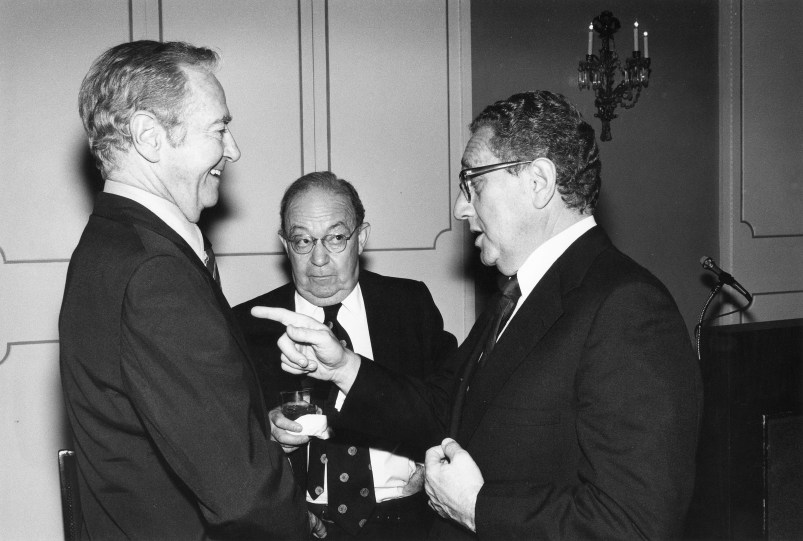
Original caption: American politician US Senator Henry M Jackson (1912 – 1983) (left) laughs at a comment by Secretary of State Henry Kissinger (right) during an unspecified event, mid 1970s. Visible between them is journalist Theodore H White (1915 – 1986). (Photo by Diana Walker/Getty Images)
When you talk about these forms of coverage in isolation you sort of get the idea, but when you consider that these are stand-ins for billions of dollars in political spending, you start to see the real limitations of these coverage conceits. They’re pernicious but they’re not intentionally deceptive or misguided. It’s a grasping effort to make sense of exceedingly difficult things to cover. Imagine covering a Pepsi v. Coke advertising campaign. It would suck!
Are You Still With Me?
If you’re still following along, you probably see where this goes next. The modern political campaign has reduced partisans and the media to trying to guess, predict, and pseudo-analyze whether the mass marketing campaign underway out there is effectively reaching the low-information voter. Much of the backbiting against candidates and their campaigns involves would-be Don Drapers armchair-quarterbacking over mass marketing techniques.
Another chunk of the discourse comes down to would-be media critics arguing not over the substance of politics but over the coverage and how it will be perceived by people who may never see it and who we don’t understand very well in the first place.
Brace Yourself
I broke this all down into some of its constituent parts — simplifying it somewhat — because we’re going to be in a whirlwind of emotional outbursts, severe backbiting, and unsolicited campaign advice from everyone and their mother over the next few days given how last night’s debate went. Most of it will be misdirected in the ways I’ve outlined here.
In particular, there’s a subset of media and partisans that I’ll call the “Do Something!” caucus. It’s a cost-free position to take. Do something! Anything! It demands action as an emotional release valve. It doesn’t matter what the action is, so long as it’s not inaction.
Demanding that Biden step down and Democrats come up with a new nominee without a plan for how or for who replaces him is a patented “Do Something!” caucus move. The “Do Something!” caucus loves pretending that politics is chess and that chess is winnable with clever moves. The “Do Something!” caucus obsesses over messaging strategies.
Biden gave the “Do Something!” caucus a lot to work with last night.
What’s Next?
I do not know.
I repeat: I do not know.
That’s part of what draws me to politics. It is not predictable. It surprises you. Making predictions robs me of the joy of the unexpected, though in truth much of the unexpected in politics over the past 8 years has brought little joy.
For my part, the emotional edge to last night’s debate came from the knowledge that tens of thousands of Americans are working night and day to shore up the foundations of democracy and to protect them from another assault by Donald Trump. It is the calling of our time.
On balance, Joe Biden has been a remarkably effective leader of that effort. More so than I would have imagined. But he fell down on the job last night, and that let a lot of people down.
Trying to collect my thoughts reading the debate reactions from readers you already posted, and hearing about Axelrod and Plouffe going on tv and just aimlessly panicking, and the biggest thing that came to mind was the Access Hollywood tape. I’m about your age and that’s the only time I can recall that the other side actually panicked. You had reporters saying they were hearing from GOP operatives that all was lost.
I just donated money to the Democrats for the first time in a while. Yes, this was terrible but my reaction is to suddenly face up to the horror of the reality of Trump and to prioritize doing more and to temporarily ignore my Longer-term concerns Such as climate change.
I just gave $250 to Biden. Might not be a lot for some but it is for me.
When I got off work tonight & drove home, I turned on the radio (& the debate) for the time it took me to get there. A couple of minutes was enough to know it was a shit show. By the time I got home I was royally disgusted & angry. With the panel for clearly letting Trump aggress his way into extra time (though they had mic control). With Biden for sounding sick & confused – like a parody of what the right says about him, for missing clear opportunities to slam Trump for nonsense. With Trump for sounding sharp despite spewing utter bullshit at every turn. With this country for shoveling propaganda into their brains & not straight up laughing this clownish asshole out of the country.
I will admit to feeling a little panicked when President Biden came out the gates at the debate as slowly (maybe even decrepitly) as he did. To my surprise, however, I am feeling far less down about this than I would have expected. It reminds me too much of the way we trial lawyers tend to react when something goes badly wrong in a jury trial. This can range from having an important cross-examination turn sour on you to having your client say something seemingly disastrous while testifying. At the end of days like that the level of despondency you feel can be overwhelming. We’ve all been there. You go back to the office and announce, “It’s over. We’re going to get killed.”