November 19, 2024 marked the 1,000th day of the ongoing Ukraine-Russia conflict. While the violence rages on, Ukrainians mourn their losses, bury their dead, and try to find small moments of normalcy.
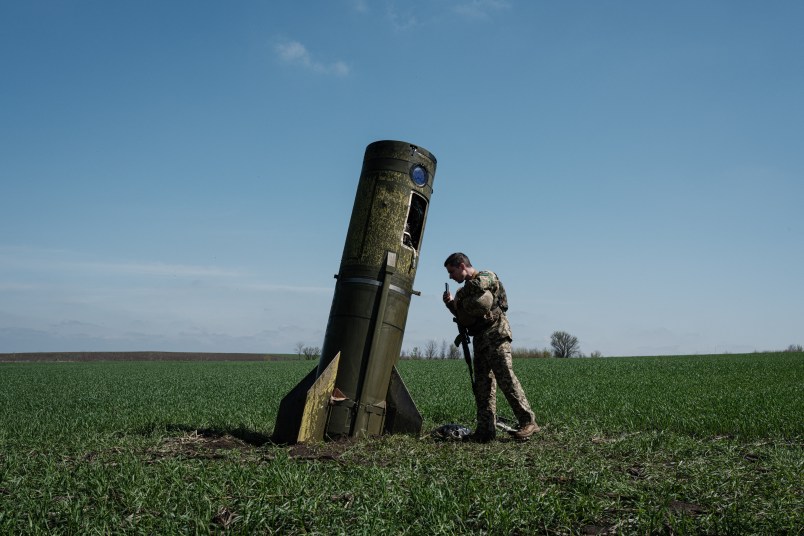
A Ukrainian soldier looks at a Russian ballistic missile in a field
A Ukrainian serviceman looks at a Russian ballistic missile’s booster stage that fell in a field in Bohodarove, eastern Ukraine, on April 25, 2022, amid the Russian invasion of Ukraine. (Photo by YASUYOSHI CHIBA/AFP via Getty Images)
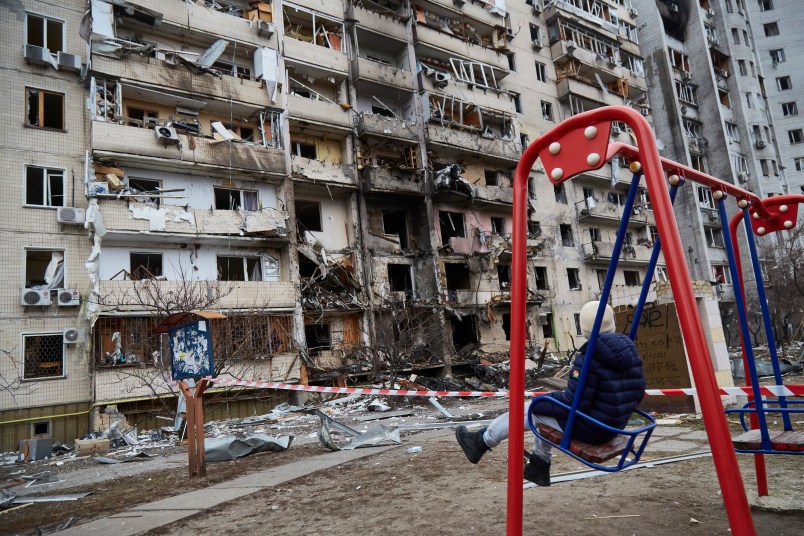
A child on a swing outside a residential building damaged by a Russian missile
A child on a swing outside a residential building damaged by a missile on February 25, 2022 in Kyiv, Ukraine. (Photo by Pierre Crom/Getty Images)
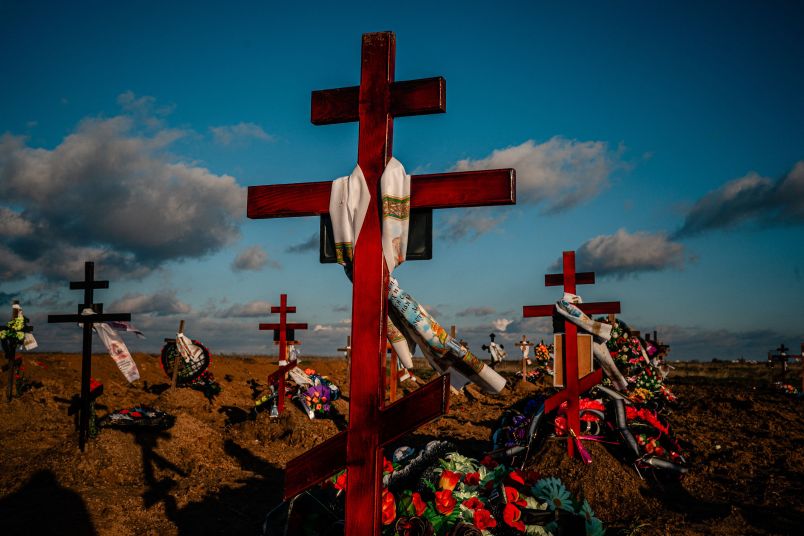
Memorial crosses in Kherson, Ukraine
Memorial crosses are seen on the new graves at a cemetery in the southern city of Kherson on December 28, 2022. (Photo by DIMITAR DILKOFF/AFP via Getty Images)
Collected remnants of shells and missiles used by the Russian army to attack Ukraine
This aerial picture taken on December 7, 2022 shows an expert of the prosecutor’s office examining collected remnants of shells and missiles used by the Russian army to attack the second largest Ukrainian city of Kharkiv, amid the Russian invasion of Ukraine. (Photo by OLEKSII FILIPPOV/AFP via Getty Images)
A Ukrainian rocket launch
M142 HIMARS launch a rocket at Russian position on December 29, 2023, in Ukraine. M142 HIMARS have proved to be a highly effective weapon, striking targets both on the front line and deep in the Russian rear. (Photo by Serhii Mykhalchuk/Global Images Ukraine via Getty Images)
A child walks in front of a destroyed school in northern Ukraine
A child walks in front of a damaged school in the city of Zhytomyr, northern Ukraine, on March 23, 2022. (Photo by FADEL SENNA/AFP via Getty Images)
Civilian women hold weapons during a military training
Civilians hold weapons as they take part in a military training given by a former Ukrainian serviceman at a civic center in the Kharkiv region on September 13, 2024, amid the Russian invasion in Ukraine. (Photo by SERGEY BOBOK/AFP via Getty Images)
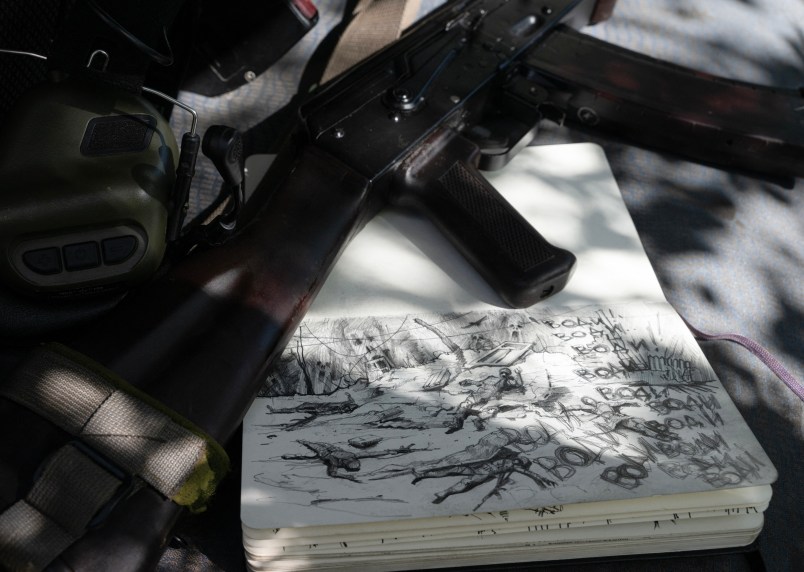
A Ukrainian reconnaissance drone pilot’s sketchbook
A photograph taken at a position near Chasiv Yar, Donetsk region, on May 1, 2024, shows drawings in the sketchbook of Ukrainian reconnaissance drone pilot of the 22nd Brigade Andriy, 48, called “Roy” from his war name, amid the Russian invasion of Ukraine. When Russia invaded Ukraine, Andriy volunteered to fight, becoming a machinegunner and then a drone pilot. And “to keep from going mad,” this architect began to draw the horrors of war. (Photo by GENYA SAVILOV/AFP via Getty Images)
People gather outside a damaged school in Odesa, Ukraine
People gather outside a school damaged as a result of a Russian strike in Odesa on November 8, 2024, amid Russian invasion in Ukraine. (Photo by OLEKSANDR GIMANOV/AFP via Getty Images)
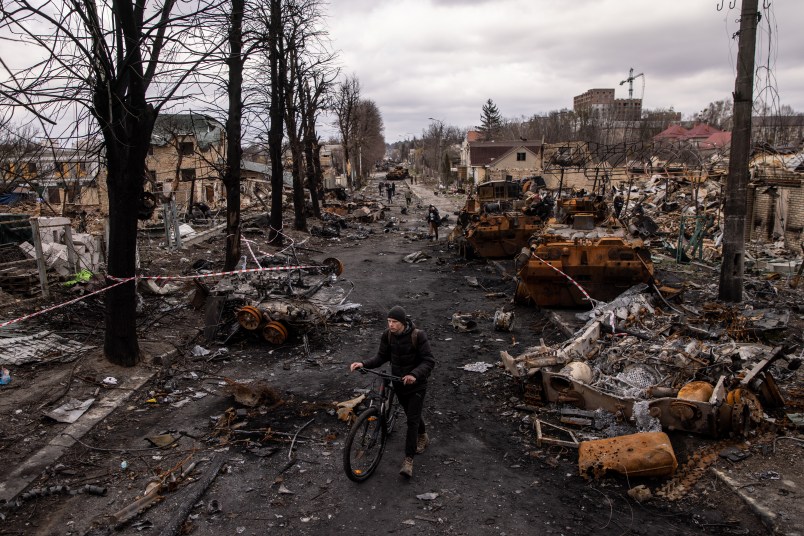
A man walking his bike through debris on a destroyed street in Bucha, Ukraine
A man pushes his bike through debris and destroyed Russian military vehicles on a street on April 06, 2022 in Bucha, Ukraine. The Ukrainian government has accused Russian forces of committing a “deliberate massacre” as they occupied and eventually retreated from Bucha, 25 km northwest of Kyiv. Hundreds of bodies were found in the days after Ukrainian forces regained control of the town. (Photo by Chris McGrath/Getty Images)
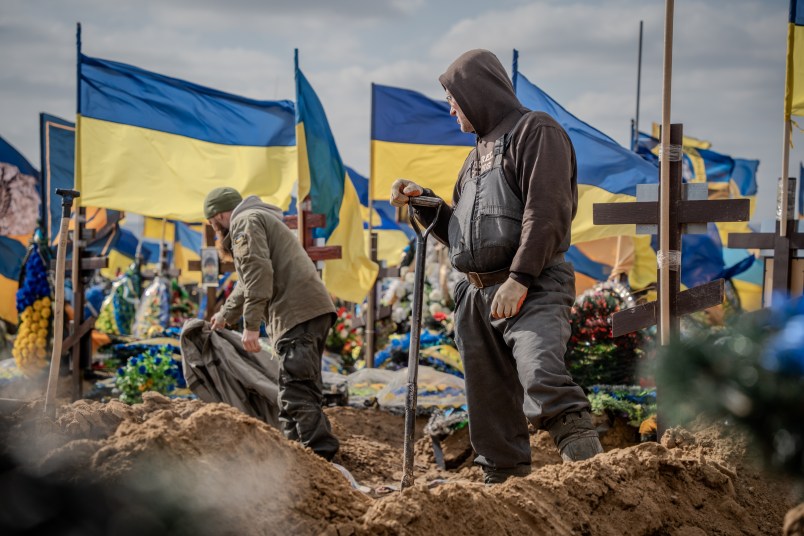
A Ukrainian military cemetery
Cemetery No. 18 hosts burials of Ukrainian military personnel who died in battles defending Ukraine’s sovereignty from Russian military aggression, and gravediggers prepare to work during a military funeral on March 2, 2024 in Kharkiv, Ukraine. (Photo by Hnat Holyk /Gwara Media/Global Images Ukraine via Getty Images)
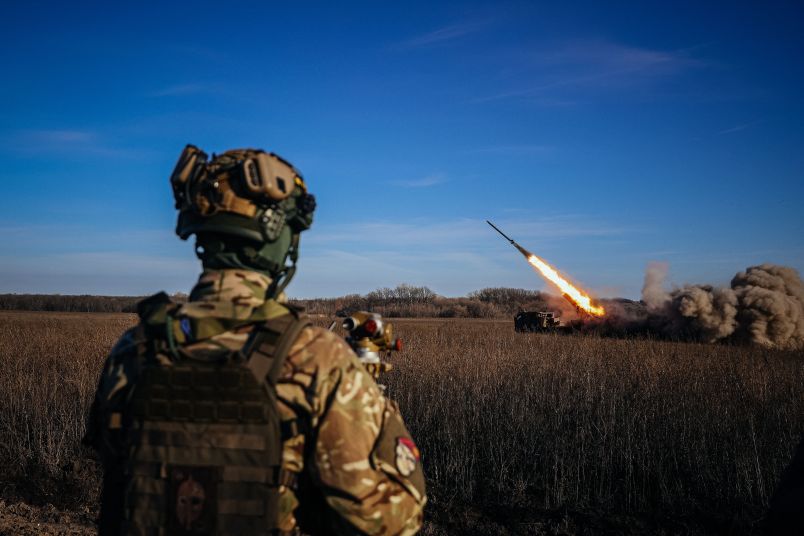
A Ukrainian soldier watches a rocket launcher
A Ukrainian soldier watches a self-propelled 220 mm multiple rocket launcher “Bureviy” firing towards Russian positions on the front line, eastern Ukraine on November 29, 2022, amid the Russian invasion of Ukraine. (Photo by ANATOLII STEPANOV/AFP via Getty Images)
A DJ plays music for volunteers collecting useable bricks of a destroyed cultural center
A DJ plays music for volunteers of the “Repair Together” charity organization, who collect useable bricks of a destroyed cultural center in the village Yagidne, Chernigiv region, on July 8, 2023, amid the Russian invasion of Ukraine. (Photo by GENYA SAVILOV/AFP via Getty Images)
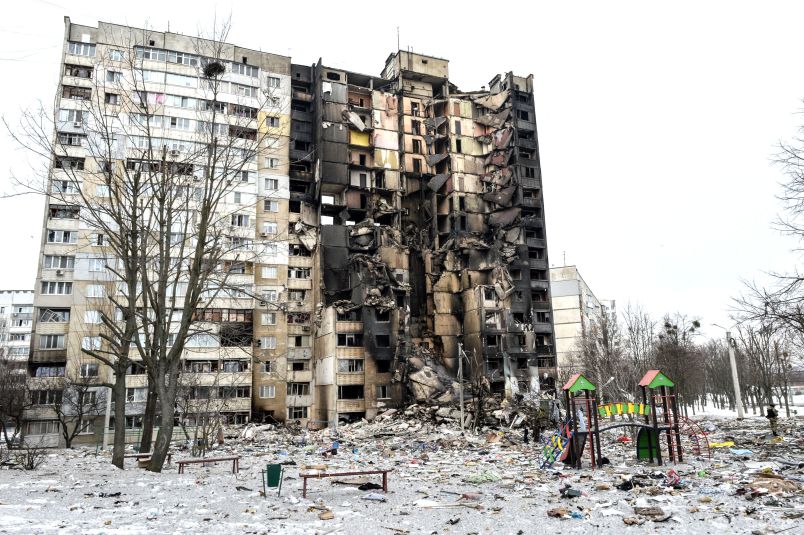
A damaged apartment building in Kharkiv, Ukraine
This picture shows an apartment building damaged after shelling the day before in Ukraine’s second-biggest city of Kharkiv on March 8, 2022. (Photo by SERGEY BOBOK/AFP via Getty Images)
Locals take shelter in a metro station during an air strike in Kyiv
Local residents take shelter in a metro station during an air strike alarm in Kyiv, on November 20, 2024, amid the Russian invasion of Ukraine. (Photo by ROMAN PILIPEY/AFP via Getty Images)
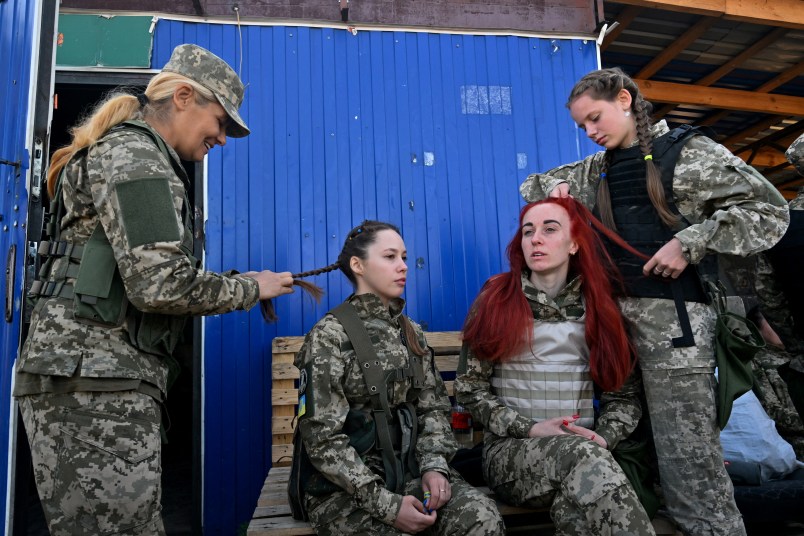
Ukranian cadets find small moments of normalcy during military training
Ukrainian cadets, wearing new military uniforms designed specially for women, have their hair braided as they take part in a training during the “Uniform matters” event organized to present the outfit and test it under military training conditions, on the outskirts of Kyiv on July 12, 2023. (Photo by SERGEI SUPINSKY/AFP via Getty Images)
Rescue work operations at a damaged apartment building
Police officers and State Emergency Service of Ukraine rescuers work at an apartment building damaged after an airstrike in Kharkiv, on October 31, 2024, amid the Russian invasion of Ukraine. (Photo by SERGEY BOBOK/AFP via Getty Images)
This story first appeared at ProPublica. ProPublica is a Pulitzer Prize-winning investigative newsroom. Sign up for The Big Story newsletter to receive stories like this one in your inbox.
Wrapping his wife in a blanket as she mourned the loss of her pregnancy at 11 weeks, Hope Ngumezi wondered why no obstetrician was coming to see her.
Over the course of six hours on June 11, 2023, Porsha Ngumezi had bled so much in the emergency department at Houston Methodist Sugar Land that she’d needed two transfusions. She was anxious to get home to her young sons, but, according to a nurse’s notes, she was still “passing large clots the size of grapefruit.”
Hope dialed his mother, a former physician, who was unequivocal. “You need a D&C,” she told them, referring to dilation and curettage, a common procedure for first-trimester miscarriages and abortions. If a doctor could remove the remaining tissue from her uterus, the bleeding would end.
But when Dr. Andrew Ryan Davis, the obstetrician on duty, finally arrived, he said it was the hospital’s “routine” to give a drug called misoprostol to help the body pass the tissue, Hope recalled. Hope trusted the doctor. Porsha took the pills, according to records, and the bleeding continued.
Three hours later, her heart stopped.
The 35-year-old’s death was preventable, according to more than a dozen doctors who reviewed a detailed summary of her case for ProPublica. Some said it raises serious questions about how abortion bans are pressuring doctors to diverge from the standard of care and reach for less-effective options that could expose their patients to more risks. Doctors and patients described similar decisions they’ve witnessed across the state.
It was clear Porsha needed an emergency D&C, the medical experts said. She was hemorrhaging and the doctors knew she had a blood-clotting disorder, which put her at greater danger of excessive and prolonged bleeding. “Misoprostol at 11 weeks is not going to work fast enough,” said Dr. Amber Truehart, an OB-GYN at the University of New Mexico Center for Reproductive Health. “The patient will continue to bleed and have a higher risk of going into hemorrhagic shock.” The medical examiner found the cause of death to be hemorrhage.
D&Cs — a staple of maternal health care — can be lifesaving. Doctors insert a straw-like tube into the uterus and gently suction out any remaining pregnancy tissue. Once the uterus is emptied, it can close, usually stopping the bleeding.
But because D&Cs are also used to end pregnancies, the procedure has become tangled up in state legislation that restricts abortions. In Texas, any doctor who violates the strict law risks up to 99 years in prison. Porsha’s is the fifth case ProPublica has reported in which women died after they did not receive a D&C or its second-trimester equivalent, a dilation and evacuation; three of those deaths were in Texas.
Texas doctors told ProPublica the law has changed the way their colleagues see the procedure; some no longer consider it a first-line treatment, fearing legal repercussions or dissuaded by the extra legwork required to document the miscarriage and get hospital approval to carry out a D&C. This has occurred, ProPublica found, even in cases like Porsha’s where there isn’t a fetal heartbeat or the circumstances should fall under an exception in the law. Some doctors are transferring those patients to other hospitals, which delays their care, or they’re defaulting to treatments that aren’t the medical standard.
Misoprostol, the medicine given to Porsha, is an effective method to complete low-risk miscarriages but is not recommended when a patient is unstable. The drug is also part of a two-pill regimen for abortions, yet administering it may draw less scrutiny than a D&C because it requires a smaller medical team and because the drug is commonly used to induce labor and treat postpartum hemorrhage. Since 2022, some Texas women who were bleeding heavily while miscarrying have gone public about only receiving medication when they asked for D&Cs. One later passed out in a pool of her own blood.
“Stigma and fear are there for D&Cs in a way that they are not for misoprostol,” said Dr. Alison Goulding, an OB-GYN in Houston. “Doctors assume that a D&C is not standard in Texas anymore, even in cases where it should be recommended. People are afraid: They see D&C as abortion and abortion as illegal.”
On November 18, 2024, Hope Ngumezi touches the grave of his late wife in Pearland, Texas. Ngumezi’s wife, Porsha, died last year from sepsis at 11 weeks pregnant after miscarrying. Ngumezi is now a single father to his two children who are seven and four years old. (Danielle Villasana for ProPublica)
Doctors and nurses involved in Porsha’s care did not respond to multiple requests for comment.
Several physicians who reviewed the summary of her case pointed out that Davis’ post-mortem notes did not reflect nurses’ documented concerns about Porsha’s “heavy bleeding.” After Porsha died, Davis wrote instead that the nurses and other providers described the bleeding as “minimal,” though no nurses wrote this in the records. ProPublica tried to ask Davis about this discrepancy. He did not respond to emails, texts or calls.
Houston Methodist officials declined to answer a detailed list of questions about Porsha’s treatment. They did not comment when asked whether Davis’ approach was the hospital’s “routine.” A spokesperson said that “each patient’s care is unique to that individual.”
“All Houston Methodist hospitals follow all state laws,” the spokesperson added, “including the abortion law in place in Texas.”
“We Need to See the Doctor”
On November 15, 2024, Hope Ngumezi poses for a portrait with his two sons at their home in Houston, Texas. Ngumezi’s wife, Porsha, died last year from sepsis at 11 weeks pregnant after miscarrying. Ngumezi is now a single father to their two children who are seven and four years old. (Danielle Villasana for ProPublica)
Hope marveled at the energy Porsha had for their two sons, ages 5 and 3. Whenever she wasn’t working, she was chasing them through the house or dancing with them in the living room. As a finance manager at a charter school system, she was in charge of the household budget. As an engineer for an airline, Hope took them on flights around the world — to Chile, Bali, Guam, Singapore, Argentina.
The two had met at Lamar University in Beaumont, Texas. “When Porsha and I began dating,” Hope said, “I already knew I was going to love her.” She was magnetic and driven, going on to earn an MBA, but she was also gentle with him, always protecting his feelings. Both were raised in big families and they wanted to build one of their own.
When he learned Porsha was pregnant again in the spring of 2023, Hope wished for a girl. Porsha found a new OB-GYN who said she could see her after 11 weeks. Ten weeks in, though, Porsha noticed she was spotting. Over the phone, the obstetrician told her to go to the emergency room if it got worse.
To celebrate the end of the school year, Porsha and Hope took their boys to a water park in Austin, and as they headed back, on June 11, Porsha told Hope that the bleeding was heavier. They decided Hope would stay with the boys at home until a relative could take over; Porsha would drive to the emergency room at Houston Methodist Sugar Land, one of seven community hospitals that are part of the Houston Methodist system.
At 6:30 p.m, three hours after Porsha arrived at the hospital, she saw huge clots in the toilet. “Significant bleeding,” the emergency physician wrote. “I’m starting to feel a lot of pain,” Porsha texted Hope. Around 7:30 p.m., she wrote: “She said I might need surgery if I don’t stop bleeding,” referring to the nurse. At 7:50 p.m., after a nurse changed her second diaper in an hour: “Come now.”
Still, the doctor didn’t mention a D&C at this point, records show. Medical experts told ProPublica that this wait-and-see approach has become more common under abortion bans. Unless there is “overt information indicating that the patient is at significant risk,” hospital administrators have told physicians to simply monitor them, said Dr. Robert Carpenter, a maternal-fetal medicine specialist who works in several hospital systems in Houston. Methodist declined to share its miscarriage protocols with ProPublica or explain how it is guiding doctors under the abortion ban.
As Porsha waited for Hope, a radiologist completed an ultrasound and noted that she had “a pregnancy of unknown location.” The scan detected a “sac-like structure” but no fetus or cardiac activity. This report, combined with her symptoms, indicated she was miscarrying.
But the ultrasound record alone was less definitive from a legal perspective, several doctors explained to ProPublica. Since Porsha had not had a prenatal visit, there was no documentation to prove she was 11 weeks along. On paper, this “pregnancy of unknown location” diagnosis could also suggest that she was only a few weeks into a normally developing pregnancy, when cardiac activity wouldn’t be detected. Texas outlaws abortion from the moment of fertilization; a record showing there is no cardiac activity isn’t enough to give physicians cover to intervene, experts said.
Dr. Gabrielle Taper, who recently worked as an OB-GYN resident in Austin, said that she regularly witnessed delays after ultrasound reports like these. “If it’s a pregnancy of unknown location, if we do something to manage it, is that considered an abortion or not?” she said, adding that this was one of the key problems she encountered. After the abortion ban went into effect, she said, “there was much more hesitation about: When can we intervene, do we have enough evidence to say this is a miscarriage, how long are we going to wait, what will we use to feel definitive?”
At Methodist, the emergency room doctor reached Davis, the on-call OB-GYN, to discuss the ultrasound, according to records. They agreed on a plan of “observation in the hospital to monitor bleeding.”
On November 15, 2024, a sonogram of Hope Ngumezi’s firstborn on the fridge at his home in Houston, Texas. Ngumezi’s wife, Porsha, died last year from sepsis at 11 weeks pregnant after miscarrying. Ngumezi is now a single father to their two children who are seven and four years old. (Danielle Villasana for ProPublica)
Around 8:30 p.m., just after Hope arrived, Porsha passed out. Terrified, he took her head in his hands and tried to bring her back to consciousness. “Babe, look at me,” he told her. “Focus.” Her blood pressure was dipping dangerously low. She had held off on accepting a blood transfusion until he got there. Now, as she came to, she agreed to receive one and then another.
By this point, it was clear that she needed a D&C, more than a dozen OB-GYNs who reviewed her case told ProPublica. She was hemorrhaging, and the standard of care is to vacuum out the residual tissue so the uterus can clamp down, physicians told ProPublica.
“Complete the miscarriage and the bleeding will stop,” said Dr. Lauren Thaxton, an OB-GYN who recently left Texas.
“At every point, it’s kind of shocking,” said Dr. Daniel Grossman, a professor of obstetrics and gynecology at the University of California, San Francisco who reviewed Porsha’s case. “She is having significant blood loss and the physician didn’t move toward aspiration.”
All Porsha talked about was her devastation of losing the pregnancy. She was cold, crying and in extreme pain. She wanted to be at home with her boys. Unsure what to say, Hope leaned his chest over the cot, passing his body heat to her.
At 9:45 p.m., Esmeralda Acosta, a nurse, wrote that Porsha was “continuing to pass large clots the size of grapefruit.” Fifteen minutes later, when the nurse learned Davis planned to send Porsha to a floor with fewer nurses, she “voiced concern” that he wanted to take her out of the emergency room, given her condition, according to medical records.
At 10:20 p.m., seven hours after Porsha arrived, Davis came to see her. Hope remembered what his mother had told him on the phone earlier that night: “She needs a D&C.” The doctor seemed confident about a different approach: misoprostol. If that didn’t work, Hope remembers him saying, they would move on to the procedure.
A pill sounded good to Porsha because the idea of surgery scared her. Davis did not explain that a D&C involved no incisions, just suction, according to Hope, or tell them that it would stop the bleeding faster. The Ngumezis followed his recommendation without question. “I’m thinking, ‘He’s the OB, he’s probably seen this a thousand times, he probably knows what’s right,’” Hope said.
But more than a dozen doctors who reviewed Porsha’s case were concerned by this recommendation. Many said it was dangerous to give misoprostol to a woman who’s bleeding heavily, especially one with a blood clotting disorder. “That’s not what you do,” said Dr. Elliott Main, the former medical director for the California Maternal Quality Care Collaborative and an expert in hemorrhage, after reviewing the case. “She needed to go to the operating room.” Main and others said doctors are obliged to counsel patients on the risks and benefits of all their options, including a D&C.
Performing a D&C, though, attracts more attention from colleagues, creating a higher barrier in a state where abortion is illegal, explained Goulding, the OB-GYN in Houston. Staff are familiar with misoprostol because it’s used for labor, and it only requires a doctor and a nurse to administer it. To do a procedure, on the other hand, a doctor would need to find an operating room, an anesthesiologist and a nursing team. “You have to convince everyone that it is legal and won’t put them at risk,” said Goulding. “Many people may be afraid and misinformed and refuse to participate — even if it’s for a miscarriage.”
Davis moved Porsha to a less-intensive unit, according to records. Hope wondered why they were leaving the emergency room if the nurse seemed so worried. But instead of pushing back, he rubbed Porsha’s arms, trying to comfort her. The hospital was reputable. “Since we were at Methodist, I felt I could trust the doctors.”
On their way to the other ward, Porsha complained of chest pain. She kept remarking on it when they got to the new room. From this point forward, there are no nurse’s notes recording how much she continued to bleed. “My wife says she doesn’t feel right, and last time she said that, she passed out,” Hope told a nurse. Furious, he tried to hold it together so as not to alarm Porsha. “We need to see the doctor,” he insisted.
Her vital signs looked fine. But many physicians told ProPublica that when healthy pregnant patients are hemorrhaging, their bodies can compensate for a long time, until they crash. Any sign of distress, such as chest pain, could be a red flag; the symptom warranted investigation with tests, like an electrocardiogram or X-ray, experts said. To them, Porsha’s case underscored how important it is that doctors be able to intervene before there are signs of a life-threatening emergency.
But Davis didn’t order any tests, according to records.
Around 1:30 a.m., Hope was sitting by Porsha’s bed, his hands on her chest, telling her, “We are going to figure this out.” They were talking about what she might like for breakfast when she began gasping for air.
“Help, I need help!” he shouted to the nurses through the intercom. “She can’t breathe.”
“All She Needed”
On November 15, 2024, Hope Ngumezi holds his son’s hand at their home in Houston, Texas. Ngumezi’s wife, Porsha, died last year from sepsis at 11 weeks pregnant after miscarrying. Ngumezi is now a single father to their two children who are seven and four years old. (Danielle Villasana for ProPublica)
Hours later, Hope returned home in a daze. “Is mommy still at the hospital?” one of his sons asked. Hope nodded; he couldn’t find the words to tell the boys they’d lost their mother. He dressed them and drove them to school, like the previous day had been a bad dream. He reached for his phone to call Porsha, as he did every morning that he dropped the kids off. But then he remembered that he couldn’t.
Friends kept reaching out. Most of his family’s network worked in medicine, and after they said how sorry they were, one after another repeated the same message. All she needed was a D&C, said one. They shouldn’t have given her that medication, said another. It’s a simple procedure, the callers continued. We do this all the time in Nigeria.
Since Porsha died, several families in Texas have spoken publicly about similar circumstances. This May, when Ryan Hamilton’s wife was bleeding while miscarrying at 13 weeks, the first doctor they saw at Surepoint Emergency Center Stephenville noted no fetal cardiac activity and ordered misoprostol, according to medical records. When they returned because the bleeding got worse, an emergency doctor on call, Kyle Demler, said he couldn’t do anything considering “the current stance” in Texas, according to Hamilton, who recorded his recollection of the conversation shortly after speaking with Demler. (Neither Surepoint Emergency Center Stephenville nor Demler responded to several requests for comment.)
They drove an hour to another hospital asking for a D&C to stop the bleeding, but there, too, the physician would only prescribe misoprostol, medical records indicate. Back home, Hamilton’s wife continued bleeding until he found her passed out on the bathroom floor. “You don’t think it can really happen like that,” said Hamilton. “It feels like you’re living in some sort of movie, it’s so unbelievable.”
Across Texas, physicians say they blame the law for interfering with medical care. After ProPublica reported last month on two women who diedafter delays in miscarriage care, 111 OB-GYNs sent a letter to Texas policymakers, saying that “the law does not allow Texas women to get the lifesaving care they need.”
Dr. Austin Dennard, an OB-GYN in Dallas, told ProPublica that if one person on a medical team doubts the doctor’s choice to proceed with a D&C, the physician might back down. “You constantly feel like you have someone looking over your shoulder in a punitive, vigilante type of way.”
The criminal penalties are so chilling that even women with diagnoses included in the law’s exceptions are facing delays and denials. Last year, for example, legislators added an update to the ban for patients diagnosed with previable premature rupture of membranes, in which a patient’s water breaks before a fetus can survive. Doctors can still face prosecution for providing abortions in those cases, but they are offered the chance to justify themselves with what’s called an “affirmative defense,” not unlike a murder suspect arguing self defense. This modest change has not stopped some doctors from transferring those patients instead of treating them; Dr. Allison Gilbert, an OB-GYN in Dallas, said doctors send them to her from other hospitals. “They didn’t feel like other staff members would be comfortable proceeding with the abortion,” she said. “It’s frustrating that places still feel like they can’t act on some of these cases that are clearly emergencies.” Women denied treatment for ectopic pregnancies, another exception in the law, have filed federal complaints.
In response to ProPublica’s questions about Houston Methodist’s guidance on miscarriage management, a spokesperson, Gale Smith, said that the hospital has an ethics committee, which can usually respond within hours to help physicians and patients make “appropriate decisions” in compliance with state laws.
After Porsha died, Davis described in the medical record a patient who looked stable: He was tracking her vital signs, her bleeding was “mild” and she was “said not to be in distress.” He ordered bloodwork “to ensure patient wasn’t having concerning bleeding.” Medical experts who reviewed Porsha’s case couldn’t understand why Davis noted that a nurse and other providers reported “decreasing bleeding” in the emergency department when the record indicated otherwise. “He doesn’t document the heavy bleeding that the nurse clearly documented, including the significant bleeding that prompted the blood transfusion, which is surprising,” Grossman, the UCSF professor, said.
Patients who are miscarrying still don’t know what to expect from Houston Methodist.
This past May, Marlena Stell, a patient with symptoms nearly identical to Porsha’s, arrived at another hospital in the system, Houston Methodist The Woodlands. According to medical records, she, too, was 11 weeks along and bleeding heavily. An ultrasound confirmed there was no fetal heartbeat and indicated the miscarriage wasn’t complete. “I assumed they would do whatever to get the bleeding to stop,” Stell said.
Instead, she bled for hours at the hospital. She wanted a D&C to clear out the rest of the tissue, but the doctor gave her methergine, a medication that’s typically used after childbirth to stop bleeding but that isn’t standard care in the middle of a miscarriage, doctors told ProPublica. “She had heavy bleeding, and she had an ultrasound that’s consistent with retained products of conception.” said Dr. Jodi Abbott, an associate professor of obstetrics and gynecology at Boston University School of Medicine, who reviewed the records. “The standard of care would be a D&C.”
Stell says that instead, she was sent home and told to “let the miscarriage take its course.” She completed her miscarriage later that night, but doctors who reviewed her case, so similar to Porsha’s, said it showed how much of a gamble physicians take when they don’t follow the standard of care. “She got lucky — she could have died,” Abbott said. (Houston Methodist did not respond to a request for comment on Stell’s care.)
It hadn’t occurred to Hope that the laws governing abortion could have any effect on his wife’s miscarriage. Now it’s the only explanation that makes sense to him. “We all know pregnancies can come out beautifully or horribly,” Hope told ProPublica. “Instead of putting laws in place to make pregnancies safer, we created laws that put them back in danger.”
For months, Hope’s youngest son didn’t understand that his mom was gone. Porsha’s long hair had been braided, and anytime the toddler saw a woman with braids from afar, he would take off after her, shouting, “That’s mommy!”
A couple weeks ago, Hope flew to Amsterdam to quiet his mind. It was his first trip without Porsha, but as he walked the city, he didn’t know how to experience it without her. He kept thinking about how she would love the Christmas lights and want to try all the pastries. How she would have teased him when he fell asleep on a boat tour of the canals. “I thought getting away would help,” he wrote in his journal. “But all I’ve done is imagine her beside me.”
On November 15, 2024, at their home in Houston, Texas, the son of Hope Ngumezi plays near cards that display memories they have with their late mother. Ngumezi’s wife, Porsha, died last year from sepsis at 11 weeks pregnant after miscarrying. Ngumezi is now a single father to their two children who are seven and four years old. (Danielle Villasana for ProPublica)
The Undisclosed Sex Assault Settlement Wasn’t Enough?
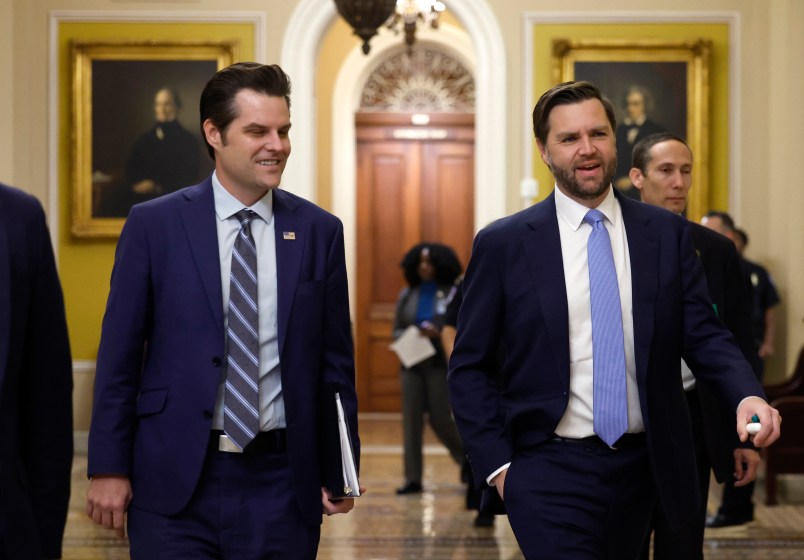
With Matt Gaetz out, Pete Hegseth’s nomination for secretary of defense comes under closer scrutiny. It’s not just the sexual assault allegation he settled in 2017 — and failed to disclose to the Trump transition team — that’s cause for concern.
If we use the Trump II trifecta of retribution, corruption, and destruction as the analytical framework, Hegseth probably best slots in under the destruction theme. He is someone with nowhere near the management experience expected of someone running the Pentagon; he is eager to root out “wokeness” in the military; and he comes to the job with a passel of other right-wing notions and agenda items.
A sampling of the latest reporting on Hegseth:
TPM’s Hunter Walker: Hegseth Railed Against ‘Insidious’ Security Measures That Kept Far-Right Extremists Out Of Armed Forces
WaPo: Pete Hegseth’s Army unit in Iraq was rocked by a war-crimes case after he left
WSJ: How Hegseth Cultivated an Image That Caught Trump’s Eye
I should note that the MAGA impulse towards destruction is closely connected to the corruption threat. Grifters prey on the chaos, the breakdown of normal policies and procedures, and the undermining of watchdogs and other accountability mechanisms. The enormous amount of money coursing through the Pentagon is ripe for even further abuse than we’ve become accustomed to.
Trump’s Second Choice For AG: Pam Bondi
To help you familiarize yourself with former Florida Attorney General Pam Bondi:
Philip Bump: Pam Bondi has shown how willing she is to use her authority to help Trump
WaPo: Pam Bondi, Trump’s AG pick, said ‘prosecutors will be prosecuted’
Politico: ‘Is she on our side?’: Jan. 6 defendants and allies puzzle over Bondi nomination
GregSargent: “Matt Gaetz’s withdrawal from consideration as Donald Trump’s attorney general is unquestionably a big victory for the rule of law. But now that Trump has put forth Pam Bondi—the former Florida attorney general whose loyalty to Trump is almost as slavish as Gaetz’s—it raises a question: Why assume she’ll be any less wedded to his agenda of unleashing the Justice Department on his enemies and otherwise reducing it to a tool of his most corrupt designs and whims?”
Point Of Clarification
Former Rep. Matt Gaetz (R-FL) seemingly settled the confusion about whether he only resigned from the current Congress but might return in the new Congress, having already been re-elected before his resignation. “I do not intend to join the 119th Congress,” Trump’s failed presumptive nominee for attorney general said in an interview.
Matt Gaetz Is Now On Cameo
“After announcing he would not return to Congress, Matt Gaetz appears to be trying out a new career option: creating personalized videos for his fans on Cameo.”–NBC News
Fox News commentator and physician Janette Nesheiwat, surgeon general
Former Rep. Dave Weldon (R-FL), director of the CDC
What Could Possibly Go Wrong?
WaPo: Trump health picks largely untested in fighting disease outbreaks
Project 2025 Is Back, Baby!
Just making sure you didn’t miss Donald Trump’s bait-and-switch of disavowing Project 2025 toward the end of the presidential campaign when it was controversial and then immediately turning back to it for appointees to his new administration:
Politico: Trump team barred from agencies amid legal standoff
NYT: Trump Is Running His Transition Team on Secret Money
WaPo: Sharp elbows and raised voices: Inside Trump’s bumpy transition
Trump Prosecution Watch
Jan. 6 case: Trump plans to fire Jack Smith’s team and “assemble investigative teams within the Justice Department to hunt for evidence in battleground states that fraud tainted the 2020 election,” the WaPo reported.
Hush money case: Trial judge cancels Trump’s sentencing for now.
RUDY!
“With a motion for civil contempt already looming over him in Washington, D.C., another judge on Friday warned Rudy Giuliani that “on pain of contempt” he must comply with requests from the Georgia election workers he defamed to surrender his assets squirreled away in an increasingly controversial storage unit on New York’s Long Island.”–HuffPost
Sign Of The Times
“Almost every week, small white supremacist and neo-Nazi groups have been descending on downtowns, gathering in public parks or rallying on the grounds of state houses and courthouses across the country.”–NYT
Fair Winds and Following Seas
PHILADELPHIA, PA- JULY 10, 2014: The SS United States is slowly rusting away in Philadelphia. The ship has been docked at a pier on the Philadelphia waterfront for 17 years and has been the target of numerous “save our ship” schemes, all of which have failed. (Photo by Michael S. Williamson/The Washington Post via Getty Images)
Every time I take I-95 through Philadelphia, I crane for a view of the S.S. United States, the largest U.S.-built ocean liner, rusting away at a pier on the Delaware River since 1996. She still holds the record for fastest transatlantic crossing, in both directions. Built at the tail end of the era of ocean liners, she cruised at 35 mph.
Repeated efforts to rehabilitate the S.S. United States over the decades have all failed and she will soon be towed to waters off the coast of Florida and sunken as a manmade reef. Photographer Stephen Mallonwent aboard for NPR recently; and even though she was long ago stripped of her fittings, his photos show she still carries herself with a certain dignity.
It’s odd that the hush money case made it as far as it did.
Alvin Bragg always seemed mercurial in his willingness to pursue it; the facts of the case all dealt with conduct around the 2016 election and the ensuing first months of Trump’s presidency. The charges weren’t the most serious, nor were they the most ambitious: the Smith and Georgia January 6 cases went to the heart of Trump’s 2020 coup attempt; Smith’s classified records case focused on a clear-cut instance of criminality.
Today I read this piece in Vox comparing the 2004 and 2024 elections and discussing what Democrats today can learn about how the Democrats came back from defeat. Author Nicole Narea says Democrats did three things: 1) They pursued a 50-state strategy, 2) They reevaluated their messaging, 3) They sought to become the party of ideas.
There’s some truth to Item #1. A 50-state strategy is absolutely something Democrats should pursue. But none of these three things are actually what happened. And they’re not why Democrats scored two successive wave elections in 2006 and 2008.
The Vox article speaks of a “reckoning” the Democrats had to have then and another “reckoning” they have to have now. I absolutely see red whenever I see people using this word in a political context. In post-election terms, it appears to mean a kind of ash and sackcloth self-criticism session on the part of whoever you have decided is to blame for the Democrats’ loss.
A new episode of The Josh Marshall Podcast is live! This week, Kate and Josh discuss Matt Gaetz’s quick rise and fall, RFK Jr.-curious Democrats and the worst people in media this week.
You can listen to the new episode of The Josh Marshall Podcast here.
We’ve been discussing a lot of plans and ingenious new strategies for a Democratic comeback which are variously half-baked, hyperbolic, histrionic or merely silly. Here’s one that I believe is not. It’s not even a strategy. It’s simply identifying a real challenge, or a knot Democrats need to untangle.
A key reason that many people are Democrats today is that they’re attached to a cluster of ideas like the rule of law, respect for and the employment of science and expertise, a free press and the protection of the range of institutions that guard civic life, quality of life and more. On the other side, say we have adherents of a revanchist, authoritarian politics which seeks break all those things and rule from the wreckage that destruction leaves in its path. So Democrats constantly find themselves defending institutions, or “the establishment,” or simply the status quo. Yet we live in an age of pervasive public distrust — distrust of institutions, leaders, expertise. And not all of this distrust is misplaced. Many institutions, professions, and power centers have failed to live up to their sides of the social contract.
In short, Democrats are by and large institutionalists in an age of mistrust. And that is challenging place to be.
The former weekend Fox News host and Army National Guard veteran who President-elect Donald Trump tapped to lead the Department of Defense has made blasting the states of the American educational system and armed forces a cornerstone of his brand. And one of the things that has him most worked up is measures that the military’s leadership have taken in recent years to weed out far-right extremists from their ranks.
In a bestselling book and in a Fox special earlier this year, Hegseth aired his critique of security measures designed to keep “patriot extremism” — a term for militia-linked ideology — out of the military. He has also shared his story of personally being dubbed an “extremist” by the Pentagon due to the ink on his body.
“I have a Christian tattoo on my chest, which is part of the reason why I was — orders were revoked from my unit and I was pushed out of my unit,” Hegseth said during “The War on Warriors” live show that aired on May 10. “There’s new concepts like ‘patriot extremism,’ which is a part of how they review the profile of people serving. So, there are real insidious aspects of what’s happening inside the Pentagon.”
Hegseth was referring to steps the Department of Defense has taken to address the threat posed by far-right militia members and white supremacists in the armed forces. He went on to attribute this to supposedly left-wing elements in military leadership.
“A lot of ideological people with too much time … staring down at a meritocracy that they don’t control,” Hegseth said in the Fox live show. “You know the left, they don’t like things they can’t control. And they look at the DoD and they say that ‘this is something we need to bring to heel.’”
The Fox special, “The War on Warriors,” promoted Hegseth’s book of the same name, which was published in June. In his book, Hegseth made even clearer his objection to the Pentagon’s steps to remove “patriot” extremists from the military — and contended that he had been among those caught up in the crackdown.
Hegseth’s central thesis is that liberal concepts have taken over today’s military. This, he explains, includes the concerns about right-wing extremists in the ranks.
“The shoehorning of Diversity, Equity, and Inclusion (DEI), Critical Race Theory (CRT), feminism, genderism, safetyism, climate worship, manufactured ‘violent extremism,’ straight up weirdo shit, and a grab bag of social justice causes that infect today’s fighting force have nothing to do with making our military more capable,” Hegseth wrote in “The War on Warriors.”
In the book, Hegseth specifically cited a military stand-down to “address extremism in the ranks” that was ordered by Secretary of Defense Lloyd Austin in February 2021. A DoD news bulletin announcing that decision noted it came after the revelation that “extremists who stormed the U.S. Capitol on January 6 were active duty service members and others were military veterans.” A substantial number of the people charged in conjunction with that attack had ties to the armed forces. Hegseth also pointed to Pentagon training materials that were leaked in 2021 which outline the “domestic extremist ideologies posing the greatest risk to the DoD.”
While the documents cited by Hegseth noted other groups, they focused on three different types of radical movements as the most serious threat to the armed forces: “‘patriot/militia’ extremism,” “anarchist extremism,” and “ethnic racial supremacy.” These training materials, which were obtained and published by Politico, included information about “risk factors” and “symbols” to help commanders, who have wide leeway to address these issues within their ranks, to identify members of these groups.
The 17-page briefing that drew Hegseth’s ire described the “anarchist” movement as including left-wing groups like “antifa” and “Occupy.” Under the umbrella of “ethnic racial” extremism it focused on white supremacist and neo-Nazi groups. Right-wing groups like the Proud Boys and Oathkeepers were included in the “patriot extremism” category.
“This ideology holds that the U.S. government has become corrupt, has overstepped its constitutional boundaries, or is no longer capable of protecting the people against foreign threats,” the briefing said of the “patriot” extremist philosophy, adding, “Some elements have openly formed militias and openly advocate for the violent overthrow of the current U.S. government.”
In his book, as he criticized these materials and other elements of the Pentagon’s crackdown, Hegseth specifically complained of the measures to eliminate white supremacists and “patriots.” He accused generals of “hunting for racists in our ranks that they know do not exist.”
“Not only does this document assert that extremism is rampant in the military, but it suggests a new form of extremism I’ve never heard of in the military called … Patriot Extremism,” Hegseth wrote. “If you want an effective military, your target recruiting constituency is … patriots. They’re not on your enemy list. Unless the purge is coming.”
These writings have made headlines since Trump tapped Hegseth to become secretary of defense on Nov. 12. Trump specifically touted “The War on Warriors” when he announced the pick. Since then, Hegseth has faced considerable controversy and sexual assault allegations.
Hegseth’s critique of the crackdown on right-wing extremists merits particular attention since, if he is confirmed, he would have the ability to change those policies. And, despite Hegseth’s contention that “patriot extremism” is made up and that there are no “racists” in the ranks there has been, in addition to the Jan. 6 attack, amplerecentevidence that white supremacists and other far-right extremists have made inroads in the U.S. military.
The Trump transition team did not respond to a request for comment about Hegseth’s seeming desire to eliminate efforts to weed out far-right extremists from the ranks. In his book and on-air statements, Hegseth only objected to the crackdown on right-wing groups. He did not describe his views on the Pentagon’s efforts to identify and address anarchists and other far-left extremists.
Overall, in his books and broadcasts, Hegseth made the case that the extremism crackdown was part of a broader problem of far-left ideology in the military that was turning off its “key constituency,” which he described as “normal dudes” and “straight, white men — who represent both the largest portion of the force and the largest drop in recruitment.”
“For the past three years, the Pentagon — across all branches — has embraced the social justice messages of gender equity, racial diversity, climate stupidity, vaccine worship, and the LGBTQA + alphabet soup in their recruiting pushes,” Hegseth wrote. “Only one problem: there just aren’t enough trannies from Brooklyn or lesbians from San Francisco who want to join the 82nd Airborne. Not only do the trannies and lesbians not join, but those very same ads turn off the young, patriotic, Christian men who have traditionally filled our ranks.”
The idea that liberal ideology poses a grave threat to the country has been a central part of Hegseth’s work. In the introduction to “The War On Warriors,” Hegseth noted the book was “closely tied” to his prior tome, “Battle For The American Mind,” which focused on the dangers of what he dubbed “progressive education.” These writings are an extension of the worldview Hegseth developed during his own college years, when he became drawn to hardline conservative politics and, specifically, concerns about the LGBT community and efforts to promote diversity.
Hegseth also wears his political and religious views on his skin. He is tattooed and, as he noted in “The War on Warriors” book and Fox special, that ink caused him to run afoul of his commanders. Ultimately, Hegseth said this incident inspired him to leave the Army. In the book and on air, Hegseth claimed the tattoo that caused the problem was a Jerusalem cross, a Crusader symbol, which, he said, got him flagged as “a white nationalist and an extremist.” However, earlier this month, the Associated Press uncovered an email from his National Guard units, which showed his fellow soldiers actually expressed concerns about another one of his tattoos. Specifically, they pointed to the phrase “Deus Vult,” which is a Latin phrase that is also associated with the medieval Crusaders and the concept of “God’s Will.” The email, which was written by the security manager of Hegseth’s unit, said the motto is linked to “members of the alt right,” has seen “White Supremacist use,” and appeared on “far-right internet pages.” Hegseth used the phrase as the closing sentence to one of his books.
“Deus Vult” isn’t Hegseth’s only tattoo that has associations with far-right extremism. He also has the roman numerals for the year “1775” on his bicep. As the moment Americans took up arms against the British, the date has had significance for a variety of far-right, modern militia groups. It is a particular fixation for “Three Percenters,” a loose coalition of militia groups who take their name from the historically dubious assertion that only three percent of colonists fought against the British. The late Mike Vanderboegh, a militia leader who was one of the founders of the Three Percenters, repeatedlyreferred to “1775” in his writings and described the first battle of the Revolution, Lexington and Concord, as the formation of the American militia. In “Absolved,” a book that was serialized on his blog, Vanderboegh referred to the date when he described a potential anti-government revolution.
“Both real sides in my imaginary civil war must be able to recognize the real threat to avoid the conflict,” Vanderbroegh wrote. “You may ask, which sides and what kind of conflict? On one side, just as in 1775, will be the Three Percent.”
In “The War on Warriors,” Hegseth referred to the same date as he railed against the supposed dangers of the “radical Left.”
“If our military, and our Republic, ever truly usurped my constitutional oath and bowed fully to the tyranny of the Left, then — to use a historical example — I would leave the British Army of 1775. I would stand and fight, and advise my kids to find a bridge in Lexington and Concord to stand their ground with me,” Hegseth wrote.
There have been multiple explanations for Hegseth’s “1775” tattoo. A New York Post article on his ink that was published earlier this month described it as “the year that Georgia joined the other twelve British colonies at the Second Continental Congress.”
TPM reached out to Hegseth on Wednesday to ask about the tattoo and his position on the Pentagon’s measures to address “patriot extremism” in the armed forces. He did not respond, however, on Wednesday evening, we received a text message from a person who would not tell us their name and asked to be quoted only as “an adviser to Pete Hegseth.” After we agreed to those conditions, they sent a terse text.
“1775 is the Army Birthday you ignorant jackass,” the “adviser” wrote.
We attempted to follow up to note that was not what the Post reported and to ask about Hegseth’s views on screening for extremist ideologies.
“All I have to say. Thank you,” the person wrote. “Have a good evening.”
Hegseth and his team apparently insist his tattoo has nothing to do with the far-right militia movement. However, in his book, the man who could go on to lead the Pentagon indicated he believes he is unquestionably someone who fits the armed forces’ current definition of an extremist “patriot.”
“Pushing for gender equality, today’s generals weaken unit readiness,” Hegseth wrote, adding, “Rooting out ‘extremism,’ today’s generals push rank-and-file patriots out of their formations (I’m one of them).”
Since the election, Morning Memo has deviated a bit from its core mission of making sense of the day’s news for you simply because it’s too soon and too fluid to offer cogent analysis that ties it all together. Or at least it’s beyond my abilities to do so.
We’ve been at similar points of flux in past presidential transitions and during other big upheavals in the news environment. When things get too fast and furious to make sense of, I revert to basic principles of inquiry: Who? What? When? Where? How? Why? Recent Morning Memos have focused more on those raw facts as a way to begin to make sense of things and less on weaving them together into a coherent whole.
While that helps to narrow the focus some, it’s still quite a bit broader than usual and less focused than I prefer. Some days have brought such a torrent of new facts that it’s been hard to differentiate things for you in a meaningful way. This isn’t an excuse or an apology. It’s an acknowledgement of the current news environment and the challenges it poses to our cognition and comprehension.
As I told my colleagues when we were all together in NYC last week, this intensely unsettled transition period will come to a close in two to three months and things will settle down some. But it’s still a Trump presidency, and it has the hallmarks of being at least as chaotic, confused, and unsettling as his first term.
I suspect Morning Memo will gradually return to a more differentiated slice of the news with each passing week, but I hope you don’t feel the need for me to rush or force it. There’s value in observing before assessing. Things will play out as they play out. Pretending to understand more than we do or forcing explanations on events won’t change that.
With all that said, I think we had a pretty good handle going into the election on what the major themes of the Trump II presidency would be and nothing so far has suggested those expectations were amiss.
The Three Horseman Of The Trump II Apocalypse
The three central themes of Trump II for Morning Memo, and for TPM more broadly, are shaping up to be: retribution, corruption, and destruction.
Those play off of and reinforce each other in fascinating and alarming ways, but they each represent a different slice of what Trump has promised, has begun to deliver, and seems likely to continue to be animated by throughout his term.
If you look back over the last two weeks of post-election Morning Memos, you’ll see that they are largely organized around these three themes. We’ll continue to use them as a prism through which to understand what is happening, how to think about it, and why the old constructs of political journalism in particular are not entirely up to the challenge of covering Trump II.
Gaetz Combined Retribution, Corruption, And Destruction
What stood out most about the now-withdrawn nomination of Matt Gaetz for attorney general was that it combined all three of the elements that most drive Trump’s animus.
Taking over the Justice Department and installing as attorney general an ostentatiously unqualified loyalist who himself had been the subject until last year of federal criminal investigation was itself destructive of the rule of law, the traditions and customs of the Justice Department as an institution, and the ethical precepts of the legal profession more broadly.
Using Gaetz to weaponize the Justice Department against Trump’s political foes, perceived enemies, and anyone else who got in his way was the promised retribution against the “Deep State,” including the investigators, prosecutors, Biden administration officials, and others.
The entire endeavor was undertaken with corrupt intent, and that was mirrored in its execution and in the anticipated rewards that succeeding in it might offer. Instead of the usual background checks for nominees like Gaetz, Trump bypassed the FBI, in whose own files lay the details of its investigation of Gaetz for allegedly paying for sex, using illicit drugs, and sexually abusing a minor. Installing Gaetz at DOJ would have served to protect Trump (though the Roberts Supreme Court has already effectively immunized him) and his entire power base from legal consequence. It would have deeply corrupted the rule of law and its fair and even application across the entire range of legal issues DOJ has a hand in, which is vast.
But this isn’t about Matt Gaetz. This is about Donald Trump. Every single thing I just outlined remains true whether it’s Gaetz or Pam Bondi, his replacement as attorney general nominee, or whoever else runs DOJ for Trump.
Even the very anti-Trump analysis that I have seen most often the past few days – he’s nominating a clown like Gaetz in order to sacrifice him and sneak through a still-deeply-unqualified candidate for AG, like a Bondi – falls short of the mark.
Trump wants to use the Justice Department as a centerpiece of his retribution, corruption, and destruction jihad. It doesn’t much matter who is the figurehead for that effort. The fact that it will no longer be Gaetz doesn’t dramatically change the analysis. Trump is the problem. The president-elect is the source, instigator, and prime mover of the malfeasance.
For all of these reasons, the old confirmation dance for cabinet nominees – and the news coverage it drives – has no real salience with Trump in office. Is it better that Gaetz was blocked? Sure, okay. Can we celebrate that as a win? Have at it. Does it change the nature or the seriousness of the threat that Trump poses to the Justice Department, the rule of law, and the constitutional order? Not even a little bit.
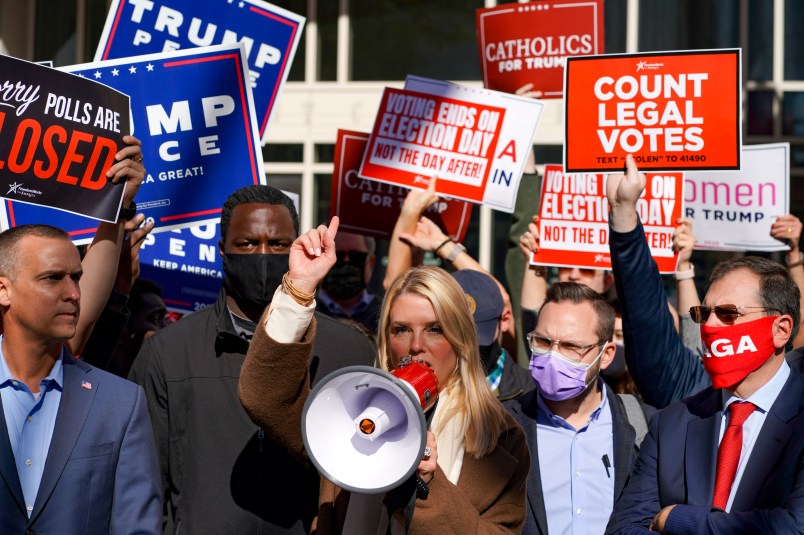
PHILADELPHIA, PA – NOVEMBER 5: Corey Lewandowski, left, and Pam Bondi speak to protestors, announcing that vote counting had halted and a judges order to allow observers within six feet of counting, outside the Pennsylvania Convention Center where election votes are being counted in Philadelphia, Pennsylvania, on November 5, 2020. People from both sides were gathered. Trump supporters questioning validity of some ballots and Biden supporters pushing for the count to continue. (Photo by Bonnie Jo Mount/The Washington Post via Getty Images)
Now It’s Hegseth’s Turn In The Barrel
WSJ: Trump Team Blindsided by Details of Sexual-Assault Allegation Against Hegseth
Politico: ‘Profound fear and anxiety among women in uniform’: Pentagon reacts to allegations against Hegseth
WaPo: Senate Republicans are more receptive to Hegseth despite Gaetz’s exit
Idaho Capital Sun: Trump’s Defense secretary nominee has close ties to Idaho Christian nationalists
David Becker, the executive director and founder of the nonpartisan Center for Election Innovation and Research, emphasized to TPM that he is not aware of “any state in American History that has given this important authority to a state auditor’s office.”
How Bad Was Salt Typhoon?
“The Chinese government espionage campaign that has deeply penetrated more than a dozen U.S. telecommunications companies is the ‘worst telecom hack in our nation’s history — by far,’ said Sen. Mark R. Warner (D-Virginia), chairman of the Senate Intelligence Committee.” –WaPo