

I was thinking about this post this morning and then I saw someone reference it on Bluesky. It’s from July 2016 (“This Is Not the Natural State of Things“) and notes that not only is the world of the last 80 years not permanent or unchangeable. It’s not even the natural state of things. The world we all grew up in, from the late 1940s to some point in the last decade, was the product of very conscious and deliberate decisions made largely in the United States but also in the capitals of Europe. For all its many imperfections and discontents it was a period of prosperity and security essentially unrivaled in history.
Suddenly, the Tune Changes
Hello it’s the weekend. This is The Weekender ☕️
In the days before law enforcement officials announced that they had found a suspect for the murder of Charlie Kirk in 22-year old Utahn Tyler Robinson, prominent figures on the right were out for blood.
Continue reading “Suddenly, the Tune Changes”The Difference Between the Coup Plotters Who Are Held to Account and Those Who Aren’t
This article is part of TPM Cafe, TPM’s home for opinion and news analysis. It was originally published at The Conversation.
Jair Bolsonaro’s conviction on Sept. 11, 2025, puts the former Brazilian president in a rogues’ gallery of failed coup plotters to be held to account for their attempted power grab.
Continue reading “The Difference Between the Coup Plotters Who Are Held to Account and Those Who Aren’t”Man Arrested in Killing of Charlie Kirk
A lot of things happened. Here are some of the things. This is TPM’s Morning Memo. Sign up for the email version.
Trump Revealed the Arrest on Fox News
After two different people were mistakenly nabbed as suspects in the assassination of right-wing extremist Charlie Kirk, President Donald Trump revealed Friday morning on Fox & Friends that the alleged assailant was finally in custody:
The bizarre spectacle of the president of the United States dribbling out news of the arrest and calling for the death penalty on a morning news show came after his FBI director had spent two days live-tweeting his own investigation and touting his relationship with the victim.
A couple of hours after Trump’s appearance on morning TV, law enforcement on the scene in Utah held a press conference announcing the arrest of a man suspected in the shooting and identified him as 22-year-old Utah resident Tyler Robinson.
“We got him,” Utah Gov. Spencer Cox declared.
Few details were immediately available about Robinson or his motives. The press conference in Utah was still underway as Morning Memo was published.
The arrest reportedly came late Thursday night in St. George, Utah, more than 250 miles away from where Kirk was killed Wednesday on the campus of Utah Valley University. Law enforcement had released new images and video Thursday of the alleged assailant fleeing the scene of the shooting. Investigators recovered a bolt-action rifle in a wooded area near campus.
The investigation under FBI Director Kash Patel has been marked by an even greater degree of confusion and chaos than is typical after a major incident, according to various reports. Patel and his top deputy, Dan Bongino, held a tense and desperate-sounding online meeting with some 200 agents Thursday morning: the NYT reported:
They expressed themselves with such fierce urgency that, in the view of some participants, it hinted at another motive: to prove they were up to the task.
The director wasted no time before calling out subordinates that he said failed to give him timely information …
Mr. Patel said he would not tolerate any more “Mickey Mouse operations,” an official on the call recounted. It was one of his few utterances without profanity, the person added.
Trump Leads the Way in Post-Shooting Vitriol
President Trump continued to lash out wildly in the aftermath of the Kirk shooting, before an arrest was made in the case or a motive established. “We just have to beat the hell” out of “radical left lunatics,” he said on the White House South Lawn.
White House deputy chief of staff Stephen Miller similarly poured fuel on the fire, posting on X:
There is an ideology that has steadily been growing in this country which hates everything that is good, righteous and beautiful and celebrates everything that is warped, twisted and depraved. It is an ideology at war with family and nature. It is envious, malicious, and soulless.
A Trump State Department official, also posting on X, suggested that visitors to the U.S. would be screened for social media comments “praising, rationalizing, or making light” of Kirk’s death.
Sign of the Times
A false report of an active shooter on the grounds of the U.S. Naval Academy led to an altercation between a midshipman and a law enforcement officer in which both were injured:
Amid the initial chaos and confusion on campus, the midshipman mistook a law enforcement officer for the shooter and struck him in the head with a parade rifle. The law enforcement officer then fired at the midshipman, wounding him in the arm, the officials said.
Appeals Court Judges Publicly Rip Supreme Court
In an extraordinary display of dissatisfaction with the Roberts Court’s unprecedented use of the shadow docket during the first few months of the Trump II presidency, the full 4th Circuit Court of Appeals publicly questioned during oral arguments Thursday how they’re supposed to follow the high court’s cryptic and often unexplained decisions.
Quote of the Day
“It has been observed that individual Americans are putting up more fight than many institutions. Those individuals are also smaller targets for the authoritarian president and his allies. They are less powerful. But that’s obviously why it’s more important for the institutions to engage and not to succumb to the climate of fear. That climate, after all, only exists if it goes unchallenged. There is no climate of fear without capitulation.”–Philip Bump
For Your Radar …
There’s a busy weekend ahead in Federal Reserve Board Lisa Cook’s legal challenge to her firing by President Trump. The D.C. Circuit ordered emergency briefing on whether to block the lower court order that temporarily reinstated her to Federal Reserve Board. An appeals court decision could come as soon as Sunday night, and the case could be at the Supreme Court by Monday.
Rare Oversight From the Senate GOP
Senator Michael D. Crapo (R-ID), chair of the Senate Finance Committee, sent a letter this week to the Social Security Administration following up on explosive revelations by the agency’s former chief data officer that DOGE had mishandled a database containing the confidential personal information of hundreds of millions of Americans. Crapo’s letter did not include a demand for documents.
Dem Senators Try to Stop Military Funeral for Ashli Babbitt
Sen. Ruben Gallego (D-AZ) tried to block the Pentagon from giving military funeral honors to Ashli Babbitt, the Jan. 6 rioter killed by law enforcement in the Capitol, but was stymied this week by Sen. Tommy Tuberville (R-AL).
How It’s Done
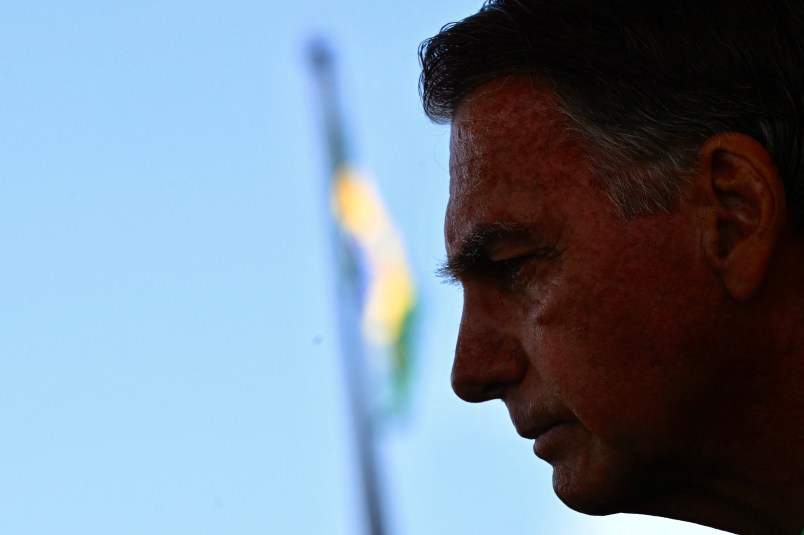
Former Brazilian President Jair Bolsonaro was sentenced to 27 years in prison for couping to overturn the 2022 election.
Pro-couping Secretary of State Marco Rubio condemned the outcome: “The United States will respond accordingly to this witch hunt.”
Do you like Morning Memo? Let us know!
We Remain Adrift in an Ocean of Lies: 30 Hours After the Charlie Kirk Shooting
Fire poured out of my eyes when I sat down at my computer and saw a Semafor email with the subject line “National Reckoning.” They cooled when I opened the email and saw the top item was a PPRI poll from March 2025. (“National reckoning” turns out to be from an Atlantic article about Kirk’s close relationship with the Trump family which was quoted in the email.) The poll contains the worrisome news that only 53% of Americans “completely disagree” with the statement that “political violence is sometimes necessary.” The story comes into clearer focus when the result is broken down by people’s view of Donald Trump. Only 39% of Trump supporters (those with a favorable view of him) believe this while 66% of his opponents do.
In other words, people who hold a favorable view of Donald Trump are overwhelmingly more likely to believe that political violence has a legitimate role in our society. The number of Trump supporters who believe this is 27% higher than that of his opponents. This is of course the least surprising thing imaginable to anyone who has lived in the United States or on earth for the last decade. But we live in a media ecosystem of ideational bullshit. So it yet comes as a breath of fresh air, a sublime encounter with reality.
Continue reading “We Remain Adrift in an Ocean of Lies: 30 Hours After the Charlie Kirk Shooting”We Don’t Even Talk About the Guns Anymore
A day after a gunman killed right-wing influencer Charlie Kirk, the internet has been ablaze with recriminations: exhortations from the center and left for both sides to “lower the temperature,” calls from the president and his followers on the right to exact revenge on liberals (despite the perpetrator being unknown and at large).
This is how the mass or particularly high profile shooting routine goes now — a mad dash to unveil the suspect’s identity (sometimes claiming the privacy and reputation of innocents along the way), the better to pin the violence on one political party or the other. It’s worth asserting, as some pundits seem to find it uncouth, that it’s simply true that right-wing extremists have killed far more people and tended to be more violent than their left-wing counterparts in the past few decades.
Still, it’s striking that discussion of guns, the tools virtually always used to carry out this violence, has all but fallen out of the national discourse. Even Democrats hardly bother to bring it up anymore.
I suspect this is the malignant influence of the Supreme Court at work. Even when a Republican administration can be moved to pass a restriction, its shelf life is limited.
In 2017, the Las Vegas music festival shooting was so particularly gruesome that even the Trump administration was roused to action. The Bureau of Alcohol, Tobacco, Firearms and Explosives (ATF) passed the bump stock ban rule, classifying the device as a machine gun and thus, illegal. A few years later, the Supreme Court knocked it down.
The Roberts Court has drastically expanded the Second Amendment — once thought to speak to militias — into an individual right to have firearms in the home. It knocked down New York’s century-old concealed carry law, expanding people’s ability to tote guns in public. (It did draw the line at letting domestic abusers carry firearms — except for Justice Clarence Thomas.)
The gun-friendly Court has made a near-impossible feat Sisyphean. We have a Republican Congress utterly unwilling to pass meaningful legislation to stem the scourge of gun violence, backstopped by a Supreme Court that sees the Second Amendment as untouchable.
It seems like, and currently is, a lost cause. Still, dropping the subject cedes significant ground to the right. The United States is not the only country with hyper-partisanship and an irresponsible, bloodlusty leader. It’s the guns.
— Kate Riga
GOP Rep Wants a Statue of Charlie Kirk
In the wake of the killing of Turning Point USA co-founder and online provocateur Charlie Kirk, some Republicans are pushing for the kind of commemorations often reserved for elected officials, military figures, and civil rights activists. Rep. Anna Paulina Luna (R-FL) — who previously worked for TPUSA — sent a letter to House Speaker Mike Johnson (R-LA) asking him to help create a statute of Kirk for the U.S. Capitol.
“This is not a symbolic gesture, but a permanent testament to his life’s work, his courage, and his sacrifice,” Luna wrote in the letter to Johnson. “It will stand as a reminder that political disagreement must never be answered with violence, and that the fight for truth must carry on.”
Trump ordered that flags be flown at half-staff in the wake of the shooting as well.
— Nicole Lafond
Tales from a Different Democracy
Jair Bolsonaro, the former president of Brazil and political and spiritual ally of Donald Trump, was found guilty this afternoon for his own plot to stay in office following his loss in the election.
“The government wanted to remain in power by simply ignoring democracy — and that is what constitutes a coup d’état,” Supreme Court Justice Alexandre de Moraes said Tuesday, according to the Washington Post. “The leader of the criminal group made it clear — publicly and in his own words — that he would never accept defeat at the ballot, a democratic loss in the elections, and that he would never abide by the will of the people.”
The conviction rolled out over several days, as justices announced their decisions one by one.
“They acted to hijack the soul of the republic,” said Justice Cármen Lúcia, who cast the third, deciding vote.
Brazil emerged from a military dictatorship in 1985, and prosecutors had argued that conviction of Bolsonaro was necessary to prevent a return to that era.
The former president will be sentenced this week, and faces decades in prison.
— John Light
In Case You Missed It
Insiders Describe the Trump FBI Clown Show in Vivid, Buffoonish Detail
Charlie Kirk Dead After Being Shot During a College Event in Utah
Yesterday’s Most Read Story
More Thoughts on the Kirk Murder
What We Are Reading
Florida officials watching for ‘vile, sanctionable’ behavior from teachers after Kirk killing
More Thoughts on the Kirk Murder
I wanted to share two-and-a-half follow-on thoughts about the murder of Charlie Kirk and everything that is coming in its wake.
We are now seeing an escalating campaign of valorization of Kirk, one that a lot of non-partisan media and certainly everyone in the conservative movement is contributing to. Quite a few of his opponents are getting carried along with this. At the same time, you have the more extreme members of the right calling for violent and/or legal retribution against the “left” based on essentially nothing. As usual, the call is led by none other than the president of the United States. Yesterday we noted that political violence and terrorism is the antithesis of civic or liberal democracy. Because of that, civic democrats have the greatest interest in opposing it. But the gist of the matter is that we oppose civic violence targeting anyone regardless of belief, regardless of the qualities of the person. It applies to everyone. We don’t need to elevate someone or pretend they were something they weren’t to express our opposition to political assassination. And we shouldn’t. Kirk was a hyper-aggressive partisan who advocated a lot of deeply retrograde beliefs. That is just a fact. Let’s not pretend otherwise. His murder is at the same time deeply wrong and a disaster for the country.
Continue reading “More Thoughts on the Kirk Murder”Listen To This: Put Up Or Shut Down
Kate and Josh discuss the great shutdown debate and the Roberts Court’s signaling on pocket rescissions.
Continue reading “Listen To This: Put Up Or Shut Down”Insiders Describe the Trump FBI Clown Show in Vivid, Buffoonish Detail
A lot of things happened. Here are some of the things. This is TPM’s Morning Memo. Sign up for the email version.
Desperate to Keep His Job, Patel Did the White House’s Bidding
A new lawsuit containing devastating allegations about the clownish politicization of the FBI calls into serious question whether the bureau — under the nominal control of Kash Patel — is up to the task of investigating a major case like the assassination of Charlie Kirk.
Hours before Patel befooled himself by live-tweeting the serial apprehension then release of two different people mistakenly believed to be Kirk’s assailant, three fired senior FBI officials described in vivid detail a bureau nearly crippled by the social media obsessions of Patel and his top deputy Dan Bongino.
The three men — former acting FBI Director Brian Driscoll Jr., Steven Jensen, and Spencer Evans — sued in federal court in D.C., claiming their terminations were political retaliation in violation of the First and Fifth Amendments and unlawful under other various protections for FBI employees. The named defendants are Patel, Attorney General Pam Bondi, the FBI, the Justice Department, the Executive Office of the President, and the United States.
The entire complaint is worth a read to appreciate the buffoonish of Patel and Bongino, but also of a White House that variously:
- used an inexperienced 29-year-old staffer to vet candidates to lead the FBI;
- refused to fix a clerical error that made Driscoll the acting director instead of the acting deputy director.
But the overall impression left by the lawsuit is far worse: an FBI supine to the Trump White House, led by feckless loyalists who easily wilt under pressure from the likes of deputy chief of staff Stephen Miller.
With striking specificity that suggests Driscoll kept contemporaneous notes, the lawsuit recounts numerous episodes in which Patel and Bongino claimed they were under pressure from the White House and MAGA trolls on social media. Patel even went so far as to admit that the purges of FBI officials are illegal, will result in lawsuits, and force him to be deposed, the lawsuit alleges.
“Patel explained that he had to fire the people his superiors told him to fire, because his ability to keep his own job depended on the removal of the agents who worked on cases involving the President,” the lawsuit alleges.
Putting pliant doofuses in charge of the FBI strengthens White House control of federal law enforcement, which Trump has long threatened and has now begun to use to exact retribution against political foes.
Kirk Gunman Still on the Loose
A manhunt continues this morning for the gunman who assassinated 31-year-old conservative activist Charlie Kirk on a university campus in Utah. Two different men were initially detained in connection with the shooting but were later released. Video from the scene appears to show the gunman on the roof of a nearby building immediately after a single shot struck Kirk in the neck.
Trump Threatens Broad Retaliation for Kirk Killing
The mix of public and social media reaction to the Kirk assassination is nearly unbearable to observe. Outside of the hotheaded reactions, it was striking that some mainstream news outlets veered into lionizing Kirk despite his extreme politics. At MSNBC, commentator Matthew Dowd was fired for inartful on-air comments that noted Kirk’s extremism, despite his apology that he hadn’t intended to blame Kirk for his own shooting.
All of that, though — even the wave of right-wing threats of retaliation — paled next to the president of the United States making a televised address from the Oval Office attacking the “radical left” and suggesting he would use the power of the federal government to go after his political foes as payback for Kirk’s death:
One Trump dynamic on display here is that when bad things happen on his watch he reasserts some semblance of control by raging louder. Powerless to events, he projects power with anger, reactivity, and threats. Even when he is the one in charge, he becomes the complainer-in-chief, Karen-ing his way to the front of the line to see the manager. It suits the media of TV and social media, even if in the real world it tends to emphasize weakness and ineptitude.
Trump DOJ Retreats From Bogus Claim in Court
When Kirk was assassinated, I was listening in on a federal court hearing in D.C. on the Trump administration’s aborted Labor Day removals of hundreds of unaccompanied Guatemalan children. The most newsworthy development to come out of the hearing on a preliminary injunction was the Trump DOJ retreating from its prior position that the parents of the children had requested their repatriation.
In what is now a predictable pattern from the administration, DOJ official Drew Ensign made certain factual representations during an emergency hearing over the Labor Day weekend. Those representations later turned out to be false, misleading, or incomplete. A different DOJ lawyer showed up in court with a modified position so the judge can’t take Ensign to task.
In yesterday’s hearing, U.S. District Judge Tim Kelly noted how the government’s representations have “evolved.” Kelly didn’t immediately rule, but he seemed inclined to issue a preliminary injunction barring removals of minor children without giving them the due process required under the law. He seemed mostly interested in determining how broadly he can legally craft such an injunction.
More Bad Facts in U.S. Attack on Venezuelan Boat
The NYT (and later the WSJ) reported that in the moments before the U.S. Navy attacked an alleged drug-running boat off the coast of Venezuela it had appeared to turn back toward shore, further undermining the shaky legal claim that the United States was acting in self-defense.
There was already enough wrong with this incident, as Georgetown law professor Marty Lederman writes in a new piece for Just Security: The Many Ways in Which the September 2 Caribbean Strike was Unlawful … and the Grave Line the Military Has Crossed.
Quote of the Day
“This situation brings us the closest we have been to open conflict since World War II.”– Polish Prime Minister Donald Tusk, on the first time NATO planes have engaged Russia over allied airspace
Purge Watch
- On a 2-1 vote, the D.C. Circuit Court of Appeals overruled the district court and reinstated Shira Perlmutter as the register of copyrights at the Library of Congress while the appeal of her case continues.
- Greg Sargent: The judge used Trump’s own tweet against him to buttress the case that he unlawfully fired Federal Reserve Board member Lisa Cook.
Bari Weiss in Line for Major Role at CBS News
Indebted to the Trump White House for facilitating its acquisition of CBS, the merged company’s new owner is poised to buy Bari Weiss’ Free Press and give her a prominent role as editor in chief or co-president of CBS News, the NYT reports.
The Topsy Turvy Epstein Scandal
The first casualty of the renewed, through-the-looking-glass version of the Jeffrey Epstein scandal ends up being … the British ambassador to the United States.
Do you like Morning Memo? Let us know!
The Death of Charlie Kirk
I don’t have much to share on the death of Charlie Kirk beyond what I suspect is obvious. We want a society where political participation and activism, even things we disagree with or find despicable, can take place without the threat of violence. This isn’t just a general belief that we don’t want people to be hurt or die by violence. It’s the basis of the society and political order we want to live in and which at this very moment is under a graver threat than at any time in our lifetimes.
Right-wing violence, both of an organized paramilitary sort and by radicalized loners, has become such a scourge in recent years that on the extremes you hear voices for things like armed versions of Antifa and the like as some sort of counter. My point is not to equate the two. It is to note that when elections, speech and non-violent political activism give way to paramilitary and political violence the forces of civic democracy have already mostly lost the battle. Fascists do civil violence better than civic democrats. It’s a foundational element of their political philosophy. It’s the verdict of logic and history.
Continue reading “The Death of Charlie Kirk”