

Trump diehard Rep. Andy Biggs (R-AZ) clutched onto ex-President Donald Trump’s lies about the 2020 election on Thursday during an Oversight Committee hearing on Cyber Ninjas’ shambolic “audit” of the election results in Maricopa County, Arizona.
Continue reading “Biggs Clings To Big Lie During Cyber Ninjas Hearing: ‘We Don’t Know’ Who Won Arizona”Reconciliation Is Risen
A new episode of The Josh Marshall Podcast is live! This week, Josh and Kate recap the abrupt resurrection of the reconciliation package last week, and look ahead to the debt ceiling standoff.
You can listen to the new episode of The Josh Marshall Podcast here.
Whoa Nelly
The deepest corruption surrounding the Big Lie was Trump’s weaponization of the Justice Department. Big new report from the Senate Judiciary Committee just out this morning on exactly that aspect of the conspiracy.
READ: Senate Report On Trump’s Attempts To Weaponize DOJ To Overturn 2020 Election
Some Key Takeaways:
- The report zeroes in on the Jan. 3 Oval Office meeting with DOJ bigwigs.
- Jeff Clark spearheaded the campaign to have the DOJ declare the election corrupt.
- DOJ leadership threatened to resign en masse if Trump installed Clark as acting attorney general.
- White House Counsel Pat Cipollone and his deputy Patrick Philbin threatened to resign as well.
- The panel confirmed that Trump wanted to fire U.S. Attorney for the Northern District of Georgia BJay Pak because he believed the prosecutor was a “never-Trumper,” sparking Pak’s forced resignation.
- Rep. Scott Perry (R-PA) played a key role in pressing a DOJ official to participate in the Big Lie.
The Senate Judiciary Committee released a sweeping, 400-page report on Thursday delving into former President Trump’s attempts to wield the Justice Department to subvert the 2020 election.
Continue reading “READ: Senate Report On Trump’s Attempts To Weaponize DOJ To Overturn 2020 Election”Guy Running Wisconsin’s Fake Election ‘Audit’ Admits He Doesn’t Know How Elections Work
A lot of things happened. Here are some of the things.
Kudos For The Honesty?
Former Wisconsin Supreme Court Justice Michael Gableman, who baselessly claimed the 2020 election was “stolen” from Trump and who’s been appointed to lead the Wisconsin GOP’s Arizona-inspired review of the election results, is remarkably candid about his credentials.
- Election laws are “not intuitive,” and “no one can call elections laws common sense,” Gableman claimed in a Milwaukee Journal Sentinel interview this week. “Once you understand them, it may be common sense but it’s not intuitive.”
- Here’s the kicker: “And so most people, myself included, do not have a comprehensive understanding or even any understanding of how elections work.”
- Wisconsin Assembly Speaker Robin Vos (R) has given Gableman $676,000 in taxpayer funds to run the so-called audit.
- Oh and Gableman went to MyPillow CEO Mike Lindell’s ridiculous “Cyber Symposium” last month.
Kicking The Debt Ceiling Can Down The Road
Senate leaders worked late into the night on the new tentative deal to extend the debt ceiling until December.
- The final details are still being hammered out amid vigorous debate over whether this was a McConnell cave or merely setting Democrats up for more headaches down the road.
- A vote on the tentative deal is expected this week, but the exact timing remains uncertain.
Texas Abortion Ban Is Temporarily Blocked By A Judge
U.S. District Judge Robert Pitman on Wednesday put out an order that bars state court judges, court clerks and any other state officer from enforcing Texas’ six-week abortion ban that allows a private citizen to sue anyone they believe helped provide an abortion and collect $10,000 from the defendant if the citizen wins the suit.
- Under Pitman’s order, the officers are prohibited from “accepting or docketing, maintaining, hearing, resolving, awarding damages in, enforcing judgments in, enforcing any administrative penalties in, and administering any lawsuit” under the law.
- “From the moment” the ban went into effect, “women have been unlawfully prevented from exercising control over their lives in ways that are protected by the Constitution,” the judge wrote in his decision.
- Pitman’s order isn’t the final word in the fight over the law. Anti-abortion group Texas Right to Life signaled that the case will be brought before “a higher court.”
UPDATED: Important New Details On Critical Jan. 3 White House Meeting
Last night, the New York Times obtained a copy of the Senate Judiciary Committee’s interim report on the final stages of Trump’s desperate attempt to weaponize the Justice Department to cling to the presidency several days before the Jan. 6 Capitol insurrection. This morning the report was released publicly.
- White House counsel Pat Cipollone joined top DOJ officials’ threat to resign en masse in Trump’s infamous meeting with them on Jan. 3, during which the then-President laid out a plan to install loyalist Jeffrey Clark as acting attorney general, according to the Times’ report on the committee’s findings.
- The interim report contains other new details on Trump’s crusade to overturn the election, per the Times, including more information on Clark and Rep. Scott Perry’s (R-PA) roles in the scheme.
- The report also firms up the sequence of events leading to the abrupt resignation of then-U.S. Attorney Byung “BJay” Pak in Atlanta, as first reported by TPM.
Sanders Refused To Condemn Protests Against Sinema Unless …
Sen. Bernie Sanders’ (I-VT) office told Sen. Cory Booker’s (D-NJ) staff that the Vermont senator wouldn’t sign Democrats’ joint condemnation of the protests against Sen. Kyrsten Sinema (D-AZ) unless it included the language, “While we hope Senator Sinema will change her position on prescription drug reform and support a major [budget] reconciliation bill …”
- Read copies of the exchange between the senators’ staff obtained by Axios reporter Alayna Treene:
Congress Scrutinizes Cyber Ninjas/Ninja Turtles
The House Oversight Committee will hold a hearing this morning on Cyber Ninjas’ disastrous audit of Arizona’s 2020 votes that was commissioned by state Republicans (and which ultimately failed to prove Trump won Arizona).
- Doug Logan, the CEO of Cyber Ninjas who repeatedly peddled pro-Trump conspiracy theories about the election on Twitter, was invited to the hearing. It doesn’t seem like he’ll be coming, though.
- Sen. Dick Durbin (D-IL) gave a shout-out to the “ninja turtles” yesterday during a Senate Judiciary Committee hearing:
Lewandowski Demanded Money In Exchange For His Banishment
Before he was jettisoned by Trumpworld over allegations of sexually harassing a Trump donor, Corey Lewandowski, who led the pro-Trump Make America Great Again Action superPAC, demanded hundreds of thousands of dollars for his resignation, according to the Daily Beast.
- Trump’s response was essentially “LOL no,” the Daily Beast reports.
Texas GOPers Screech About The Border Amid A School Shooting
“This is one of, if not the most, urgent matter[s] that we’re facing in the United States at this time,” Texas Gov. Greg Abbott (R) declared yesterday after at least four people were injured in a high school shooting in Arlington.
- Oh, you didn’t think he was talking about the shooting, did you? Nah, Abbott was bloviating about Biden’s immigration policies during a PR stunt at the border.
- Sen. Ted Cruz (R-TX) managed to spare a few words about the shooting before promptly getting back to business:
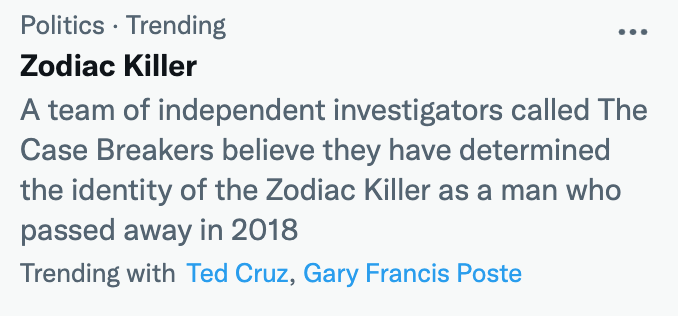
- But maybe Cruz, who may or may not be the Zodiac Killer, could’ve been too distracted by a team of private investigators’ unconfirmed claim to have discovered the identity of the killer yesterday to do a better job of reacting to the school shooting, a development that didn’t go unnoticed by the internet:
Do you like Morning Memo? Let us know!
Dems Declare Victory On Debt Ceiling With Short-Term Extension
Senate Democrats will accept a short-term increase in the debt limit that would raise the ceiling high enough to stave off default until December, a kick-the-can quick fix floated by Minority Leader Mitch McConnell (R-KY) on Wednesday afternoon. Democrats will reportedly not accept an increase in the debt ceiling through budget reconciliation.
The situation sets up a new debt-ceiling showdown for later in 2021.
Follow our live coverage below:
Abject Fold
Where Things Stand: Grassley Congratulates Korean-American Nominee On ‘Work Ethic’ Of ‘Your People’
If confirmed, Lucy Koh, one of President Biden’s judicial nominees, would become the first Korean American to serve as a U.S. appeals court judge.
During the start of her confirmation hearing before the Senate Judiciary Committee today, ranking Republican Sen. Chuck Grassley (R-IA) — an 88-year-old who just announced he’s running for another six-year term — made a remark that could only be interpreted as wildly inappropriate, at best, and pretty racist, at worst.
Continue reading “Where Things Stand: Grassley Congratulates Korean-American Nominee On ‘Work Ethic’ Of ‘Your People’”First Major Second Amendment Case Before Supreme Court In Over A Decade Could Topple Gun Restrictions
This article is part of TPM Cafe, TPM’s home for opinion and news analysis. It first appeared at The Conversation.
The stakes in one of the most significant Second Amendment cases in U.S. history are high.
The Supreme Court’s ruling in New York State Rifle & Pistol Association v. Bruen, expected by mid-2022, could declare a New York state restriction on carrying concealed handguns in public places unconstitutional.
Such a ruling in favor of the plaintiffs, which include a National Rifle Association affiliate, could loosen gun regulations in many parts of the country.
In my view as a Second Amendment scholar, this case is also noteworthy in that how the court reaches its conclusion could affect the Second Amendment analysis of all weapons laws in the future.
The court is set to hear oral arguments on Nov. 3.
Long on the books
In 1911, after an increase in homicides, New York instituted a handgun permitting system. In 1913, the permitting system was amended to address concealed carrying.
For more than a century, someone seeking to carry a concealed handgun for self-defense in the state has needed to file a permit application showing that they have what the law calls “proper cause.”
To obtain an unrestricted permit, applicants must “demonstrate a special need for self-protection distinguishable from that of the general community,” such as by showing they are being stalked.
New York’s attorneys defend this restrictive approach to issuing concealed carry permits as an effective means to reduce gun violence. In 2020, there were 43,592 gun deaths in the United States, including suicides and homicides. There are also over 80,000 non-fatal firearm injuries each year.
New York has some of the strictest gun laws in the country, and its homicide rate is below the national average.
The plaintiffs
Robert Nash and Brandon Koch were denied unrestricted concealed carry permits because a judge determined that they did not satisfy New York’s proper-cause standard.
Instead, Koch was issued a license to carry a concealed handgun for self-defense while traveling to and from work. Both plaintiffs’ licenses also permit them to carry concealed handguns for hunting and target practice, and for self-defense in areas not “frequented by the general public.”
Along with the NRA’s New York affiliate, Nash and Koch contend that these limitations on their ability to carry a concealed handgun violate their right to bear arms. They assert a broad view of the right to carry a handgun, one that extends virtually “whenever and wherever” the need for self-defense might arise.
New York’s law defies that conception of the Second Amendment.
The Heller ruling’s muted effects
In considering Bruen, the Supreme Court will focus on the meaning of an important precedent: District of Columbia v. Heller.
When the Supreme Court issued its Heller ruling in 2008, a 5-4 majority struck down Washington, D.C.‘s ban on the possession of handguns in the home. The court held for the first time that the Second Amendment protects an individual’s right to keep and bear arms.
Writing for the majority, the late Justice Antonin Scalia declared that the “central component” of the Second Amendment was not a “well regulated Militia,” but rather “the inherent right of self-defense.”
But the majority’s decision included cautionary language that lower-court judges have since relied on to uphold gun laws.
“The right secured by the Second Amendment is not unlimited” and is “not a right to keep and carry any weapon whatsoever in any manner whatsoever and for whatever purpose,” Scalia wrote. His opinion even contained a list of “presumptively lawful regulatory measures,” such as restrictions on the possession of firearms by felons or bans on carrying them in sensitive places like schools and government buildings.
The NRA and other gun rights supporters have bristled at the general acceptance by judges of the constitutionality of laws restricting firearm use.
That discontent culminated in Bruen.
More and more states have allowed concealed handguns
In 1980, most Americans lived in places that either banned concealed carry or had a New York-style “proper cause” permitting regime. An NRA push beginning in the late 1980s loosened public carry laws around the country.
In states where gun rights advocates possess relatively little clout, gun rights supporters hope that Bruen will accomplish through the courts what they have failed to accomplish through the political process.
Today, New York is one of eight states requiring that people seeking to carry concealed handguns have a “proper” or “good” cause. California, Delaware, Hawaii, Maryland, Massachusetts, New Jersey and Rhode Island have similar laws on the books.
If the court strikes down New York’s law, Americans in those states could expect an increase in the number of people legally carrying handguns in their communities. Anyone who wants to carry a concealed handgun would have an easier time doing so.
A ‘text, history and tradition test’
Bruen could also be a turning point for how judges evaluate all Second Amendment cases – whether they’re about assault weapons, tasers or felon-in-possession offenses.
Until now, judges have generally assessed whether such restrictions are justified by current public safety concerns.
Many gun rights advocates are asking the Supreme Court to reject that approach. Instead, they want judges to decide cases on the sole basis of history and tradition unless the judiciary’s interpretation of the text of the Second Amendment resolves the issue. This is known as the “text, history and tradition” test.
Justice Brett Kavanaugh is credited with first articulating this test in a dissent he issued prior to his rise to the Supreme Court.
Justices Clarence Thomas, Neil Gorsuch and Amy Coney Barrett all have embraced similar judicial philosophies to some degree.
But there’s a catch: Guns have always been regulated in America.
New York’s regulation has been on the books for over a century and had a legacy that extended back even further.
If the justices abandon a conventional approach for the text, history and tradition test, I would expect a new round of lawsuits over weapons laws that have already survived prior court challenges. Gun rights advocates would likely, for example, sue over restrictions on large-capacity magazines or safe storage requirements in places where those issues have already been resolved.
This litigation would call on judges to rule on the sole basis of a difficult historical exercise: comparing modern laws addressing modern guns and contemporary gun violence to the laws, practices and weapons of a bygone era.
Trump’s justices may tip the scales
The court has three main options.
It could uphold New York’s law. It could strike it down. Or it could find a middle ground, such as issuing a narrow ruling that punts big questions about gun restrictions down the road.
Chief Justice John Roberts has steered his colleagues toward narrow rulings before. But he will hold little sway if the three justices former President Donald Trump appointed team up with Samuel Alito and Clarence Thomas, the court’s two other conservatives, on a far-reaching majority opinion.
Trump conferred with the NRA before nominating Gorsuch, Kavanaugh and Coney Barrett – all of whom received the gun group’s blessing.
The ruling will underscore the significance of their presence on the court.
Eric Ruben is an assistant professor of law at Southern Methodist University.
This article is republished from The Conversation under a Creative Commons license. Read the original article.
Here’s Why McConnell Blinked
Why is Mitch McConnell blinking? Let’s be clear: this is a blink, not a cave. There’s a lot to play out. But here is the gist. Democrats refusal to budge on using reconciliation to beat Republicans’ repeated filibusters is moving quickly toward a situation where there will literally be only two options: filibuster carve-out or debt default. Those are both very bad options to McConnell. As I noted yesterday, this isn’t a matter of saying “Oh Democrats are tougher. They won’t cave.” It’s that the mechanics of reconciliation will mean there’s no more time. They’ll have no way to cave. That calendar reality creates a very bad situation for McConnell.
Continue reading “Here’s Why McConnell Blinked”