


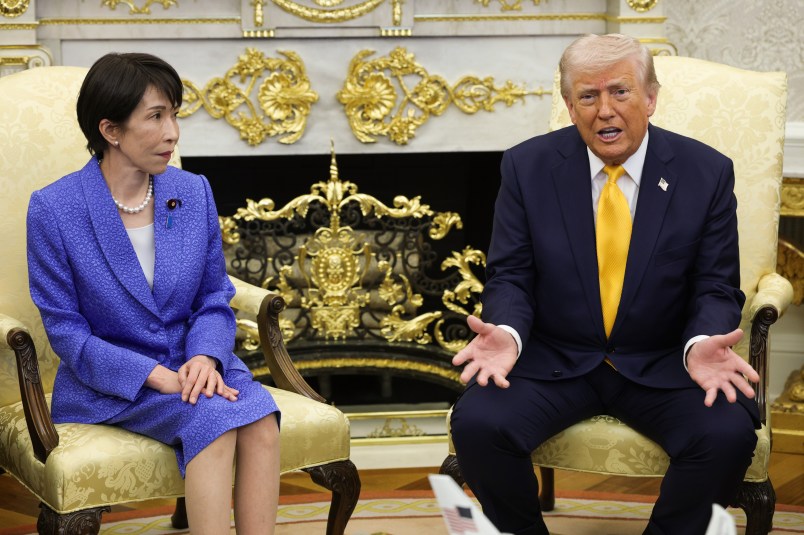
During a Cabinet meeting at Camp David on Friday, President Donald Trump touted growing “investment” into the U.S. since he took office.
“There’s never been anything like it from the standpoint of investment into our country,” Trump told reporters and members of his administration. “It’s five to six times higher than anybody has ever seen, than any other country, not just us, has ever had.”
Part of a diatribe about the economy which included a segment about his tariffs, the president was likely referring at least in part to the several trillions of dollars in foreign investment commitments his White House announced beginning last year after Trump leveraged threats of historically high tariffs as a bargaining chip with various countries. (The president employed equally aggressive tactics to elicit financial commitments and expensive gifts from U.S. companies including tech giants Apple and Nvidia.) There’s even a whole page on the White House website titled, simply, “Investments,” touting $10.7 billion in U.S. and foreign investment commitments beneath pulsating text that reads “The Trump Effect.”
The webpage frames the numbers as if they’re dollars already spent. But in many cases, they aren’t.
“The Trump approach remains to be seen,” Ryan Mulholland, a senior international economic policy fellow at the Center for American Progress, a left-leaning think tank, told TPM.
A year ago, international trade experts and economists told TPM that many foreign governments were playing Trump. Today, some investment agreements are already underway, while others have virtually no mechanism to be executed at all. It remains to be seen whether Trump’s stick approach to foreign economic relations will send real dollars flowing to U.S. companies and workers — or whether it’s just one more way for Trump to enrich himself, his family and companies allied with the president.
‘Where do these deals leave us?’
New money coming from foreign governments to the U.S. is up compared to last year, according to data from the Bureau of Economic Analysis. And commitments for 2026 made in 2025 are much higher than those made in 2024. But they’re not the highest in history. New foreign investment commitments were nearly $20 billion higher under former President Joe Biden in 2022. And their impact on U.S. prosperity is much more of a mixed bag.
There’s no indication that new foreign investment in the U.S. stems from Trump’s trade deals, according to available federal data. And most deal-related boosts won’t show up in the most recent figures from the BEA. What is apparent in the data, though, are high-tech investments into the AI industry — new investments that are separate from Trump’s trade policy agreements, a late June research paper from the Federal Reserve showed.
The economic hallmark of Trump’s second presidential term are his tariffs, which his administration has said are aimed at correcting long-running imbalances between the U.S. and its trading partners. One of his attempts at correction — to levy blanket tariffs using a 1970s era law — was struck down by the Supreme Court. A second tariff scheme using a different provision was blocked by a lower court, too. Small businesses are suing Trump right now to overturn his administration’s third attempt at reordering global trade through tariffs, which SCOTUS ruled were a tax on the American people. All the while, Trump and his officials are hammering home the idea that the president’s savvy salesmanship has saved a failing American economy.
“I think other countries have largely figured out that they can give Trump a sort of headline that he likes, and in exchange win all of the details of a trade deal,” Mulholland said.
“Where do these deals leave us? Are we in a better position to create prosperity for everyday people? Are we in a position to work with our partners and allies around the world to solve the challenges that impact people’s lives? I think on both of those scores,” Mulholland continued, “Trump’s very sort of short-term, zero sum kind of view of trade relationships has hurt us.”
Trump is prepared to act if foreign governments fail to uphold their agreement terms, White House spokesman Kush Desai told TPM in an email.
“President Trump means what he says, and he has never hesitated to leverage the might of the American economy to hold trading partners accountable to their agreed-upon commitments,” Desai said.
Meeting Trade Commitments Will Prove ‘Very Difficult’ for Most Countries
Japan agreed to invest $550 billion in U.S. manufacturing sectors including semiconductors, pharmaceuticals, and the shipbuilding industry with special financing provisions that mean Japan will pay for the projects at little cost to America. That deal, along with commitments on U.S. tech and manufacturing investments from Taiwan and shipbuilding from South Korea, has progressed the most.
“I guess the only place where we’ve seen some action is really on Japan’s commitments. “The conditions are [once] the project is approved, the Japanese government is obligated to provide financing for it,” Greg Auclair, a statistician and researcher at the Peterson Institute for International Economics, told TPM. “That’s a very small list right now.”
Already, Japan and Taiwan have poured about $75 billion into the U.S., Auclair said, though he noted that opaque commitment terms and novel financing mechanisms make it harder to know whether those investments are one-to-one correlations with the trade deals.
Auclair co-published a report suggesting foreign governments will have a hard time financing their commitments to the U.S. Auclair showed that even if some countries with commitments to Trump tap significant portions of their investment capacities and turn them toward the U.S., those nations would still struggle to fulfill their pledges over a 10-year timeline.
“I don’t think they will all be fulfilled,” Auclair’s co-author Adnan Mazarei told Politico in January.
Countries would essentially have to rob Peter to pay Paul — reallocating import schema to benefit the U.S. at the expense of other trading partners, selling foreign assets to purchase more American ones, and bumping up against their own debt capacities.
“Putting everything together,” Auclair told TPM, “it would be possible for them to meet the pledges but very difficult.”
An update to Auclair’s January report will show that the first year of Trump’s presidency saw foreign investment in the U.S. align with the long-run average, he said, pushing back on Trump’s narrative of historic inflows of foreign cash.
In some cases, Trump’s overbearing tactics have pushed countries to take the opposite tack, reducing exposure to the U.S. economy while creating historic trade agreements with other countries.
The European Union in January closed a deal with several South American countries that’d been more than two decades in the making. The bloc of 27 European countries also closed a “landmark” free trade deal with India in January to protect against growing U.S. trade volatility. A bloc of South American countries are now in talks with Japan, and Canada is diversifying its economy away from the U.S. as evidenced by a recent electric vehicle deal with China.
“So there are a lot of instances where governments are seeking to reduce their exposure to the United States, and that is a direct result of Trump’s belligerence on the world stage,” Mulholland said.
Future U.S. presidential administrations, he added, will be limited as a result.
“[Other countries’] ability to negotiate kind of new things with the United States,” Mulholland said, “is going to be hamstrung by commitments that they’ve already made to each other in the deals they did to reduce their exposure to the Trump administration.”
This article has been updated to include a statement from the White House.
This article has been updated to correct the amount of new and planned investment from Japan and Taiwan. It is $75 billion. TPM regrets the error.




“It remains to be seen whether Trump’s stick approach to foreign economic relations will send real dollars flowing to U.S. companies and workers — or whether it’s just one more way for Trump to enrich himself, his family and companies allied with the president.”
I can’t explain it, but I’ve got this weird feeling that it’s just one more way for Trump to enrich himself, his family and companies allied with the president.
This is good reporting that confirms that Shitler’s deal-making is his usual mix of big headlines and empty results, sort of like the sizzle from a Trump steak.
PFFT… The TRUMP EFFECT… take reasonably healthy country and turn it into an Oligarchy that enriches the few and fucks the many.
The through line is theft, always theft.
That White House website has become such a joke.