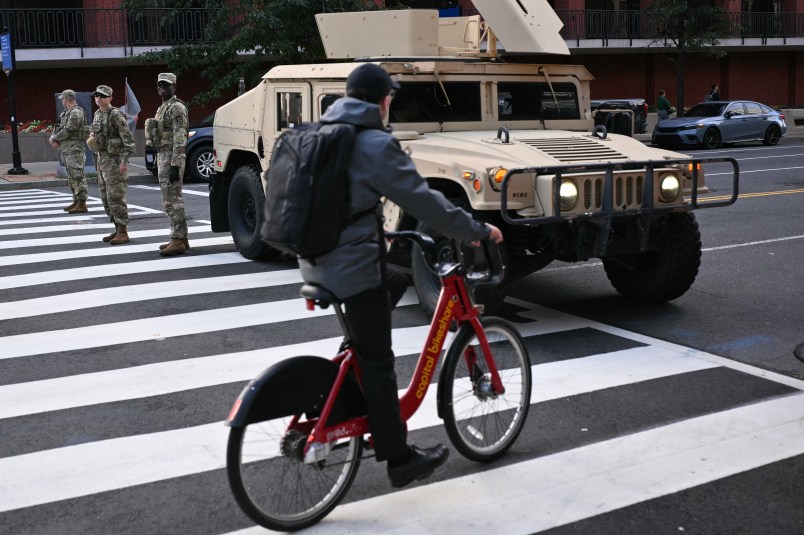
More than a year after President Donald Trump deployed the National Guard into Washington D.C. on a broad crime-deterrence mission, the once unthinkable scene of armed soldiers patrolling American streets has become the daily backdrop. A panel of the D.C. Circuit Court of Appeals on Wednesday delved into how long that would continue.
The lawyer for the city described “issues where the National Guard is posting troops near ballot drop boxes, issues where the National Guard is sending troops to residential neighborhoods far from any federal property or interest, dramatically altering life in the district.”
But the panel — composed of three appointees of Democratic presidents — seemed to struggle with the district’s lessened sovereignty, as it’s long been deprived of the statehood its inhabitants want. The president and Congress have broad power over the district, though the city argued Wednesday that there are still some restraints that prevent Trump from deploying both D.C. and out-of-state Guard for a now four-year-long mission with no inciting event.
“All it takes is a request, and two of the three people who are listed as requesting are people the president controls — it’s not much of a speedbump, it just is one,” said Judge Cornelia Pillard, an Obama appointee.
The administration resisted that characterization, as it would likely struggle to find pretext to redeploy the Guard, should the court force the current occupation to end.
The district court ruled in November that the deployment was unlawful; the president has the authority to mobilize the Guard to protect federal property, wrote Judge Jia Cobb, but cannot unilaterally deploy the guard for general crime fighting. She stayed that order to give the administration time to appeal.
This summer, Trump extended the Guard occupation through 2029, saddling the taxpayer with a daily price tag estimated to exceed $3 million.