

This article is part of TPM Cafe, TPM’s home for opinion and news analysis. It was originally published at Balls and Strikes.
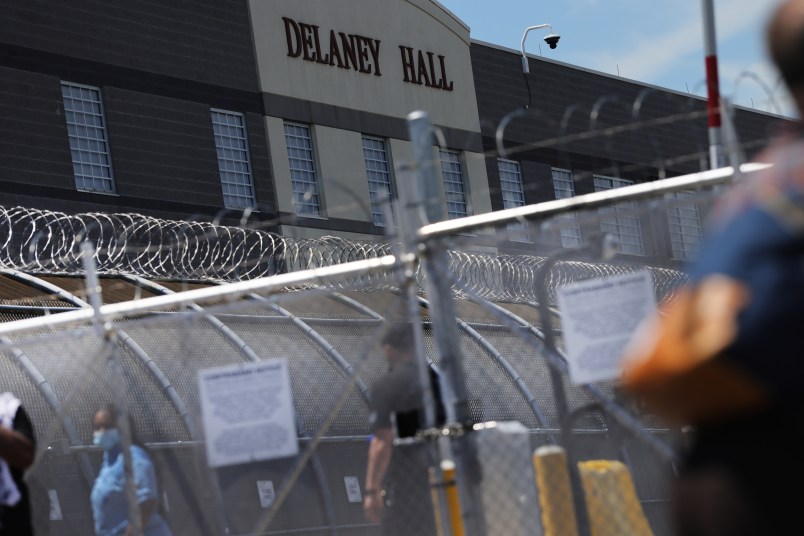
For the past several weeks, hundreds of detainees at Delaney Hall, an immigration detention center in Newark, New Jersey, have been on a labor and hunger strike. Participants in the strike are refusing to perform their work assignments or eat meals in protest of what they describe, in a series of handwritten letters smuggled out of the facility, as “unlawful and forced detention” and “inhumane treatment” that violates their constitutional rights. Among the myriad “injustices and irregularities” named in the letters are rotten food riddled with worms; persistent “unresolved issues” with bathrooms in “terrible and inhumane” condition; and detainees being forced to work for practically pennies or, more often, for no pay at all.
Delaney Hall was the first immigration detention center to open during President Donald Trump’s second term in office. And like almost all immigration detention facilities, Delaney is owned and operated by a private prison corporation. GEO Group, a company valued at approximately $3.3 billion, signed a 15-year contract with Immigration and Customs Enforcement in February 2025, providing ICE with the facility and “support services” like security, maintenance, and food services, in exchange for over $60 million annually.
But it is the detainees—not GEO Group—who actually do that work.
“We were the ones who shoveled the snow during the winter,” said one Delaney Hall detainee, in a statement provided to The American Prospect last week. “We are the ones serving the food, we are the ones who clean the units, we are the ones who clean the bathrooms.” American Friends Service Committee, a Quaker-founded social justice organization working with the immigrants at Delaney Hall, also said in a press release that detained workers can go months without receiving even the pittance they were promised, if they are compensated at all.
Forced labor practices like these are pervasive throughout ICE detention centers. In February, for example, the Supreme Court ruled on an immigrant labor case involving a GEO Group-operated facility, in Colorado. The company’s “so-called Sanitation Policy,” as Justice Elena Kagan referred to it in her majority opinion, required detainees to clean all of the facility’s common areas without pay or risk increasingly severe punishments, including solitary confinement. Additionally, “the so-called Voluntary Work Program” offered detainees a dollar a day for other necessary work like preparing food and doing laundry.
Former detainees had sued, arguing that these policies violated the forced labor provision of a federal anti-trafficking law, as well as Colorado’s prohibition on unjust enrichment. And GEO Group tried to get the case dismissed, claiming it was following directions from the government, so the trial cannot proceed. The Supreme Court didn’t buy it, which means that the case, GEO Group v. Menocal, can at least proceed to a jury trial.
Among the reasons GEO Group does not like trials: Trials can be very expensive for GEO Group, cutting into the money they make by coercing detainees to work for free. In a 2017 case involving another GEO Group-run ICE facility, the state of Washington and migrants detained at a detention center in the state both sued the company for violating Washington’s Minimum Wage Act. GEO Group fulfilled its contractual obligations with ICE by relying heavily on detainees whom it paid only one dollar a day, which GEO Group estimated saved it from having to hire 85 additional full-time employees. In 2021, a jury awarded the detainees roughly $17.3 million in back pay, and the court awarded $5.9 million in unjust enrichment to the state. GEO Group appealed, but the Ninth Circuit affirmed the ruling last year.
Since Trump’s return to office, the legal landscape has started to shift. Last year, in early January, the National Labor Relations Board filed a formal complaint against GEO Group. The NLRB alleged that GEO Group violated the rights of workers detained at an ICE facility in California by punishing the organizers of a labor and hunger strike with solitary confinement and transfers out of state. Within a few weeks of the complaint’s filing, however, Trump reentered the White House and fired members of the NLRB, and the remolded agency withdrew the complaint.
Forcing immigrant detainees to work for their captors isn’t just exploitative. It’s unconstitutional. The Thirteenth Amendment explicitly prohibits slavery and indentured servitude, except “as a punishment for crime whereof the party shall have been duly convicted.” But immigration detention is a form of civil confinement. People held in detention centers are simply waiting—behind bars—for the resolution of their immigration cases. This is punitive in practice, but not in law, as they are incarcerated, but not in prison. Only 12 percent of the people who have been detained at Delaney Hall since it opened have ever been convicted of anything.
By gutting the NLRB, Trump made it easier for corporations like GEO Group to profit off of unpaid, unconstitutional labor. And it’s not the only way he is doing so. Policies embraced by the Trump administration in his second term have caused immigration detention to skyrocket. Instead of targeted arrests, ICE uses indiscriminate raids and roving patrols. Instead of going after “the worst of the worst,” as the administration often claims to, it is going after people who are doing everything right, arresting migrants when they show up to court proceedings and ICE check-ins. Instead of granting discretionary releases, the administration has pushed for more mandatory detention.
At the same time, the One Big Beautiful Bill Act of 2025 is providing ICE with tens of billions of dollars to finance more human warehouses. According to the American Immigration Council, there were 40,000 people in immigration detention when Trump took office in January 2025. By mid-January 2026, the detainee population soared to a record high of 73,000, reflecting an increase of over 75 percent.

The strike at Delaney Hall is not an isolated incident. In recent weeks, hundreds of other immigration detainees across the country have participated in similar strikes. But Homeland Security Secretary Markwayne Mullin told reporters last week that “only a handful” of detainees at Delaney were refusing to eat, and it was because they wanted “ethnic” food.
In their letters, the migrants write that GEO Group is failing to “meet the basic conditions necessary to protect our health and our lives.” And as one recently-released Delaney detainee quipped, in an interview with The Guardian last week, “If we are going to be detained for months so this company can profit, they should at least provide a better service.”
Since reentering the White House, Trump has waged an aggressive campaign to detain and deport people of color—building more detention infrastructure, arresting more people, and releasing fewer. And as the immigration detention population grows, so too does the nation’s Thirteenth Amendment crisis.







Slavery never ended in America.
In our United States today, the massively cruel detention centers are the biggest injustice of all. We cannot have too many spotlights aimed at these centers of constant abuse, these concentration camps.
They’ve got the camps, and they’ve got the guards. Inconveniently for them, they haven’t quite managed to establish the Volksgerichtshof yet, though not for lack of trying.