


President Donald Trump last Friday announced his intent to nominate former Federal Reserve Board Governor Kevin Warsh to chair the central bank, tapping a Republican economist with industry and government street cred, but whose public displays of political obsequiousness could contribute to distrust in Fed independence.
Trump’s insistence that federal agencies previously immune to presidential interference now bend to his desires have been made manifest across the government. His attempts to strong-arm the Fed into interest rate cuts began during his first presidential term, but Trump II has seen the political pressure on the central bank ratcheted up severely. Over the last year, Trump has argued publicly with Federal Reserve Chair Jerome Powell, attempted to remove Federal Reserve Governor Lisa Cook under the likely false pretense of mortgage fraud, and in the move which seemed most disturbing to lawmakers on Capitol Hill, the Department of Justice in January launched a bogus investigation into Powell, a major escalation of Trump’s pressure campaign against the Fed.
Warsh’s reputation gave several GOP senators — who initially expressed alarm at what Powell and others saw as the thinly veiled weaponization of the DOJ to try to force the Federal Reserve into submission — cover to support his nomination. But not the one who matters.
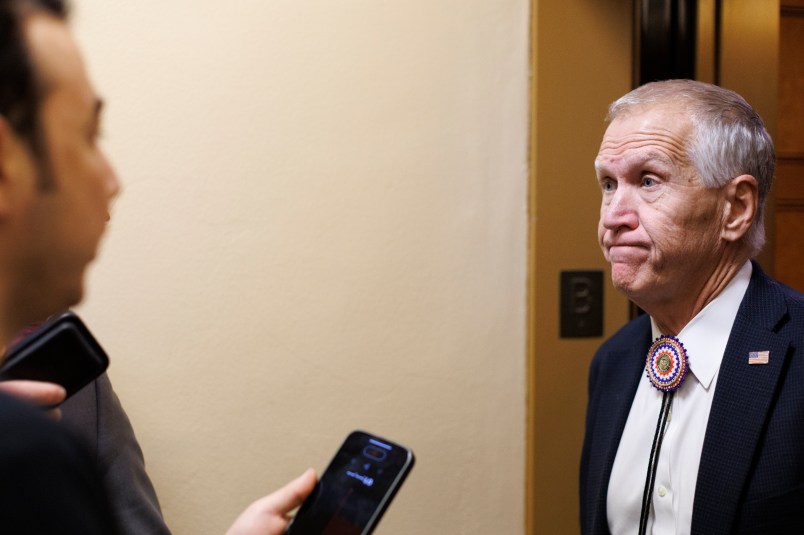
Retiring Sen. Thom Tillis (R-NC) has over the last year emerged as a chronic thorn in Trump’s side. A member of the Senate Banking Committee that would need to approve Warsh before he can be confirmed by the whole Senate, Tillis vowed to block any Trump Fed nominee until the investigation into Powell concluded. Praising Warsh’s qualifications in an X post last Friday, Tillis doubled down on that opposition. By Tuesday afternoon, Tillis was still standing firm, rejecting a presidential pardon of Powell as sufficient to end his blockade.
“This is foundational to Fed independence,” Tillis told POLITICO, “and if you reward this sort of behavior and there’s no compelling evidence that could convince me or a jury that he’s guilty of it then you’ve got to stand on Fed independence.”
Republicans have a 13-11 majority on the banking committee, which means if every Democrat and Tillis vote against Warsh, his nomination won’t be able to move out of committee. Senate Majority Leader John Thune (R-SD) has basically said the Senate can’t confirm Trump’s Fed pick without Tillis’ support, POLITICO reported.
Because of this confluence of events, along with Warsh’s own on-the-record hyperpartisan rhetoric, experts who spoke to TPM were wary of the idea that a Warsh Fed could remain independent and set apolitical monetary policy.
“I think there is a distinction in that Kevin Warsh’s views are pretty heavily correlated to political cycles more than most,” Skanda Amarnath, executive director of macroeconomic policy research organization Employ America, told TPM. “There’s not a lot of things in the public record that back up Kevin Warsh as someone who thinks beyond the political. So that is something that he will have to work really hard to disprove.”
Who is Kevin Warsh?
Warsh is currently an economic policy fellow at the Hoover Institution, a right-leaning think tank out of Stanford University. He served on the Fed Board of Governors between 2006 and 2011 during the global financial crisis, spent four years on the White House National Economic Council under former President George W. Bush, and worked on Wall Street.
Since stepping down from the Fed in 2011, Warsh has been a critic of America’s central bank.
Will Warsh Be Independent of Trump?
That, said Mark Sobel, chief economist and vice chair at the Official Monetary and Financial Institutions Forum, is the “trillion dollar question.”
Based on Trump’s behavior, economists and government watchers are skeptical of Warsh’s ability to ignore Trump’s public pressure and make independent decisions. Speaking on the Bloomberg Surveillance podcast, Marc Short, who was ex-Vice President Mike Pence’s chief of staff, said Warsh would face Powell’s fate if he didn’t fall in line with Trump’s goal of lowering interest rates.
“[T]he president would not have moved forward with his nomination unless he had pretty strong assurances that Warsh was looking to lower rates when he got there,” Short said.
The Fed chair doesn’t operate unilaterally, but one shouldn’t underestimate their influence on the rest of the board, and on the way markets and international systems view the U.S. central bank, Erica Groshen, former Bureau of Labor Statistics commissioner, told TPM.
“If you had a chair who was very politically motivated and the rest of the committee was not, then you might have more turmoil within the committee than we’d normally see, and that could make it very difficult to go forward,” said Groshen, who also worked at the New York Fed.
Evident turmoil at the Fed would lead to more split decisions among governors and reduce investor trust in the U.S. economy and its central bank. That could mean less investment in the U.S., Groshen said, which could lead to fewer jobs. “And that would, I think, be destabilizing and not good for the country.”
Shape-Shifting Monetary Policy
Warsh didn’t always have opinions that align with Trump’s current policies. In a 2010 speech as a Fed governor, Warsh offered a warning against protectionism and encouraged free trade.
“U.S. companies are made better by global competition,” Warsh said, before lauding “pro-growth trade policies,” according to a transcript of the speech. Warsh was therefore viewed in 2024 as a risky option for Treasury Secretary by MAGA elites who favored tariffs. No stranger to the Wall Street Journal opinion pages, Warsh in 2013 co-authored an op-ed decrying government spending. “The growing debt burden threatens to crush the next generation of Americans,” the piece read. He’d previously held the reputation of a hawk, focused more on controlling inflation by keeping interest rates higher. In a 2023 WSJ op-ed diminishing the Fed’s monetary policy relevance, Warsh singled out federal government “subsidies, credits and handouts” to corporations as part of the cause of the government’s expanding reach and spending.
“He was pretty critical of the Fed for cutting rates in September 2024 and did not think that the Fed had a good case for lowering interest rates throughout that year,” said Employ America’s Amarnath, “until President Trump won.”
Over the last year, Warsh has said he wants to cut interest rates in line with Trump’s desires, which on its face isn’t necessarily a bad thing. The merits of whether a rate cut is in order can and should be debated among decision makers, said Karen Dynan, a Harvard University economics professor and senior fellow at the Peterson Institute for International Economics.
“It’s not impossible to make an economic argument that would be consistent with lowering rates,” Dynan, who also served as chief economist at the U.S. Treasury Department, told TPM, though not, she emphasized, lowering rates to the 1% Trump wants.
“You want to be independent of political influence,” said Dynan.
But First, Will Warsh Be Confirmed?
Warsh’s nomination also brought out Republican senators, some of whom had shown discomfort with the Trump Department of Justice investigation into current Federal Reserve Chair Powell.
The route may be steep, but experts who spoke with TPM believe Warsh will be the next Fed chair one way or another.
In addition to Tillis, Sen. Lisa Murkowski (R-AK) has said she would not vote for Trump’s Fed pick until the DOJ investigation is resolved. A spokesperson for Murkowski did not respond to a TPM request for comment.
“I think it will ultimately depend on when and how the president, the administration handles this criminal investigation of the Fed,”Amarnath said. “Obviously so long as that is active there will be a block on Kevin Warsh.”
That doesn’t nullify Warsh’s confirmation though, Amarnath said. If the DOJ drops its Powell investigation Tillis has suggested he’s a “yes” on Warsh. If Trump’s DOJ prolongs the sham investigation, Tillis could stonewall his confirmation until he leaves Congress on Jan. 3, 2027, unless he resigns sooner. Another road block could emerge on the slim chance Democrats take the majority in the Senate following November’s midterm elections, though Amarnath doesn’t think that’s likely.
Sobel said he tries not to wade into politics but believes Warsh will be the next Fed chair in spite of all the drama.
“Kevin Warsh knows his stuff. He’s qualified for the job and I assume he is going to be put in charge of the Fed on schedule,” Sobel told TPM. “How they do their sausage making I don’t know.”



I am sure Tillis will show near Flake-like resolve in blocking Trump’s nominee!
That alone should be as disqualifying as being a member of the Charles Koch Foundation-funded Smith Institute for Political Economy and Philosophy at Chapman University.
Ya think?
Skeptical?
Isn’t it a known that the First Felon only wants a puppet in there to do his bidding?
And the confirmation hearing will be unanimous. Bet on it.
Kevin Warsh is a poltical hack and economists know this: