


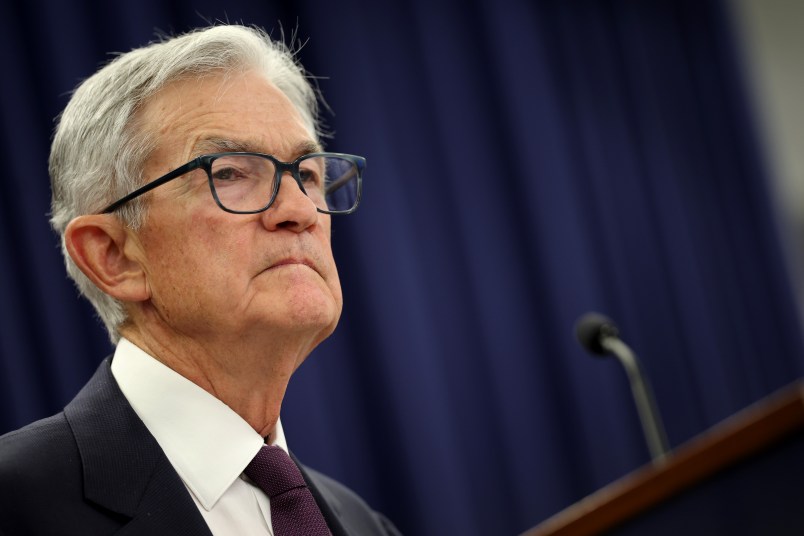
President Donald Trump’s attempts to intimidate the Federal Reserve into doing whatever he says have so far done much more harm than good for the president.
Trump has, over the past year, sought to use social media threats and grumbles in the press to intimidate the Federal Reserve Board of Governors into lowering interest rates at his command and in spite of the governors’ interpretations of economic data. But by escalating those attacks into two highly dubious and politically unpopular legal battles, the administration appears to be doing more harm than good to Trump’s ultimate goal of installing members who align with his desire to lower rates. (At this point, there are indications that even Wall Street is starting to turn on the president.)
Instead, Trump has created a situation wherein his own 2017 Fed nominee-turned-political enemy, Federal Reserve Chair Jerome Powell, is poised to lead the central bank even after his tenure expires in May. Powell has also not rejected the idea of remaining on the board after his term as chair ends (he has two more years left of a term as governor), throwing a wrench in Trump’s ability to exert more influence over the central bank.
What would it mean if Powell stayed on past his chairship, something that’s only been done once before in history?
“Powell will likely be doing ‘damage control’ in response not just to a new Fed chair, but to a new kind of Fed chair, a kind that Trump will be trying to make into ‘the new normal,’” Cornell Law professor and Federal Reserve policy consultant Robert C. Hockett told TPM. “[Powell] will aim to prevent ‘normalizing’ that new sycophancy that Trump is now trying to institute.’”
Here’s how the administration’s pressure campaign came to so spectacularly backfire.
How We Got Here
After publicly sparring with Powell over the cost of renovations during an extremely rare visit to the Federal Reserve building, Trump tried to fire Federal Reserve Governor Lisa Cook over dubious claims of mortgage fraud seemingly drummed up by Federal Housing Finance Agency Director Bill Pulte, who has also lobbed similar attacks, thus far unsuccessfully, against several of Trump’s political enemies. Cook sued to stay her removal until her case was resolved in court and has repeatedly emerged victorious. The case was heard by the Supreme Court, which appears poised to allow Cook to remain in her position while she defends herself against Pulte’s shoddy allegations, which he lodged in a criminal referral to the DOJ. SCOTUS is expected to issue a decision later this year.
These tornadic developments would have amounted to nothing for the president. But unfortunately for Trump, he didn’t stop there.
Appointing a Syncophant
Trump appointed his chief economist Stephen Miran to the Federal Reserve Board of Governors to replace former President Joe Biden board appointee Adriana Kugler, who stepped down unexpectedly last August. Miran began his role as a Fed governor in September 2025, but held on to his role as chair of the White House Council of Economic Advisers until Feb. 2026, a dual employment which represented an unusual conflict of interest.
Since joining the Fed, Miran has participated in five rate-setting meetings and has voted to lower interest rates more than every other voting member at all but one meeting. At the most recent Fed meeting, Miran was, remarkably, the only governor to vote for rate cuts despite the obviously inflationary pressures mounting from Trump’s war in Iran. The move suggested he just didn’t care about appearing independent from the president.
Miran’s sycophantic tenure is finite, though. Originally set to last only until the end of Kugler’s term, in January, Miran stayed on when Trump failed to appoint a replacement. If Trump’s nominee to succeed chair Powell is confirmed, Miran will be out at the Fed.
Which brings us to the next element of this story.
The Lawsuit, The Nomination, and the GOP Resistance
In January, Powell revealed that Trump’s DOJ had subpoenaed the Federal Reserve in an apparent criminal investigation into him and the Fed. Specifically, Trump ally and U.S. Attorney for the District of Columbia Jeanine Pirro’s office has theorized that Powell committed a crime when he testified during a congressional hearing last year about the cost of a Federal Reserve building renovation project.
Powell shot back vehemently. In a statement and video, the Fed chair called the investigation a blatant attempt to influence central bank policy.
“This is about whether the Fed will be able to continue to set interest rates based on evidence and economic conditions — or whether instead monetary policy will be directed by political pressure or intimidation,” Powell said in the video.
Policy watchers decried the administration’s thinly veiled attempt to intimidate the Fed. Every living former Fed chair joined with other past economic policy officials to condemn the Trump administration, calling the lawsuit an “unprecedented attempt” to interfere with U.S. central bank independence.
“This is how monetary policy is made in emerging markets with weak institutions, with highly negative consequences for inflation and the functioning of their economies more broadly,” the bipartisan group wrote in a Substack post.
Some Republicans in Congress joined in, such as Sen. Lisa Murkowski (R-AK), who called Trump’s legal tactic “nothing more than an attempt at coercion.”
A federal judge this month blocked the DOJ’s subpoena of the Fed and called the government’s evidence against Powell “so thin and unsubstantiated” as to be “pretextual.” On Wednesday, the Washington Post reported a government prosecutor said DOJ attorneys “do not know at this time” what criminal evidence the government has against Powell during a closed-door meeting.
The Trump administration has yet to back down, and notably, Republican senator and Senate Banking Committee member Thom Tillis (R-NC) vowed to block any Trump Fed nominee until the criminal investigation into Powell, also a Republican, has concluded. That makes Trump’s nomination of Kevin Warsh, a former Federal Reserve governor and economist whose position on Federal Reserve rate-setting and economic policy is more in line with Trump’s, all but irrelevant for now.
Tillis isn’t running for reelection, so even if the sham investigation into Powell stretches through the end of 2026, Warsh could have a path to confirmation in the beginning of 2027 without the Tillis blockade.
But that still doesn’t clear the way for Trump’s Fed takeover because there’s no guarantee Powell won’t finish his term as a governor, which extends until 2028, even after he ceases chairing the board.
Powell Isn’t Backing Down
At last week’s Fed meeting, where every Fed board governor except Miran voted not to cut interest rates, Powell said for the first time that he hasn’t decided whether he’ll stay on as a Fed board member after his term as chair expires.
“Powell will carry immense ‘persuasive authority’ on the Board, much more than the new chair,” Hockett said of the dynamic that would persist if Powell stays on. “So the latter’s attempts to ‘build a consensus’ in favor of Trump’s priorities will have to win over Powell too, or bypass him — neither of which would be easy even assuming it somehow possible (a stretch).”
Hockett said if Powell remains on the board, he’d likely want to act as a “counterweight” to preserve Fed independence.
“He will violate the norm now in order to preserve the traditional Fed norms for the future,” Hockett said.




(At this point, there are indications that even [Wall Street is starting to turn]
Wow, the Street is really quick, I mean who would have guessed that the guy who bankrupted 4 or 5 casinos really should not be close to the Federal Reserve.
Arabic proverb: They asked the pharaoh, “What made you a tyrant?” He said, “No one stopped me.”
We all have to do what DJT’s parents could never do, i.e. say “NO” to him. Stop Trump!! He is entering lame duck status, and hopefully the midterms will make him even “lamer” and grind his agenda and antics to a halt.
Tyrant Trump decided to go all the way in term 2 with outrageous self-dealing because when he did it before “nobody cared”.
Feels like we’re discovering that the greatest obstacle to Trump getting what he wants may be his own consistently shambolic incompetence, mirrored in so many of his flunkies. Alas, this is not always good news (see the Iran war).
The guy is just very very bad at what he does, even when measured by his own definitions of what counts as doing well.
What may be said about the Republican Party?
They follow a loser who has had 6 bankrupties and a number of other bussiness failures.
Does this mean they are more stupid then their leader and will follow him into Hell?