


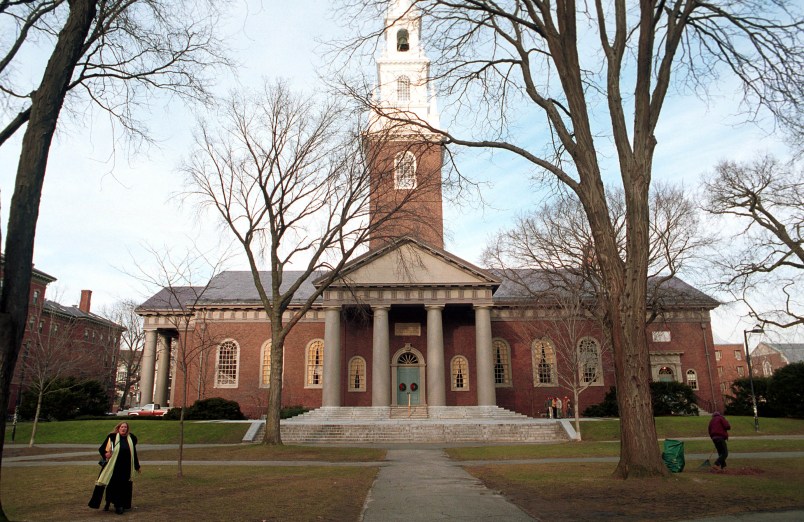
I wanted to point your attention to this recent article from the Times on the battle between Trump and Harvard University. It captures the Times’ feature quality. It contains good factual detail, but it radiates what I can only describe as a Chernobyl-level condescension and contempt, not so much for anything “liberal” but anything not conservative, or not in line with what it terms the “rightward shift of the country” — anything that can be construed as a posture of opposition to Donald Trump. The Harvard board is portrayed as reflexively and out-of-touchedly liberal, repeatedly shocked in a weak-kneed sort of way and yet also, paradoxically, headstrong in its inability to resist outmoded Trump I-era “resistance” thinking. In a few words, weak, out-of-touch and contemptible.
There’s not a single mention of the fact that the entire campaign is illegal on its face and an unprecedented and corrupt power grab with no antecedent in the U.S. government’s almost 80-year research-focused partnership with the country’s leading university. But why get stuck in the nitty gritty?
There’s one dynamic which I think has been lost in most of the commentary on free speech, higher education and Trump going back over the last 18 months. It was in the background of Columbia’s justifications of its original deal with the White House. It was closer to the foreground in the University of Michigan’s decision to shutter its DEI Office in favor of aid guarantees for students from underprivileged backgrounds.
“Antisemitism” is in many ways a loaded phrase. Or rather, it is an overdetermined one. It’s antisemitism if it contains what we might call certain ideological genetic markers. And antisemitism does have many clear genetic markers that serious students of it know at a distance. But a less fraught and perhaps more functional definition is simply a climate or attitude of hostility toward those who are conspicuously Jewish or identified as such. Both ways of using the term have their use. My point here is simply to distinguish them. And at a number of campuses, the administration and a significant portion of faculties thought that some of that did exist. That doesn’t mean they thought the protests themselves were antisemitic or targeted Jews. Maybe some did or didn’t. There was also some reconsideration of the post-Obama era direction of university “DEI” programs vs. the more mechanistic “civil rights” programs and procedures which preceded them.
This may have been right on the merits. Or it could be the simple fact that universities aren’t immune from the political winds of the larger society. Or it could have been the fact that no university can ignore the views of its major donors. My goal here isn’t to agree or disagree with these points. I’m simply asserting the claim that the leadership and some percentage of the faculty at many universities had come to believe that elements of the protests had triggered such a climate of hostility, even if the protests writ large weren’t antisemitic or hostile to Jews in themselves. I don’t think we can understand the dynamics of the last three months of Trump’s war on the universities without seeing this part of the puzzle. All of that is altogether different from what Trump has been trying to do, which has been to use Jews and purported concern about antisemitism as a cudgel to put universities into de facto receivership, disappear non-citizen pro-Palestine activists and turn back the clock on the whole spectrum of civil rights to like 1950 or 1955. Along with lack of preparation, lack of imagination and general cowardice, that belief put these institutions significantly off balance when Trump first struck back in January and February.
On the lack of preparation front, one of the clearest things is that if colleges and universities were thinking of anything along these lines it’s absolutely clear and fairly obvious they should have done it late last year — ideally, before Trump was elected and certainly before he was inaugurated. Of course, that didn’t happen. But it is what it is.
The University of Michigan got a lot of pushback earlier this year when it shuttered its DEI office. But last night the Democratic members of the Board of Regents (the board has a 6-to-2 Democratic majority) published this opinion piece squarely and publicly in defense of academic freedom, against political coercion and making the case for the role of higher education in making America free, prosperous and secure.
This is one of the more direct cases of a major university attaching itself to Harvard’s actions and probably running a fair amount of risk for doing it. My sense is that the White House’s war on universities is at least partly slipping out of its grip. The whole game here is that the White House needs to mutilate a handful of universities but do so one by one, each isolated and on its own as it happens. I think it’s obvious that the White House cannot manage this if universities are banding together. It has to be one at a time. The Times did its best to put Harvard in a bad light (stubborn, not listening to reason). But Harvard has hit back hard at the White House and doesn’t seem inclined to pull back, even after what the Times says were quiet attempts on the White House’s part to bring them back to the table. The whole “Oh, we sent that letter by accident” thing was bizarre and made the White House look silly. “We didn’t mean to send it. And you should have known that. But also we meant it. And can you please start negotiating again?” That’s weak and pathetic.
All the Trump White House knows is gangster tactics. Because that’s all Trump knows. And that means a million different flavors of the same damn ice cream, which is extortion. In that world, if you get that kind of reply, the only possible response is overwhelming and brutal. You think you’re setting the tone and the moment, but I fucking am. And we’re not even going to debate it because my actions will speak totally for themselves.
But the White House hasn’t done that. And I think that’s for a mix of two reasons. The first is that I’m not sure they have another card to play. The second is that they’re facing small but discernible losses on a number of fronts. It’s harder to assert power in the face of waning power. What we’re seeing here is the equivalent, on the law firm front, of the White House cutting a deal with Paul, Weiss and then just after that having Kirkland & Ellis say, “Nah, fuck you guys.” You’ve got to do something big to shift back that dynamic.
I’m no big fanboy of Harvard. I probably have that same feeling that everyone who didn’t go to the place has for what is certainly the most prestigious if not the best university in the country. When I was in high school, I drove an hour into Los Angeles for a Harvard admissions event at some fancy home of who knows who. I was very hungry at that age to accomplish something. I sat and waited with all the fancy parents and their kids and the woman from the admissions office started her little talk by saying, “You know they say, that when you arrive at Harvard, you go to Byerly Hall” — the admission department — “and kiss the ground. Because that’s where the coin flip fell in your favor.”
I remember sitting there smiling attentively and thinking, “Oh, fuck that. Are you kidding me?”
So that’s my Harvard.
But Harvard has great power and social and cultural clout and vast reserves of money. They’re one of the few institutions with the resources to hold out in a litigation posture for a significant period of time with major cut offs. My hope is that they will eventually win legal rulings that provide cover for small or less wealthy institutions. Anything like that is still a ways off. It will be important to watch to see if other universities start making similar statements backing Harvard and risking the White House’s retaliation. If enough do that, I think the whole thing will start to fall apart.