


Donald Trump has announced that he will impose in 30 days a new round of tariffs on Canada. Those tariffs are at best of dubious legality. They are justified under the Smoot-Hawley Tariff Act of 1930, which has quite likely been superseded by subsequent post-war trade legislation. But questions of legality, while critical, tend to obscure the more elemental question of why? There are at least arguments as to why the U.S. might want to impose protectionist measures against China or other countries with far lower wages and workforce protections. There are other weaker but still arguable rationales for protectionism targeting Europe. One can even make arguments about Mexico since wages south of the border are still much lower than in the U.S. (To be clear, I mostly don’t agree with these arguments, though I also disagree with a doctrinaire free trade approach.) There’s really no economic or strategic argument for these tariffs on Canadian goods at all. Canada has comparable living standards and regulatory regimes to the U.S.; key U.S. industries like autos are woven across the U.S. border. The anchor of U.S. prosperity has always been the way it amounts to a massive free trade zone. And Canada only extends that to the north. And yet tariffs against Canada appear to be the White House’s near or entire focus.
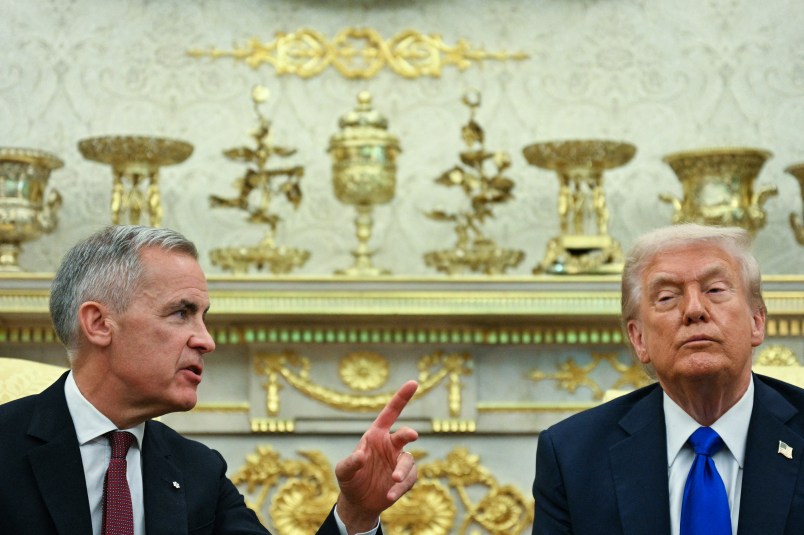
This Politico piece suggests that one motivation may be Prime Minister Mark Carney’s push for “middle powers” to assert their collective power in an increasingly multipolar world. The White House doesn’t like that, sees it as a threat to U.S. global dominance, and is beating up on Carney and Canada to get him to back off. But that doesn’t seem like an adequate or satisfying explanation. At least in the near term “middle powers” talk is mostly just talk. It’s not meaningfully showing up in international power dynamics. But, more than that, it suggests a more reasoned and strategic approach to tariff and geopolitics than there’s really any evidence for.
As with the war with Iran, I think this greatly underestimates Trump’s individual emotional state, his need to dominate and need for self-soothing as a driver of major foreign policy and economic policy decisions. Canada is becoming the abused wife that Trump is lashing out at because things are going so badly at work. His hopes and dreams are crashing: The midterms look bad. His leg is caught in a veritable bear trap in his Iran War. So he goes home and beats up his wife, or in this case, lashes out at Canada. It’s another case of executive self-soothing oddly akin to what got Trump into Iran in the first place.
The American press has always understated and underestimated the gleaming continuities between Trump’s inter-personal and political selves. He needs to dominate. He needs you to lose because that’s the only way he knows he’s won. He hungers to be fawned over. Going back to 2015, people who’ve lived with chronic abusers recognized the type — palpably, intuitively, from experience — and those patterns which have marked his personal life — cheated business partners, raped and assaulted women — have been imposed on the country as a whole. There’s almost nothing in his presidency that can’t be reduced to this basic, ingrained and lifelong framework. Canada, vulnerable to abuse because of its proximity and economic dependence, is Trump’s convenient go-to to act out on these impulses. Actually invading Greenland is complicated. Certainly going to war with Iran — despite its almost total international isolation — is pretty hard too. Regular rounds of sub-lethal abuse of Canada is much easier.
As we discussed beginning late last year, as Trump’s domestic fortunes, domestic popularity and power decline, he becomes more dependent and focused on leaning into his nearly unlimited powers abroad. These tariffs are probably illegal, whereas the Iran War, for all its stupidity and folly, is probably not. But the Supreme Court has already shown it will give Trump a year or so of illegal tariffs before calling off the fun. This is an extension of the same whims, need for distraction and predation, the same drive for dominance and self-soothing for the inner pain of failure. And to our great shame, America’s great shame, our northern neighbors are taking the brunt of it.