


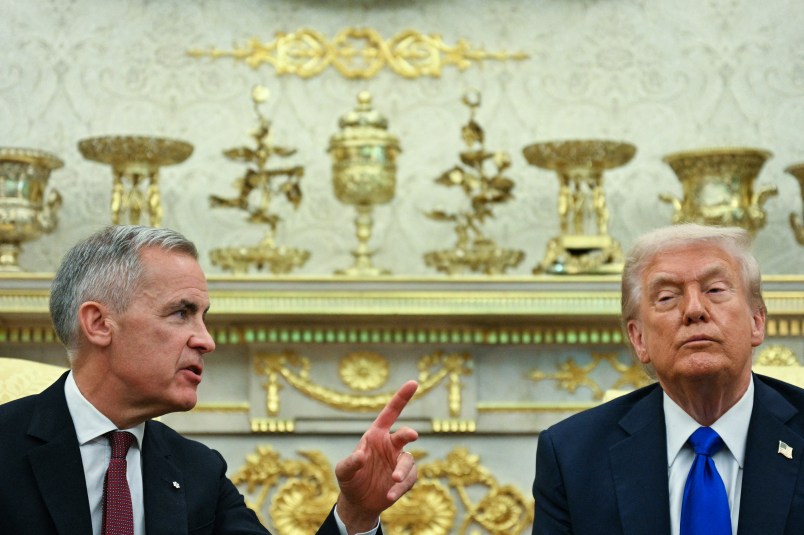
Donald Trump has announced that he will impose in 30 days a new round of tariffs on Canada. Those tariffs are at best of dubious legality. They are justified under the Smoot-Hawley Tariff Act of 1930, which has quite likely been superseded by subsequent post-war trade legislation. But questions of legality, while critical, tend to obscure the more elemental question of why? There are at least arguments as to why the U.S. might want to impose protectionist measures against China or other countries with far lower wages and workforce protections. There are other weaker but still arguable rationales for protectionism targeting Europe. One can even make arguments about Mexico since wages south of the border are still much lower than in the U.S. (To be clear, I mostly don’t agree with these arguments, though I also disagree with a doctrinaire free trade approach.) There’s really no economic or strategic argument for these tariffs on Canadian goods at all. Canada has comparable living standards and regulatory regimes to the U.S.; key U.S. industries like autos are woven across the U.S. border. The anchor of U.S. prosperity has always been the way it amounts to a massive free trade zone. And Canada only extends that to the north. And yet tariffs against Canada appear to be the White House’s near or entire focus.
Join TPM to get full-access to our reporting, newsletters, and other member-only features.