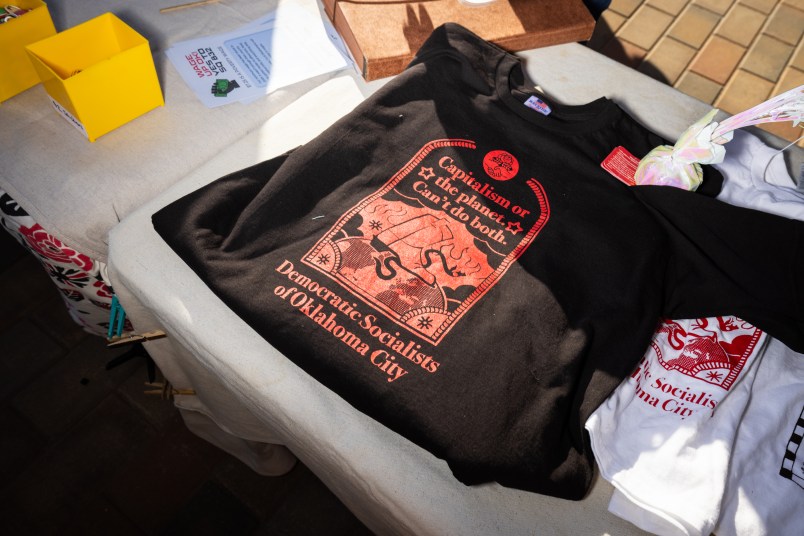
Sometimes I write a post which is about information that is not new or secret but new to me. This is one of those posts. I’m sharing it because the information is new to me and I suspect many TPM readers. It’s helpful for me in thinking about the rise of the Democratic Socialists of America as the most visible left faction within the current Democratic Party. Recently I noticed that many or most of the DSA elected officials who’ve achieved some level of electoral success have been denounced, censured or rejected by the local affiliates or council who endorsed them in the first place. Along similar lines, the national DSA is consistently more doctrinaire and left-wing not only than it’s candidates but its local chapters in the major metros where its power is strongest. This isn’t surprising or really new. It’s a general pattern for ideologically-based organizations, an unsurprising feature of the tensions between ideology and complex electorates.
Back to those prominent DSA-backed politicians. I and many others have argued for a while that “socialist” seems more a matter of branding for a lot of DSA candidates, whereas the actual policies and positions sound a lot like pretty ordinary New Deal-style liberal-labor politics. Of course, what counts as “socialism” is wildly over-determined. You’ve certainly see those memes that show like the Socialist Party platform from the 1910s or 1920s and it mostly matches things we take for granted or did take for granted as the mid- and late-20th century New Deal state.
I note all this because we are all or all should be looking for ways to stitch together Democratic Party unity for critical elections in 2026, 2028 and beyond. If some differences are more matters of degree than kind, unity in diversity becomes more possible.
It’s with this in mind that I started looking more closely at Megan Romer, the national co-chair of the DSA. There are two co-chairs but, for whatever reason, Romer is the one who seems most visible. Romer is part of and a leader of some sort of something called the Red Star caucus of the DSA. As the name suggests, this is considerably more left-wing than anything we might call left/New Deal. The caucus defines itself as …
… a Marxist-Leninist caucus in DSA. Our primary goal, the goal which informs all of our organizing work, is to abolish capitalism and, ultimately, to achieve communism. We do not believe that capitalism can be reformed into socialism – it must be overthrown and replaced.
They go on to say that they see the DSA not as a conventional party and certain not as a faction within the Democratic Party but rather a vehicle or incubator for creating a vanguard revolutionary party.
We do not specify exactly how this party will emerge, but we believe DSA can foster its creation — DSA’s resources, broad membership, organizing ethic, and robust democratic processes make it, out of all existing US socialist organizations, the best incubator for such a party.
I quote this from Points of Unity, Red Star’s statement of principles on its website. There’s a lot more but it’s all pretty standard from a Marxist-Leninist viewpoint and outlook. As you’d probably expect, a major theme of Red Star’s politicking is attacking AOC as a capitalist running dog who has exploited DSA for careerist ambitions.
In any case, I’m not shocked by any of this stuff. I was born in and grew up around a lot of political radicalism. That probably shapes a lot of my political outlook. This stuff is as old as the hills. And I generally don’t have a lot of patience for making a big deal about tiny radical sectarian groups trying the standard burrowing-in tactics on larger left-wing parties. But this seems a little different. As I told someone yesterday, you can’t really say this is some malign cherry-picking among the countless caucuses operating under the DSA banner or a Fox News-worthy attempt to elevate random weirdos or extremists to discredit Democrats or the political left generally. Romer is the head of the national DSA. (Technically, she’s the national co-chair. But we seldom hear about her co-chair, Ashik Siddique.)
One of the ironies of this is that as terms developed over the first half of the 20th century, “socialism” (in the sense of socialist parties and so forth) generally became self-identified as socialist over and against the anti-democratic elements of communism which, of course, also claimed the socialist label. Old news for people who know this history but a lot of the most intense anti-communists were socialists, though that can seem odd to those outside these sectarian debates. Indeed, the DSA, which Michael Harrington helped found in 1982, was at the forefront of that element of socialist politics. There’s a reason “democratic” is there at the front of the label.
This is definitely suboptimal for Democrats or the anti-Trump opposition. But this is about more than optics. Strong civic democracy is what I think a lot of us are trying to rebuild in this country. We don’t support it as some off-the-shelf antidote to Trumpism but because that’s what we believe in, and only a rebirth of a vital civic democracy can bring us back from this moment. This vanguard, Marxist-Leninist revolutionary party claptrap is the polar opposite of that. It’s the seed corn of left-wing authoritarianism. For me personally, it’s difficult to separate a lot of this from what amounts to revolutionary cosplay. No, I don’t expect workers’ soviets to be taking power in any of our cities. More to the point, this isn’t meant to delegitimize or attack the various candidates running under the broad DSA banner. As I noted above, some of this is par for the course. A certain kind of person focuses on actual politics and getting elected. Others focus on grabbing slots on committees and arguing over manifestos. But Marxist-Leninist vanguard parties are not some version of New Dealism. We should be aware this exists as a real force in the national DSA. And that is a problem.