


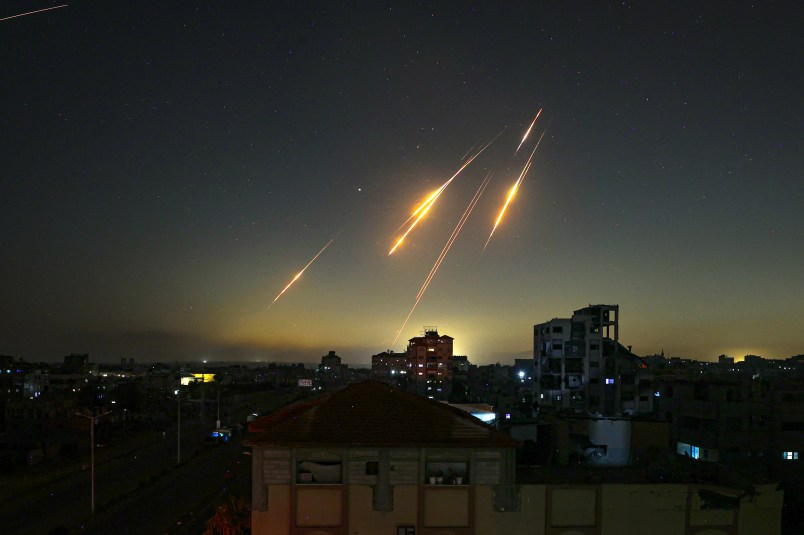
I haven’t had a lot to say about Israel and Iran because I haven’t had a lot to add. But I want to suggest something about the possible entry of the United States into the war. These aren’t conclusions, more questions I’ve had and questions that help me frame how I’ve looked at what’s happening.
In the first couple days of this hot conflict, the conventional wisdom and reporting went from Israel doing this more or less entirely on its own, perhaps even interfering in U.S. diplomacy, to the idea that the apparent rush of diplomacy between the U.S. and Iran was actually a ruse concocted by Israel and United States to lull the Iranians into letting their guard down. At first this seemed to be what they call in the online world right wing “cope,” shoving Donald Trump back into the center of the story as He-Man hero when he had actually seemed marginal to the action. But then it started showing up in news reports. And from what I can tell at this point, it’s almost treated as a given, just part of the reported story.
This certainly may be accurate. But I’m not sure that it is. I think it’s also possible that the initial attack was fabulously successful in tactical terms (no one would deny that) and Trump basically wanted in on it. Because he likes success. In a normal administration, reporters might get a clearer read on what was real or what wasn’t. But this isn’t a normal administration. Much of “what the plan is” is an unknowable thing in Donald Trump’s head and a feature of the Trumpian personality cult is that once there’s an approved story, that is the story. Period. I could be right or wrong on my supposition here. But I’m not even sure if the people inside the administration actually know. In any case, I think there’s a pretty good chance the whole ‘we were secretly working together to lull Tehran into complacency’ is a complete fiction, an online MAGA speculation that the White House and Trump glommed onto and made real because it was convenient and helpful.
Meanwhile, in the last 48 hours or so, we’ve gone from the U.S. being pretty clear it will not get involved beyond defensive assistance to Israel in blocking missiles and drones to the situation this morning, in which it seems like the U.S. may be very close to joining the Israeli bombing campaign. And this isn’t just a case of “the more, the merrier.” Only the U.S. has the combination of bunker-busting bombs and strategic bombers that make it plausible to destroy or disable all the key facilities that make up Iran’s nuclear program.
It is important to note that the U.S. has very good reason to make Iran think it may be about to do that. So it may be a ruse. We don’t know. But I think it’s very possible that the U.S. is on the verge of a major, major military campaign that it wasn’t considering at all just a few days ago and that we may be doing that more or less solely because Donald Trump is jazzed about and attracted by the idea of “winning.” And Israel is now “winning.” So he wants in.
It’s important to step back and recognize that there is really, literally no one in the inner discussion of U.S. foreign policy today who has any level of foreign policy or military crisis experience at all. That’s a big statement. But I think it bears out. The two heads of the U.S. intelligence apparatus have zero experience in intelligence work. The head of the Pentagon is Pete Hegseth and he appears to have surrounded himself with lackeys. Marco Rubio is both Secretary of State and National Security Advisor. He did focus to a degree on foreign policy in the Senate. But he’s never been involved in any national security crisis. He’s never worked in the executive branch. Even the people who are hardcore Trumpers but had some real level of foreign policy experience, like Keith Kellogg, now have other assignments. Kellogg is envoy to Ukraine. The current Chairman of the Joint Chiefs isn’t a career Army Officer. He spent a significant amount of his career in the Reserves. (I don’t think at least — but not certain on this point — that he ever served on the Joint Staff.) The point is that there’s really no one in the room, as it were, who is in a position to keep the President from just riffing. And I think there’s a decent chance that’s exactly what’s happening.
Now, a separate point. The Israelis have been threatening to attack the Iranian nuclear program for at least 20 years. It’s been a particular fixation of Benjamin Netanyahu. But it’s important to understand that it’s far from his alone. The peace camp in Israel is basically dead. But how to manage the conflict with the Palestinians is still very divisive in Israeli politics. Iran is far less so. In the past, it’s been the top generals or retired generals who’ve held Netanyahu back. The key question has always been the upsides and downsides of such an action — specifically, how many potential dangers weighed against how much you could actually destroy. I think it’s fair to say that if the assumption was that you could actually destroy the whole program militarily and not take too extreme a level of diplomatic damage, it would have happened years ago. The key is you don’t want to take all the risks if you’re still going to leave most of the program intact.
One thing that struck me very early in this conflict was that the Israelis started putting out word that while they were doing immense damage to the Iranian military and even elements of the nuclear program, they didn’t have the capacity to destroy the key underground facility at Fordow, which is buried deep in the side of a mountain not that far from the Iranian religious center at Qom. Only the Americans have the bunker buster bombs and the strategic bombers that can do that, the Israeli sources said fairly publicly. “So we hope they’ll help,” basically.
That is, to put it mildly, a very strange admission. Generals will pretty much always want a plan that provides a strong likelihood that you can achieve the strategic objective with means under your control. If you’re going to launch this kind of attack you actually want to destroy or seriously hobble the current Iranian nuclear program. But they seemed to be saying, well, we’ll start and then hopefully the U.S. will join in and do the big part. In other words, having a plan in which a critical element of the plan is something totally beyond your control. That’s not how militaries tend to operate. Militaries and countries are often not clear with themselves about their true aims or how likely they are to achieve them. But it at least seems, based on these statements, like they went into this one with a pretty clear-eyed view that they actually could not accomplish on their own what people thought they were trying to do.
Now let me state a few caveats clearly. It’s entirely possible there are lots of communications and understandings behind the scenes we don’t know about. The Israelis also may not be seeing the Iranians’ nuclear program in such binary terms. Perhaps a sufficient level of damage is enough. Perhaps that, in addition to a level of damage that could push things back a few years, is enough to send the signal that the Israelis or someone else will just destroy it again. That does seem to be the premise of the mix of military and diplomatic pressure. Make a deal, Iran, because you’re never actually going to get to a nuclear weapon. There are also reports that maybe Israel does have a plan to destroy this facility on its own. If you control the skies, which Israel does appear to control now, and you have enough time, maybe you just keep dropping more and more bombs. I have no ability to evaluate whether that makes sense. There are claims in the Israeli press that that is the plan, that that can work. Again, totally above my pay grade. I have no idea.
There’s an additional point. Beyond pro-forma condemnations, Israel’s de facto Gulf state quasi-allies have been very quiet about all this. Indeed, Europe, which has been increasingly hostile toward the unending bombardments in Gaza, has been quite hands off and non-critical about these attacks. There’s been no flurry of Security Council resolutions or condemnations or anything like it. The real message from the European states has been something like, if you can pull it off, go for it. In that sense we’re seeing the effect of Israel’s shattering of the power of Hezbollah last year. Iran’s “axis of resistance” is in shambles with a mix of the profound military damage to Hezbollah, the fall of the Assad regime and the crushing of the offensive capacity of Hamas. Add to this that Iran’s ballistic missile capacity seems far less fearsome than people assumed. Iran is weak and alone. Even Russia seems to be sending the signal to watch out and not to expect help.
What all this amounts to is that the Iranians are really, really isolated. Maybe the global community hasn’t done a lot on Gaza’s behalf. But there’s at least been a lot of rhetorical opposition. That’s almost completely absent here. Perhaps the Israelis just knew their man, that if they got the ball to the five yard line, Trump wouldn’t be able to resist swooping in and making the “win” his own. I don’t really believe that, it’s far too speculative and leaves to chance to many things you can’t control. But I can’t completely dismiss the possibility since we’ve seen so much evidence just in the last few days of Donald Trump being swept along with the swirl of events, lure of attention and wanting to get in on a win. He sees a winning operation and he can’t resist slapping the Trump nameplate on it. And here, unlike in any normal world, we’re not talking about “Donald Trump” as an administration or a national security team, but one guy — one very, very, very powerful guy — and his phone.