


One of the key arguments for a great power — other than the great power itself wanting to be one — is that they act as a guarantor of stability and the status quo. That is far from the only public or global good. And a great power will ensure that status quo on its own terms and mostly to its own advantage. But if you have any acquaintance with history, you know you can do a lot worse than relative peace and the status quo. Trump’s Iran War has been a bracing illustration of all these realities. Once the great power starts letting things break, those breakages can start multiplying very fast. Eventually you’ll find a new equilibrium, of course. But eventually can take a long time. And again, even a passing acquaintance with history tells us that things can suck without end for extended periods of time.
There’s an interesting New York Times piece from over the weekend that illustrates all these things. We know the outline. But it provides new details. As a knock-on effect of the U.S. war with Iran, the ongoing battle between Saudi Arabia and the Houthi rebel government in Yemen has again become hot. In recent weeks, the Houthis have partly cut off Saudi Arabia’s other path to the ocean. Put simply, the Saudis can export oil through the Strait of Hormuz or the Red Sea. The former has been mostly closed for months. Now the Houthis are in de facto or near control of the second. That’s a big crisis for the Saudis. This is part of the larger U.S.-Iran battle because the Houthis are clients of Iran. And Iran’s core strategy has been to create enough pain for the U.S.’s regional allies that they will force the U.S. to end the war. Remember, each time the U.S. attacks Iran, they respond by attacking the various Gulf emirates.
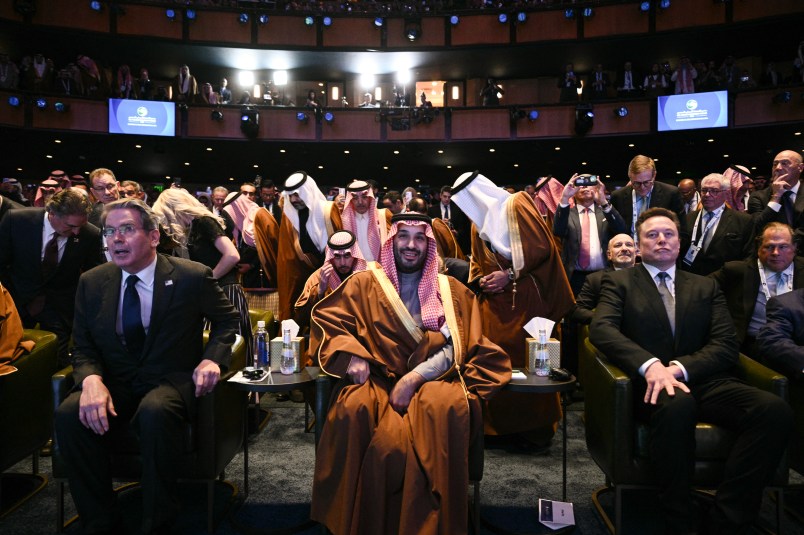
The de facto leader of Saudi Arabia, Mohammad bin Salman (MBS), has been urging Trump to help Saudi Arabia beat back the Houthis. He’s mainly been refusing them. What the Times story details is that on Thursday MBS called Trump and apparently literally begged him for help, to the extent that Trump gave in and agreed to join the Saudis’ fight. Trump had told his advisors the day before he wanted to stay out. Then MBS convinced him. But by Sunday he was back to wanting to stay out. That’s where things stand. This is an inconstant, impressionable and weak man. This is the nature of personalized rule when the would-be autocrat is in physical and mental decline.
There’s nothing righteous about teaming up with the Saudis in this case. It’s two pretty nasty players who’ve been fighting for years and causing huge civilian carnage along the way. But Trump has been willing to help before. From what I can tell, at least some of Trump’s current resistance is tied to the fact that he’s miffed at MBS for not helping with opening up the Strait. (Put a pin in that for a future post; it’s probably playing a bigger role than we imagine.) But he also doesn’t want more escalation of his politically and electorally disastrous war before the midterms. That pitiful and comical back-and-forth also demonstrates the role of personalism. The U.S. doesn’t really have a policy. It has the mindset and top fears, on any given day, of Donald Trump.
If my narrative above was a documentary, this is where you freeze the shot and say: this is why you think long and hard before you launch a war like this for essentially no reason. Lots of things can go wrong and you may end up needing to do things you don’t want to do and really shouldn’t do. But you have to because you’ve created a set of circumstances where you have no choice.
Here’s another thing to consider. The Saudis have a huge, huge amount of military hardware. On paper, they should have one of the most potent militaries in the world. But it’s always been known or mostly suspected that it’s vastly weaker than the price tag would suggest. U.S. reporting sometimes gives you the sense that the Houthis are some mountain folk on horseback. That’s not true. They control most of the country and have for some time. In practice, they’re an internationally isolated government. But Yemen is still a poor and war-torn country. The fact that the Saudi military can’t prevent them from basically blockading Saudi Arabia tells us the story. The truth is what everyone has always suspected. The Saudis have a paper army (let’s be generous and call it cardboard); when it gets into trouble, they have to call the U.S. Now they’re calling because of a crisis the U.S. started on its own. But the U.S. isn’t helping. And now Saudi Arabia is mostly blocked off from the sea.
Let me be emphatically clear: MBS isn’t some valiant player who has become yet another victim of Trump’s perfidy. He is awful in basically every way you can imagine. And the Saudis’ war in Yemen has been horribly destructive. Tens of thousands of Yemenis have died in the conflict.
But the supply of oil rests on that promise that the U.S. will take care of things if its regional allies — with their generally feeble militaries — get into trouble. The U.S. is now failing that promise two or three times over: by starting the war in the first place, by letting the Gulf kingdoms deal with the blowback on their own. That’s a reality that can’t hold. These patrimony states will either find other protection or build real militaries themselves.
In a way, it is a more brutal and militarized version of the breakdown in relations with America’s NATO and EU allies in Europe. The U.S. has become a chaos power which is not meeting the terms of the regional deal, and the other players are trying to figure out what to do in its place, what Plan B is — only there’s no immediate Plan B available. It’s not that there aren’t any downsides to the U.S. global hegemony or that it doesn’t have its critics. But what we’re seeing here isn’t the U.S. global hegemony being replaced by some more inclusive, less militarized successor. We’re seeing it just disappear. Perhaps Canadian Prime Minister Mark Carney will make some progress with his “middle powers” banding together to create a new and more just world order. But it’s definitely not here yet.
What is telling, of course, is that the Trump White House is filled with people with all sort of culture war hang-ups about Western Europe. They like sticking it to the Europeans, even if they’re not quite clear on the longterm consequences. But the Saudis and the other Gulf emirates are Trump’s guys. They’re supposed to be top oligarchic players in the new Trumpian, regional, spheres-of-influence world. But they’re getting hosed too. And Trump is doing things that will lead to even more chaos and even higher prices down the line because he mostly wants to avoid them in the next six weeks.
Simply put, when dumb leaders do impulsive things and then leave the consequences to others to clean up, things can degenerate really, really fast. And that’s exactly what’s happening.