


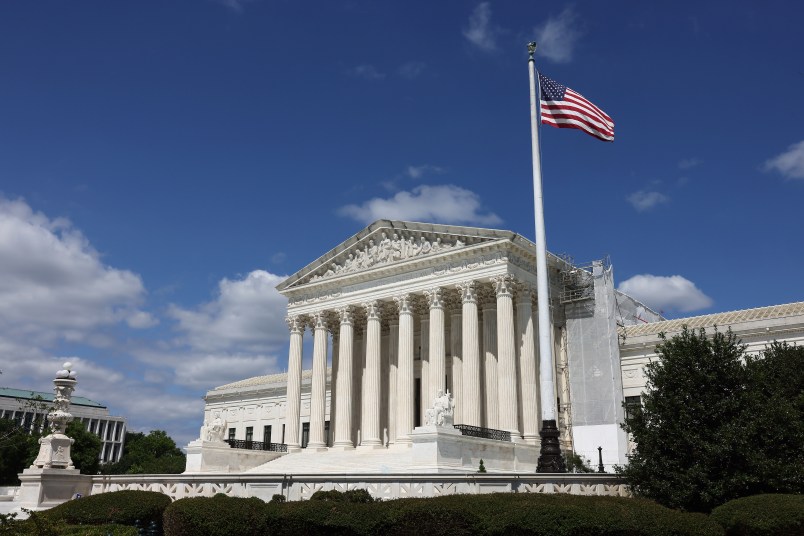
This likely goes without saying. But I’ll say it anyway and add a few points. The occasional non-terribly ruling by the corrupt Supreme Court doesn’t reduce the necessity of reform one iota. I’m not as wound up as I might have been by the anti-constitutional and frankly absurd independent agency ruling only because it was telegraphed so long in advance. (ICYMI, the Court ruled that the president has the authority to fire civil servants, unless they work for the Federal Reserve. More from Kate Riga on that here). I call the ruling absurd only because of what I guess we need to call the as-yet-tact “sound money” doctrine which makes the Fed somehow different from every other independent agency because of the more general “because” doctrine.
What I want to note here is what is semi-taken for granted even by many who despise the Court’s corruption. And that is the way it is more or less assumed now that any law, prohibition, or imperative assumed or embraced by Democrats goes up for review by the Court as though it were some kind of Guardian Council or perhaps more aptly an upper legislative house like the House of Lords. Of course judicial review is not new. That goes back 225 years. Key pieces of New Deal legislation were overruled by the pre-Carolene Products Court. And you have the entire Lochner era in which the Court held that most of what we would now call garden-variety regulation was unconstitutional.
That history certainly anticipates the Court’s current corruption. But I would argue they are qualitatively different. The idea that contract rights largely, if not entirely, trumped state regulation was not a novel doctrine. And the Court at least generally did not oppose the partisan interests of one party over the other, which is certainly the case today. What we have today as part of the openly partisan nature of the Court is that really every major exercise of power by Democrats comes up for review, in many cases where there is not even an existing Federalist Society/conservative legal movement doctrine in play. I would argue that this begins with the Obamacare decision in 2012. It followed a model which has now become entirely familiar. It generally begins with mouthing off and brainstorming on social media — comments that then gets picked up by a few generally obscure law professors who fashion it into an argument. This argument is initially treated as absurd before rapidly gaining traction on the right and then rapidly getting taken up by the Court.
At the time, the “surprise” decision to uphold the Obamacare individual mandate, largely the decision of John Roberts, was seen as a near miss or evidence of Roberts’ institutionalism. In retrospect, it is perhaps better seen as a latter-day version of Marbury v Madison, in which Chief Justice John Marshall cleverly rendered a decision that was of immediate benefit to his partisan opposition in order to entrench the general and empowering principle of judicial review. In the Obamacare case, Roberts allowed the individual mandate to remain (while striking down, on the basis of essentially nothing, Medicaid expansion) in order to lull constitutionalists into accept and even celebrating the purported institutionalism of a Court that would now sit in review of every law passed by Democrats. It is a classic case where the benefit of hindsight provides much greater clarity into what actually happened.
In today’s decisions, it’s certainly good that the Court didn’t reject states’ ability to accept mail ballots dated by Election Day. But the idea that it was even reviewed is absurd. There’s no possible constitutional deficiency in these laws. There’s not even any basis for it in the fraudulent menagerie of Federalist Society jurisprudence. It is purely the product of the short-term partisan interests of the Republican Party and far more so the whims of Donald Trump. All of these states’ laws require absolute evidence that a vote is cast by Election Day. The constitution doesn’t speak to the speed of counting (nor does existing federal law) and the long tail of counting has lasted past election day literally for centuries. Congress might pass a law banning accepting post-dated votes after Election Day. (Even in that case, I think there’d need to be at least some rational basis question for why such a law would exist given that the primary responsibility for election administration rests with states, subject to regulation by congressional statute). In any case, that’s a question on which reasonable people can differ. There is simply no basis on which this can be considered unconstitutional or in violation of existing statutes. At least with the anti-constitutional destruction of independent agencies, which is a war on the legislative branch, the conservative legal movement has obsessed and hungered for for decades. So you can at least grant them that it merely aligns with Trump’s demands rather than being the child of them.
There’s simply no future for real democratic self-government in the United States with this corrupt Court in place. That seems like a vast statement. But it’s accurate. What you have at the moment is a system somewhat — yes — on par with Iran in which you have the structure of democratic self-government but with a Guardian Council that assures that the bad people (i.e. non-Republicans) aren’t actually allowed to exercise power. This is not how even a maximalist judicial review system is supposed to work, and Democrats must break the Court’s corruption at the first possible moment. With some luck, that will come in January 2029.