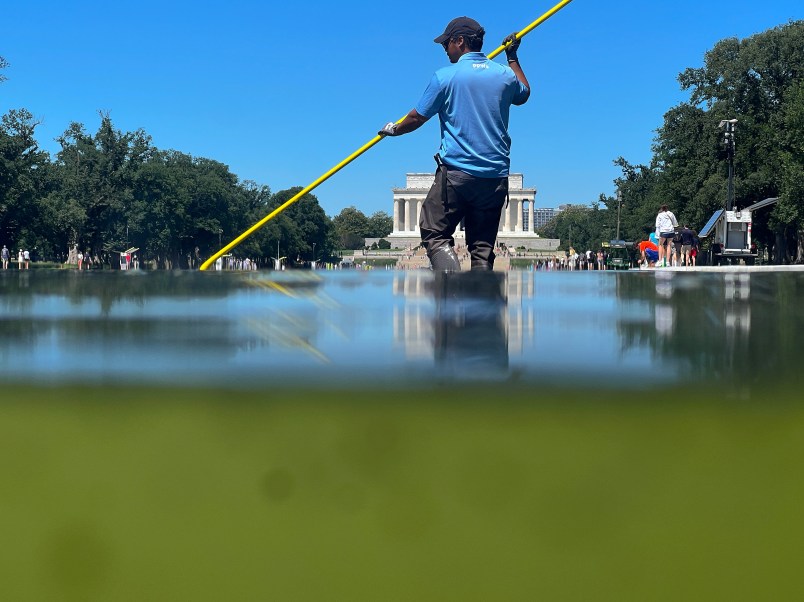
Lawyers for former Olympian David Hearn, charged with felony vandalism of Trump’s already falling apart Reflecting Pool refurb, went to court today and asked the judge in the case to allow them to review records of the grand jury that charged Hearn with a felony. (I first saw this referenced in an NBC article by TPM alum Ryan Reilly.) You’ll remember the basic details here. Trump’s botched Reflecting Pool job was already visibly peeling up from the bottom of the pool. Hearn appeared to touch one of the peeled up areas. And the Feds charged him with causing at least a substantial amount of the damage.
What’s notable about this is that the Trump DOJ has already been caught on several occasions either committing serious grand jury misconduct or improperly instructing grand jurors so as to secure indictments. That’s what Hearn’s lawyers say happened here. And they make a pretty good case.
The key issue Hearn’s lawyers are now pressing is somewhat technical. To be charged with a felony, you have to commit damage of more than $1,000. Less than that, it’s a misdemeanor. But the only witness who spoke to this issue of damages before the grand jury said that the pool was already damaged and needed to be repaired even if Hearn hadn’t done anything. That witness, a National Parks Service employee, also didn’t appear able to say what damage Hearn had even done. Hearn’s lawyers then present case law which shows that the legal standard in Washington, D.C. is that damages are calculated based on the condition the damaged item was in immediately before the defendant did his alleged crime. The government said the estimated cost of the repairs was between $6,000 and $15,000. That’s what got them over the $1,000 threshold. But the government’s sole witness said those repairs were necessary before Hearn did anything.
What Hearn’s lawyers are arguing is that if the grand jury was properly instructed on the law and legal standards, the decision to indict would make no sense. Because whatever Hearn did didn’t change the cost of the necessary repairs. Therefore, they want access to those grand jury instructions or, failing that, they want the judge to review them.
The filing also goes to some length describing the Trump DOJ’s record of grand jury misconduct and mis-instruction, including references to the Broadview Six case in Chicago. They note, tellingly, that these instances of grand jury misconduct and improper instruction seem to come especially in “matters of particular interest to current Executive Branch leadership.” In other words, when Trump or former attorney general Pam Bondi or acting AG Todd Blanche have it in for someone or is embarrassed by something the defendant did. Good point!
I lack the expertise to evaluate the legal arguments made in this filing. But the argument seems pretty compelling on its face. If the thing was already broken and required the specified repairs, the defendant’s actions can’t be what requires those repairs. You might be able to charge him with a misdemeanor for doing additional damage even if that damage had no financial consequence. But it’s the felony charge that is the issue at this point.
Of course we also have in the background that everyone could see that the pool lining was peeling up and that Hearn likely at most lifted it a bit to look at it. The possible legal insufficiency of the charges has more impact when everyone knows that the charges are basically bogus in the first place. My interest is on the issue of regularity, how much the Trump DOJ has lost the assumption that they’re basically playing straight. If they’re not — and there’s lots of evidence on that at this point — courts should and in many case will give defendants a lot more leeway to examine whether the charges they’re facing are legitimate in the first place.
Let’s keep an eye on this one.