


The country is beginning to wake up to the sheer level of strategic failure of Trump’s impulsive and unilateral war on Iran. Let me start with an extended quote from a weekend article in the New York Times …
The United States and Israel launched their war against Iran on the argument that if Iran one day got a nuclear weapon, it would have the ultimate deterrent against future attacks.
It turns out that Iran already has a deterrent: its own geography.
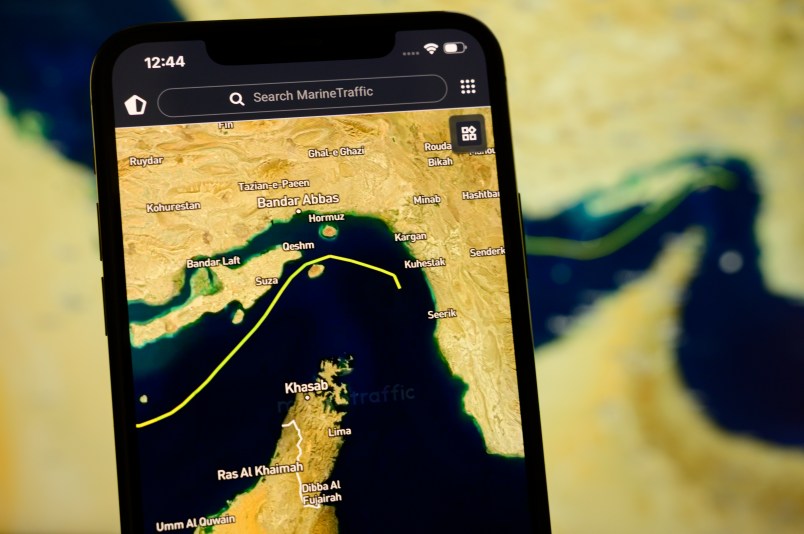
Iran’s decision to flex its control over shipping through the Strait of Hormuz, the strategic choke point through which 20 percent of the world’s oil supply flows, has brought global economic pain in the form of higher prices for gasoline, fertilizer and other staples. It has upended war planning in the United States and Israel, where officials have had to devise military options to wrest the strait from Iranian control.
The U.S.-Israeli war has significantly damaged Iran’s leadership structure, larger naval vessels and missile production facilities, but it has done little to restrict Iran’s ability to control the strait.
Iran could thus emerge from the conflict with a blueprint for its hard-line theocratic government to keep its adversaries at bay, regardless of any restrictions on its nuclear program.
This is what I’ve been saying for weeks. Control of the strait is a vastly powerful deterrent. It’s also much easier to use than any nuclear weapon, which is one of those threats that is powerful but also very hard to follow through on. I’m not claiming any great insight on this. You could see many other articles about this in the foreign policy press. But it’s only now that it’s really beginning to register in the broader U.S. news and politics discussion.
As someone pointed out to me a few weeks ago, Iran’s control of or at least leverage over the Strait of Hormuz has always been tacit in world affairs. The U.S. military has war-gamed a strait closure for decades; it’s a staple of predicted crises in the region. And it’s always been Iran as the country that was going to do it. That’s just down to simple geography and the fact that they’re the main adversary power to the regional hegemon, the United States. (It’s not something the Saudis or Kuwaitis are going to do. They’re allied to the regional Great Power.) But they’ve now shown they can close the strait without firing many shots. And the U.S. doesn’t seem to be able to do much about it.
For Iran it’s a deceptively elegant solution. Iran closes the strait with threats and perhaps some limited harassment of tankers. The U.S. could respond militarily. But the whole point is that the global economy is highly dependent on that region and that particular waterway not being a war zone. At least in the near-term U.S. military retaliation is more the problem than the solution. The only real solution would be for the U.S. to occupy a significant buffer zone in Iranian territory along the Persian Gulf. That’s probably militarily possible in the most basic sense. But how long do you occupy that strip of land? It’s not a workable solution on any long term basis.
We see something similar in the evolving press treatment of the war this morning. Donald Trump unilaterally extended the ceasefire to give the Iranians more time to respond (submit?) to his conditions. To the Iranians, though, this was Trump showing his cards. He’s in a weak position and he knows it. This has happened again and again over the last two or three weeks. But this morning the Times again says just that. “To Iran, Trump Blinked First by Extending the Cease-Fire,” the article reads. Again, the mainstream press is now saying more openly what’s been clear almost since the beginning of the conflict. Trump started this war on an impulse. In strategic terms he lost almost immediately, despite the vast damage he’s done to Iran. But he’s been unable to accept that fact. He has not made a painful but still manageable retreat or escalate. He’s stuck. He doesn’t know what to do. And he’s increasingly unable to hide that simple reality from anyone watching events unfold.