


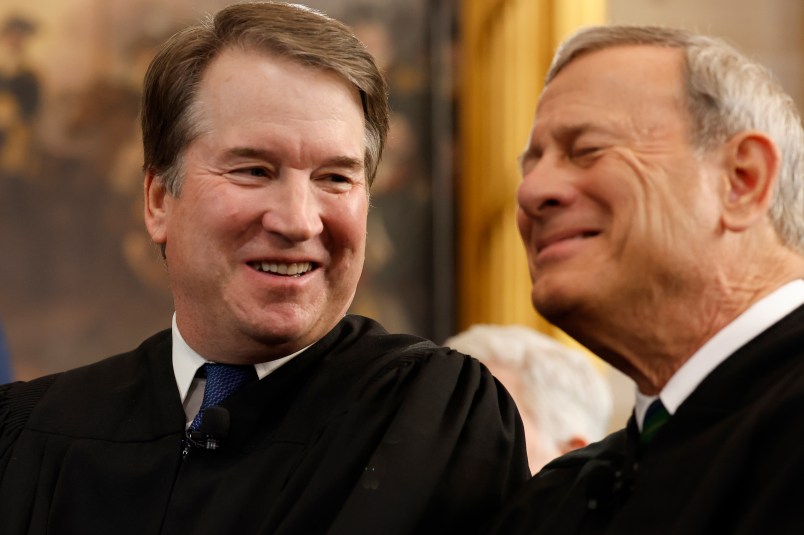
What interests me most about the Supreme Court’s telegraphed decision ending independent agencies is the ease with which they discard their governing theories (unitary executive) when the results are ones they find unpleasant (ending the independence Federal Reserve). Let’s make a note in passing that as long as they were going to make this disastrous decision, I’m glad they were also hypocrites and exempted (or suggest they are going to exempt) the Federal Reserve, because not doing so would have made it even worse.
It’s very much of a piece with 2024’s presidential immunity decision. It is demonstrably the case that the U.S. Constitution does not provide the President with any immunity from prosecution. You can argue this from absence (it literally doesn’t provide it); you can argue it from general logic, which is admittedly an inherently slippery kind of argument (no one is above the law); perhaps most convincingly you can argue by the fact that the Constitution writers very much knew how to provide immunity where they believed it should exist and did so in the case of members of Congress (speech and debate clause). They knew how to do it and decided not to for Presidents. The most generous reading of the aptly-named Trump vs. United States is that Roberts et al. decided as a matter of policy that such immunity should exist and therefore decided to create it. But it is entirely a 21st century creation with no basis whatsoever in the actual Constitution.
This week’s independent agency decision is very similar. The Court doesn’t even make much attempt to explain why the unitary executive principle doesn’t apply to the Federal Reserve beyond a hand-wavy “it’s way old” and “it’s different.” (The actual language: “The Federal Reserve is a uniquely structured, quasi-private entity that follows in the distinct historical tradition of the First and Second Banks of the United States.”) The best real explanation is that independent agencies are in the regulation business, something the majority doesn’t like, whereas, despite it’s regulatory functions, the Fed is in the stable money supply business, something the majority does like.
Peer a bit into the Court’s logic and it disassembles itself. Much of the push behind the conservative legal movement’s obsession with unitary executive power is the idea that the elaboration of the regulatory state was in a sense extra-constitutional if not anti-constitutional, a novelty of the 20th century. To the extent we place the Fed in the lineage of the First and Second Banks of the United States, this illustrates how this is very much not the case. The First Bank was almost literally part of the Constitution inasmuch as Alexander Hamilton had the idea of its creation in mind when he was helping to write and advocate for the Constitution. Certainly key architects of the Constitution very much had the idea that something like the First Bank of the United States could and should exist under the Constitution. The existence of the first two banks, quite controversial in their own day, makes clear that the architects of the Constitution very much believed that these sui generis — in the executive branch, or executive in nature, but not entirely in it — entities could exist. Because they created them. And if they could create them in the 18th and 19th centuries why couldn’t they create them in the 20th and 21st?
That reference to a “distinct historical tradition” has the feel of the Court’s Second Amendment jurisprudence, which basically amounts to “things that happened a super long time ago are cool.” But if it happened in the 20th century, not cool. The Fed is okay under a kind of grandfather clause function: it’s a super old tradition. But it only became a super old tradition because it was apparently okay for Congress to do this kind of thing. And if it could do it in 1791 or 1816, there’s no reason it couldn’t do it again in the 1930s. The argument to antiquity collapses under its own weight.
It’s fair to say that the Fed isn’t just like the NLRB. But if Congress can create one kind of independent thing, why can’t it create another? And absent some clear-cut logic in the Constitution, why does the Court get to second guess that? All of these questions basically answer themselves. The Court has decided that it gets to make policy on its own. Independent regulatory agencies aren’t okay; independent banking regulatory agencies are. Because that makes sense to them. End of story. Same as presidential immunity. The fact that almost a century of Congresses and Courts thought this was acceptable under the Constitution is irrelevant.
There is of course another possible line of argument, an argument to function. Maybe the Constitution doesn’t explicitly dictate something. But it does look to a government in which the branches of government are co-equal, one is not dominating the other. So certain actions may be justifiable to put the branches back into balance. But it’s hard to imagine such an argument today. Is there any way to argue that the current presidency is too disempowered? It’s almost a joke to even entertain the idea. Indeed, in my recent conversations with old-style judicial conservatives, I think the best argument against ideas like unitary executive power doctrines is simply to judge them by the fruit they bear. Whatever you think about the concept in the abstract, you simply cannot read anything about the creation of the Constitution, the people who argued for it or the public which approved it, and think this current situation was what anyone had in mind. Half the Federalist Papers were dedicated to arguing that the Constitution would never allow or enable this kind of untrammeled and arbitrary executive.
In a sense, the exception of the Federal Reserve is not only a small gift, a marginal limit on the destruction, but an additional gift of giving the lie to the whole enterprise. This remains a renegade and corrupt Supreme Court majority making up its own Constitution as it goes and most times, if not every time, enabling arbitrary and untrammeled presidential dictatorship.