


Callais, combined with today’s court ruling in Virginia, has jolted Democrats and sent commentators into bemoaning an accelerating “race to the bottom” and, to paraphrase Jeff Zeleny on CNN this afternoon, the end to norms that have organized American politics and redistricting for generations.
I’d like to offer a significantly different view of the situation. What we have seen over recent months is that Democrats have largely abandoned the mode of the last decade plus in which with one hand they fought the partisan battles of the day and with the other assume the mantle of defending the political norms Republicans have already destroyed. In other words, it was the responsibility of Democrats both to be contestants and referees. Republicans violated norms; Democrats tried to uphold them. That of course meant no partisan battle was ever on equal terms and Republicans almost always won them.
Through the redistricting battle and then with a thunderclap after the Callais decision Democrats have mostly abandoned this stance. There’s no race to the bottom beyond the simple fact that Democratic restraint has been removed from the equation. And that is a good thing. Democrats can release the enervating, demoralizing burden of being the custodians of an already-destroyed consensus.
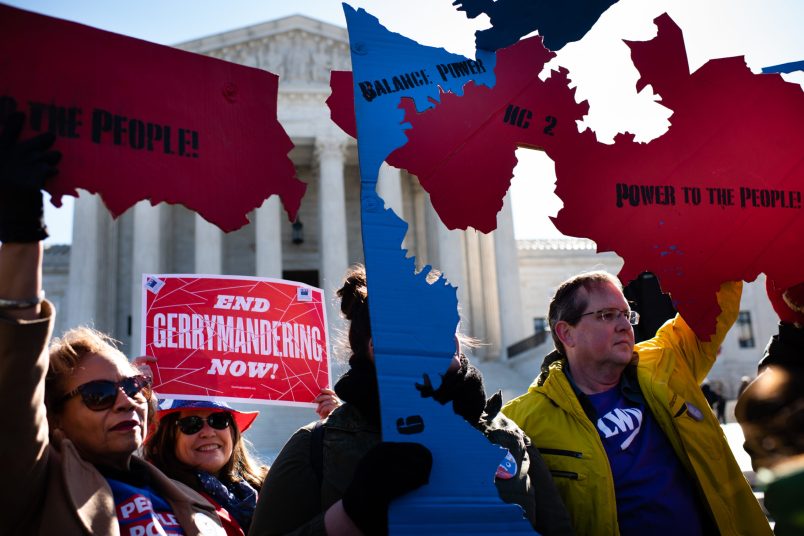
As for the disappearance of norms for generations to come, that’s not true. Democrats allow too much by accepting that blasé condemnation of all sides in equal measure. Democrats have and continue to support a national anti-gerrymandering law, one that establishes a uniform set of standards which places the interests of voters first. This race to bottom ends the moment Republicans and Donald Trump agree to back the fair set of rules Democrats are already on record backing.
Again, the two sides are not on equal footing. One supports uniform and fair rules, putting the bacillus of partisan gerrymandering and neo-Jim Crow Republican politics back in its bottle. This is not some distant aspiration. It can be done by a vote of Congress and a presidential signature. The corrupt members of the Supreme Court may again abuse their power and claim that such a law is unconstitutional. That only demonstrates the need for reform of the Court. The aims of the two sides here are not equal. One embraces democratic practice, the other doesn’t. We don’t have to bemoan a “race to the bottom” in which there are no good guys and bad guys. The right path forward is a national, uniform set of standards putting voters of all stripes first. The only question is whether Republicans and their corrupt allies on the Supreme Court will let that happen.