


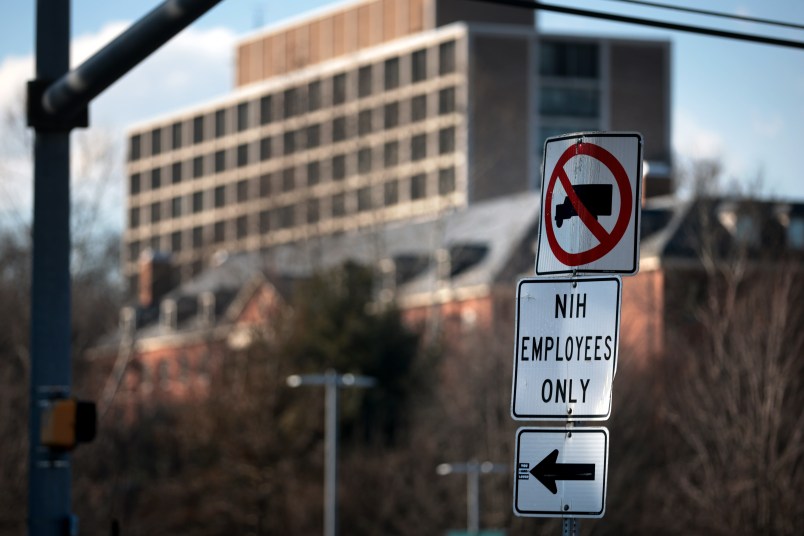
In recent days I have been inundated by reports out of HHS and particularly NIH (National Institutes of Health) and NCI (National Cancer Institute). I hope you will keep inundating me. You can find out how to contact me through encrypted channels in the footer of this post. Since it’s time consuming to dig in and confirm each individual thread of the story, which I’m in the process of doing, I want now to give you the broad picture. And the broad picture is bad. It’s nothing less than a very concerted attempt to shut down medical research across the United States.
It starts with what we know about — “freezes” of grant spending which in some cases have been blocked by the courts but in many of those cases have not yet restarted. Some of that seems to be intentional non-compliance, but a non-trivial amount of it is that when multiple things are intentionally broken at once things simply don’t snap back. In other cases, communication freezes have halted the grant-making and dispersement process because that process requires, by statute, various reviews and communications that are themselves frozen. In yet other cases, grant formulas are being altered in ways that threaten less direct breakdowns in the ecosystem of clinical research. What we discussed last week about “indirect” payments to institutions hosting research is part of that.
This is one of the points. Money is the essential factor in funding research. But if we imagine ten processes that are necessary for the money to flow, in many cases five or six have been disrupted even if the money, in theory, isn’t frozen. As you can see, I’m talking at a high level of generality here. That’s in part because the precise details are complicated and also because I know different parts of the puzzle with different levels of certainty. But I’ve communicated with enough people on the inside to have a pretty good read of the overall situation.
There’s another level of the situation that is more elusive and has received, at least in the mainstream press, much less attention. There appears to be a concerted attempt to paralyze the various institutes and centers from within. This includes things like directives that one department can’t communicate with another or various directives against internal communication. Outside speakers aren’t allowed to come to discuss their research and vice versa. It’s very hard to imagine any benign intent behind these actions. They seem to be a mix of creating multiple layers of directives to halt all activity whatsoever combined with an effort to prevent one part of the organization from knowing what political appointees are shutting down, or who they’re firing, in another. Perhaps in the spirit of human medical research, it looks like an attempt to shut down one organ system after another and then be able to say, “Welp, she died. Hard to say what happened.”
One final, sobering note. Anyone who has been reporting on events in the executive branch over the last three weeks would, I suspect, agree to this general pattern. There was a first week when everyone was in shock, scared, had no idea what to do. Then the mood shifted to anger, small-r resistance and a kind of mutual aid. I was chatting with one civil servant and noted that acting in that way must be really outside the muscle memory of most civil servants since, notwithstanding eight years of concerted propaganda, what most civil servants are really in the habit of is getting clear direction and executing it. A lot must have changed, I said. “I don’t think we’ve ever felt hunted for sport before,” this person replied.
But I’ve noticed a different note in these conversations over the last two or three days. And at least within NIH and its associated HHS research agencies that’s something along the lines of “where are the lawsuits?” Like, where’s the cavalry? On a broad level there’s no opposition cavalry coming over the hill since the opposition is frozen out of all power at the federal level. As far as lawsuits go I suspect that part of the issue is that these are incredibly complicated bureaucracies in the sense that there are multiple centers and institutes and different agencies working on different things and often the nature of administrative law means each has to be litigated individually or perhaps the facts just differ enough in different places that different legal action is required. And in every case you have to find someone with standing to bring a suit. That all comes down to the complexities of the law generally and administrative law particularly. I raise it here merely to note there’s a sense of bewilderment and fatigue. And quite apart from the impact on individual people, the civil servants and their morale really amounts to the connective tissue that allows these institutions to continue to exist. So there’s more on the line here than empathy.
If you’re at one of these agencies and you’ve already reached out to me, please keep doing so. And if you haven’t, please consider it. As I wrote above, I’m working on reporting out different dimensions of this story in more concrete detail. So many threads have been ripped free at once it’s hard to know which to pull first. But I’m working on it.
NOTE: As I have for 25 years, I welcome your responses, which you can send to talk (at) talkingpointsmemo dot com. If you’re a government worker or anyone else who has sensitive or confidential information to share about what’s happening inside the federal government you can reach me via encrypted mail at joshtpm (at) protonmail dot com or via Signal at joshtpm dot 99. Please only use these encrypted channels for confidential communication.