


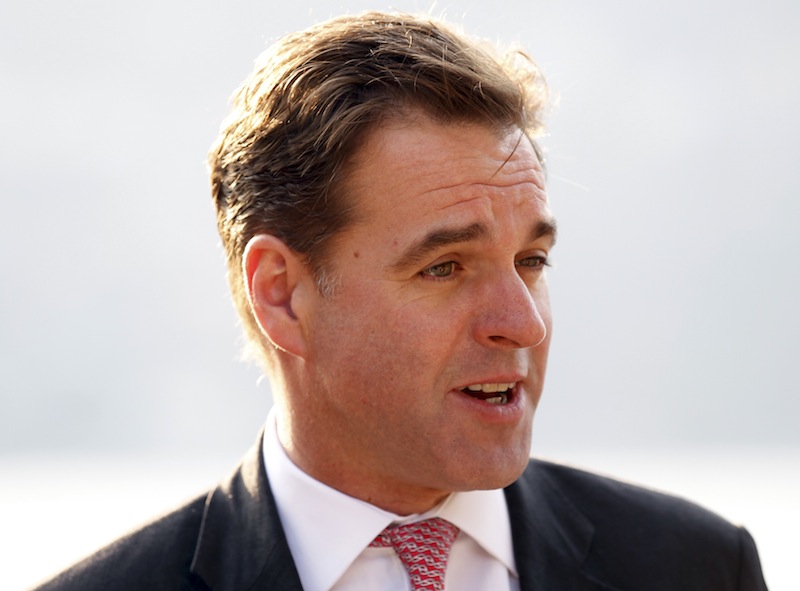
I first encountered Niall Ferguson in a real way when I was writing a review essay for The New Yorker at the end of 2003. The editors had sent me a small stack of books about what we might call the “neo-imperial” moment that took hold of Washington, D.C. in the aftermath of the 9/11 attacks. One of these books was by Ferguson, a fairly rousing and unabashed celebration of the British Empire. If anything it was among the more indirect and implicit versions of the story told by the various authors, celebrating the glories of empire and leaving it to the reader to draw the conclusion it was time to bring them back. As I’ve read columns of his here and there over the last couple decades, the historianness has receded as the tendentious provocateur has moved to the front. But something different struck me about the piece he published in The Free Press earlier this week (subscription required) about Trump’s Gaza peace plan: that was how much it matched in key outlines the piece I wrote on the same topic last week. If you recall, I wrote that the Trump plan was actually a fairly big deal and one that for a variety of reasons only Trump was in a position to pull off. The basis of the agreement is the common authoritarianism and corruption that now knits together Washington, Riyadh, Abu Dhabi and other regional capitals through the personal relationships binding together Trump family and the princely families of the Gulf.
Needless to say, I don’t consider corruption and authoritarianism good things. But they made this possible. I think we can recognize both those facts at once. Ferguson sees the exact same thing. Only he thinks it’s awesome. He won’t quite draw out the implications but he sees the exact same thing. You can even see it in the headline, where he calls the new approach “real estate-ism.”
Ferguson starts his essay, as you might expect, name-checking various liberal commentators who, in his estimation, can’t face the fact that the ceasefire they’ve claimed to want for a year or two not only happened but happened through the good offices of their archenemy. He then notes how Joe Biden and his liberal international smarty-pants advisors also couldn’t get it done. Yet while he puts up some bunting and fireworks about Trump’s special genius, the actual article describes pretty clearly what I described. These are all personalist and authoritarian regimes. The Trump family has spent the last decade building deep business ties to these families. The relationship with Israel is more complicated. But he describes it pretty much as I did — personalist regimes, Trump’s business heft, the fact that Trump’s grip on the right in the U.S. simply leaves Netanyahu no place to run if he’s on the outs with Trump. Obviously he can’t make his case to the Democrats. But he can’t make it to the Republicans either. Because Trump owns the GOP.
The difference of course is that this isn’t Ferguson articulating a equivocal analysis of the role of malign tendencies in securing a positive objective. For Ferguson, it’s all great. Remember the headline: “How Real Estate-ism Got the Deal Done in Gaza.” He speaks again and again about how they approached the negotiations “like a real estate deal” while ignoring how it was in key ways an actual real estate deal. Ferguson is never willing to play out the implications of the case he embraces to celebrate his friends and make fun of his foes.
Do we really want to live in a personalist/authoritarian regime or one in which only billionaires can become heads of state? Do we want a political system in which presidents have to engage in systematic personal corruption as the lubricant of deals between states?
Needless to say, I don’t. But these points Ferguson is less eager to discuss, contenting himself with laughing about the demise of the “liberal international order” and focusing on a real estate-infused culture of risk taking which has, he seems to argue, made Jared Kushner into the Henry Kissinger of our age. As I said, Ferguson is tendentious and a provocateur. Grappling with anything that goes beyond sick burns doesn’t interest him.
What interests me in this story is that this is, after all, one of authoritarianism’s main selling points. You do away with the battles of politics and interest groups — at least the visible ones. You concentrate the power in one person and that person hashes out deals with other leaders who are similarly freed from dealing with legislatures or over-mighty nobilities or untamed oligarchs or anyone else. I don’t think this tells us much about the best way to organize the world of politics. But it seems foolish to deny that this constitutes a proof of concept for Trumpism, albeit a misleading one.
As I reflected on this, I also considered the extent to which the decay and brittleness of America’s domestic institutions and the global institutions it built brought us to this point. Put a different way, to what extent is the U.S. system and the global system already sufficiently oligarchized and tipped toward autocracy that someone like Trump is most able to operate within it? There’s more truth in this question than I like to admit. You can say Biden was simply a weak president. I mostly don’t agree. But he and his advisors were far too wedded to the frameworks of multilateralism or perhaps a caricature of them. They were not sufficiently comfortable with wielding power. That’s a through-line through a lot of the Biden presidency. But it is equally the case that from an international perspective, Gaza brought Biden into direct engagement with Benjamin Netanyahu and the Gulf princes, two forces which have deeply embedded themselves within the U.S. political and economic system and in many ways corrupted them — both taken advantage of their corruption and deepened it. And here I don’t mean just the bright-light corruption of the Trumps, the princes, sweetheart deals and money payoffs. I mean the deeper kinds of corruption through means that are, for the most, part legal.
This brings us to a related point, perhaps a slightly optimistic one. To the extent we’re seeing this as a possible new mode of conducting foreign policy and building the international order, is there any other region in which something like this was possible? Is this new version of international relations which Ferguson celebrates as the basis for a few sick burns one that could be applied in Latin America or Europe or most of Asia or Africa? I think probably not.
The Middle East has a unique combination of relatively unchallenged autocracy and unimaginable amounts of surplus revenue. In its political and economic structure it’s very, very Trumpian. This is the proper prism through which to understand the success so far of Trump’s deal. He speaks the language, figuratively if not literally. These are economically primitive resource extraction economies built on wealth and force. They are the kinds of political economies that Trump aspires to build in the United States, notwithstanding all his chatter about manufacturing. This explains why he is more effective there than he is here.
Of course, lack of success here is all relative. He is president. He is running the show. That certainly counts for something. But all the wobbliness and unevenness is a reminder that there’s a whole apparatus of civil society and civic democracy that Trump hasn’t yet subdued. It makes every move stumbling even where it is, in key respects, successful. Everything in the Gulf moves more smoothly. Trump is on his own turf. Democracy, civil society, visibility aren’t there to get in the way.
We need to have two very different prisms for understanding what happened here. And before digging into that, I would be remiss if I didn’t mention that so far not that much has happened. He’s separated two warring parties — Israel and Hamas — who after two years had very little still left to fight over. For the reasons noted above, I do not expect this is just going to fall apart at the first difficult juncture. We’ll see. To return to the point, we should recognize both the positives that this deal-in-process could bring about while also seeing clearly how it wouldn’t have happened without a world order — and a U.S. national order — that most of us are trying our hardest to prevent from coming into being.