


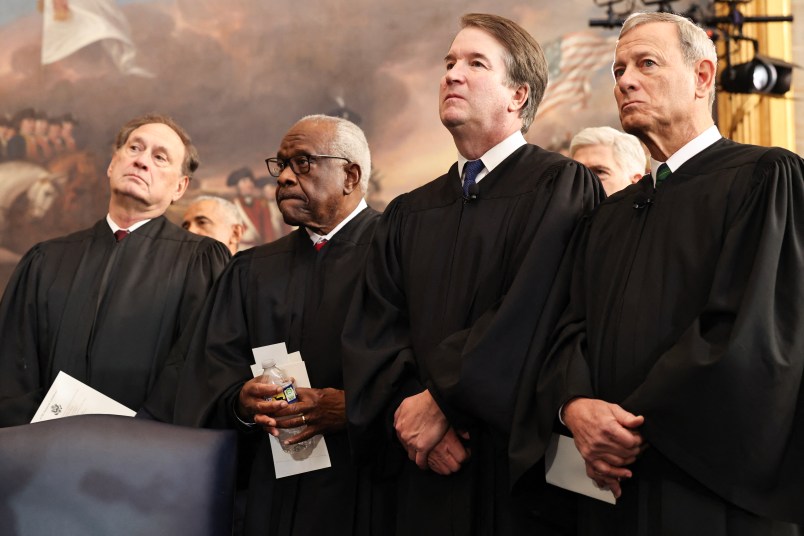
Here’s a brief follow up on yesterday’s post about the corrupt Supreme Court. Yesterday I noticed law professor Steve Vladeck arguing on Bluesky that civic democrats are making a mistake by seeking to “fix” the Court by, as he puts it, “permanently weakening it as an institution.” The gist of his argument is that you constrain the Court by “forcing it to look over its shoulder” as it decides case. In a post on the topic, he writes, “as compared to a time when Congress controlled things like when the Court sits; where it sits; which cases it hears; the Court’s budget; and what the justices must do when not hearing cases (i.e., ride their circuits), today’s Court can do just about whatever it wants, whenever it wants, and all without realistically having to look over its shoulder.”
I told him that I actually agree with the concept of having the court “look over its shoulder” — that you have a series of teeth in place to react to overreach. I’m not sure about the best method of applying that pressure. But I agree with the general principle. Or, rather, I did agree with it — but I think we’ve missed the window for that kind of intervention from Congress. (You can see our brief exchange here.)
What he describes really is the ideal way to handle a situation like a renegade, corrupt Court. But the utter lack of accountability, the very merited confidence among the justices that there is no possible brake on their corruption, is what got us to where we are. My read is that the corruption is likely too deep-set at this point for these kinds of efforts to create accountability to be effective. I also think the Court, in a perverse tandem with Donald Trump, has gotten us so far along the road toward oligarchic rule that we simply don’t have the time.
In any case, I noted this just to share views of others who, I think, see the scale of the corruption but have a different view of what to do about it. One of the few silver linings of the corrupt Court deciding to get rid of the Voting Rights Act (which, let’s be clear, is the legislative embodiment of the Civil Rights Movement and Second Reconstruction) is that it has pushed a whole additional echelon of people into the Court reform camp. Even those who really would prefer to crawl over broken glass than fiddle with the structure of the Court see now that there’s simply no alternative. The alternative is simply to accept the indefinite rule of a corrupt Court making war on the Constitution (the foundational pact which is the basis of all power and legitimacy in the United States), overruling democratic self-government and allowing only it’s own political party to enjoy real political power. And all in the cause of a vacant and meaningless institutionalism.
Along those lines I wanted to share this brief interview clip with House Minority Leader Hakeem Jeffries in which he says, to my pleasant surprise, that in the new Congress “everything is on the table to deal with this corrupt MAGA majority that is issuing political opinions that are designed to bolster the prospects of the Republican Party.”
Rhetoric is just rhetoric, of course. But you have to start with rhetoric. You begin with commitments which then have to be followed through on.
When I make the case for reform, I get emails from people who say, is this realistic? Is there any appetite for this among congressional Democrats? In the Senate, I’d say it’s a very tough row to hoe. There’s more appetite in the House, but I’m not sure most of those folks have even given it much thought. What I tell people is you have to start by making it clear to any federal Democrat that this is a sine qua non for your support. The effectiveness of that approach, along with the opinion-shaping impact of the reality of the moment, is what shifted things on gerrymandering. I was encouraged to see Jeffries properly labeling the Court as “corrupt” and saying reform is necessary. He’s further along than I’d imagined. That should encourage everyone interested in reform and the future of democracy to keep pushing.
Another thing people ask me is, how is this possible while Trump is president? Well, of course, it’s not possible with Trump as president. This is something that can only happen in 2029 assuming a Democratic trifecta, something that is by no means assured but I’d say is a better-than-even bet. What you can and must start doing now however is build the consensus to act so that everyone knows what is necessary and set to happen in early 2029. But it’s not only that, and this goes back to Vladeck’s point. There’s no bright line between enacting reform and shaping Court behavior with the threat of reform. Making the threat of reform real in 2029 will shape the Court’s behavior in 2027 and 2028. By all means let the corrupt majority do their best to head off reform by making the case that it may not be necessary.
Hold Jeffries to his words. Keep building the case for the necessity of reform. 2029 is, alas, right around the corner.