


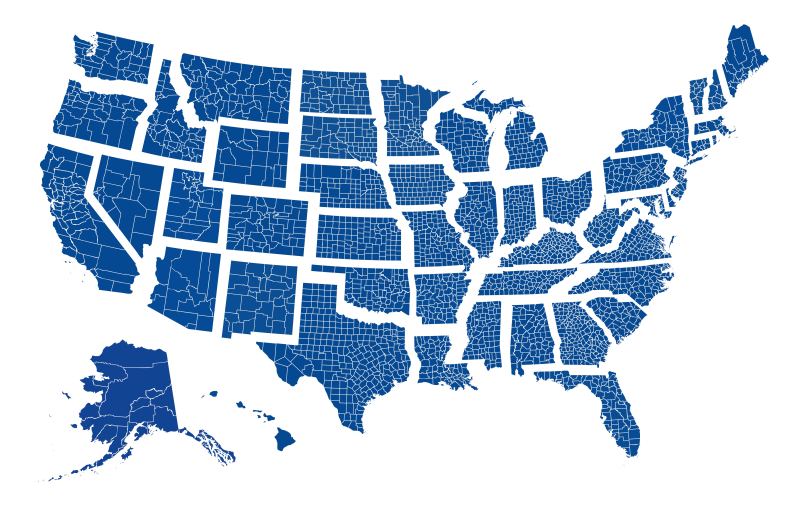
Yesterday (in this post which didn’t go up as a BackChannel) I discussed the idea of “strategic depth” as a way of thinking about the sovereignty of the states in the battle against Trumpism. I want to expand on that. Because it’s become pretty central to my thinking about how the United States is going to survive the next three and a half years and begin the process of battling back. “Strategic depth” is primarily a concept for military studies. It refers to the shape and arrangement of the physical territory a country controls and how close its borders, which may be vulnerable to military attack, are to its concentrations of population, political and industrial centers. If all a country’s key stuff is right near a vulnerable border that’s a big problem. But in addition to where its key stuff is, does it have a lot of territory to fall back on if it suffers early defeats?
To visualize this, consider longtime rivals India and Pakistan. India is a vast, continent-sized country. In comparison, Pakistan is a relatively thin strip of land with a lot of key economic and industrial centers relatively near to the common border of the two countries. Just look at a map and you can see how India could cut the country in two or overrun Pakistan with a few early military victories. This perceived lack of “strategic depth” has long obsessed Pakistan’s military and defense establishment. It’s also a key reason why Pakistan has long meddled in the internal politics of Afghanistan, trying to ensure a friendly or at least non-hostile government. In the thinking of the Pakistani military, Afghanistan is more land to fall back on, a partial solution to that lack of territory to fall back on. In hostile hands, Afghanistan is an invasion route to attack slender Pakistan from two sides at once.
A similar issue has obsessed the Israeli defense establishment. Israel is a tiny country and its major population and economic centers are only a few miles from its borders. It has no strategic depth. This was even more the case before the Six Day War in 1967 when the Jordanian border went through Jerusalem and was much closer to Tel Aviv. This has led to two key Israeli military doctrines. The first is that Israel has essentially no territory to fight on so it must do everything possible to go immediately on the offensive and fight on an opponents territory. This is critical to understanding what happened in Six Day War. The second is the need for buffer territory. There are a number of reasons Israel held on to the West Bank and the Golan Heights after the Six Day War but that need for strategic depth and to control the high points (look at the relative elevations of the Golan and the West Bank vis a vis pre-1967 Israel) were key, especially at the beginning.
Needless to say, both countries have many other motivations for their national security policies and the things they’ve justified in their minds to secure them. Both countries have done a lot of harm pursuing policies to counter their perceived lack of strategic depth. I don’t want to get distracted by those countries or those issue in this post. But I wanted to illustrate the concept. When Donald Trump won the presidency in 2024, he inherited the entire federal government, the executive branch, a Congress under Republican control and a judiciary he had stacked with no fewer than three Supreme Court justices in a single term (a totally unheard of number). That Court has interpreted law and constitution in a way that makes Trump essentially an absolute monarch within the federal government. He can fire anyone at any time for any reason. He can ignore statute law under the guise of bringing the executive branch into “alignment” with Trump’s “vision” or “policy objectives”.
There are key areas where Democrats in Congress may have moments of power, the ability to slow a few things down. But to a great degree, the battle is already lost within the federal government until the next election. It’s only in the states where opponents of Donald Trump hold executive power outside the reach of and the hierarchies of the federal government. That’s where the whole game is. It is strategic depth not in extent or remoteness of territory but in the structure of government and the state. And states have vast amounts of power, far more than we tend to realize because we’ve never been in a position where the mundane daily activities of state and local government have become so critical — its taxing powers, its policing powers, the ways in which the federal government actually struggles to effectively extend its powers to the local level at scale without the active participation of local government.
Understanding the critical role of the sovereign powers of the states as a redoubt beyond the reach of Trump’s increasingly autocratic power is really the entire game right now, at least for the next 18 months and, in various measures, almost certainly through the beginning of 2029. People can march, advocate, campaign, donate to candidates, all the stuff. But in many ways the most important thing right now is both communicating to and demanding of state officials that they act on this latent power.