


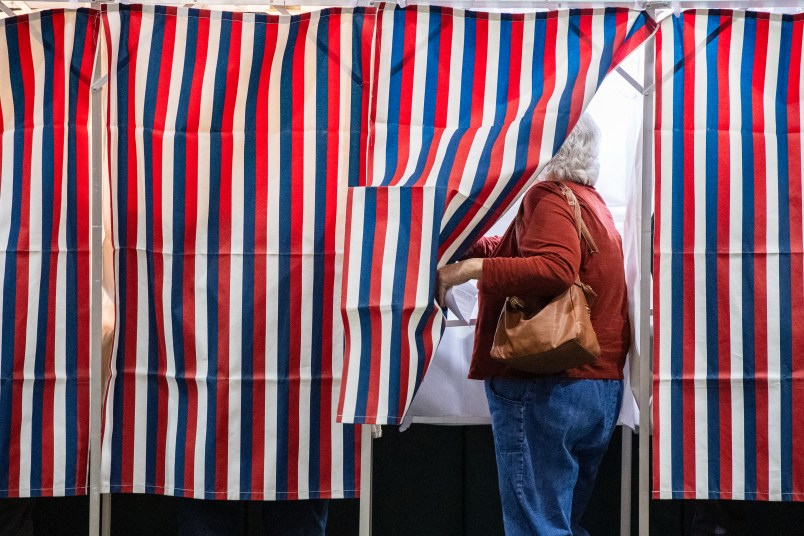
There was voting in New York state today and I had to choose a candidate in a race I’ve observed, but not really as a voter. Who should I pick? I understood the question a little better when I explained my thinking after the fact to my son.
As is often the case the race had three main candidates, two flavors of mainstream and/or establishment candidates (I say this in a purely descriptive way) and third who’s running in the left/progressive Bernie lane. As you’d expect, everyone is going to fight Trump, reform or abolish ICE, etc. The ideological complexions of the candidates I know like the back of my hand — establishment with signifiers meant to gain Independents, more straightforward Dem incumbent, and then push the Overton Window, Medicare for All, etc.
But I realized I didn’t really care about any of those things. I care about the policy issues. But in the real world, policy choices are constrained by what’s possible with the larger caucus. What I care about is the fight. And even though that word was high in the messaging for each candidate, that still didn’t address what I was looking for. In the 2026 cycle saying you’ll “fight” Donald Trump means nothing because everyone is saying it. What I was looking for was a theory of power and which, if any, of these candidates is focused on key structural changes to break and recover from Trumpism.
The truth is that you can be ready to fight like that and be in any of those three ideological lanes. They’re simply different things. And I’d be happy to vote for someone in any of those ideological lanes if they were the fighter. The limited campaign material I had a chance to peruse gave me very little insight into that question. And that’s a problem because — I would say at least — “fight,” as I’m defining it here, is far and away the most important qualification for a Democratic candidate — both at the federal and state levels.
This touches on a more general point I try to make a lot. Fight, as I’ve defined it here, can exist anywhere on that ideological spectrum. But we tend to assume “fight” equates with being more ideological and left (if you’re a Democrat) and right if you’re a Republican. I do not think that’s the case and it clouds and impoverishes our intra-Democratic conversations. “Centrist” politicians are often as responsible for this confusion as anyone since they are often selling non-confrontational politics. But just because it’s often the case that these two things align, doesn’t mean there’s a necessary alignment.
This is more than a matter of getting labels right. The one things polls tell us today is that voters are down on Democrats not because they’re too “woke” or “extreme” or that they’re too neo-liberal or “establishment.” Voters lack confidence in Democrats because they don’t fight. So you need to have a way to code that quality and then allow people to choose those candidates. You match candidates’ ideological complexion to the state or district. What works in New York won’t work in Georgia and one kind of left that works in Minnesota won’t work in Michigan. That’s all basic coalition building, matching candidates to the district, etc. But the fight element is what polls tell us pretty clearly Democratic and gettable D-leaning voters want pretty much everywhere. It’s on candidates and opinion-influencers to craft a language to signal what voters are and are not getting.