


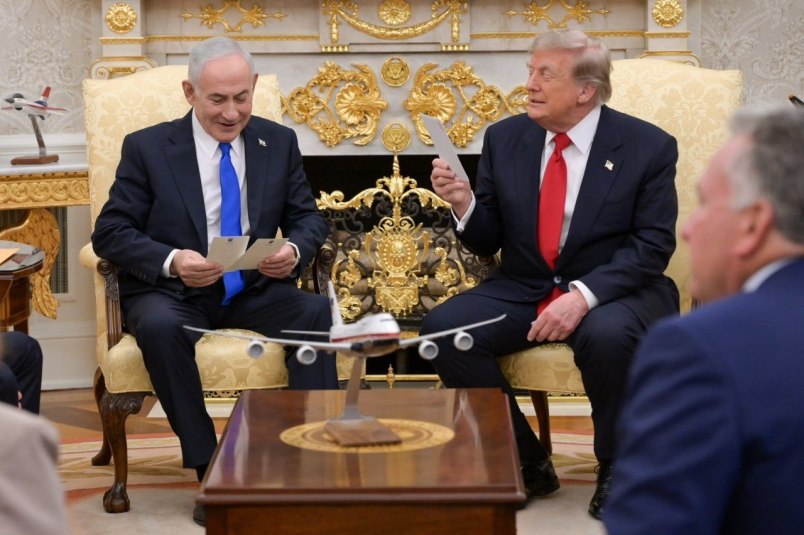
A follow up to last night’s post on Mike Huckabee, now U.S. Ambassador to Israel. Axios reports that Donald Trump is pretty conspicuously declining to endorse Benjamin Netanyahu for Israel’s October election. I would be remiss I didn’t explicitly note that it is unprecedented and outrageous that a U.S. president is even considering a formal endorsement in the election of an allied country. They’ve often had preferences of course. But we used to have respect for the internal affairs of foreign governments, especially allied ones. In any case, we don’t now. And here we are.
This appears to be part of Trump’s deliberate move away from Israel and the closely related annoyance that Israel continues to complicate his other priorities, which are one part conventional geopolitics and one part corrupt deals with various Gulf States. But there’s another factor Axios points to which we’re familiar with from the U.S. endorsement game. Netanyahu’s polls look bad. And Trump doesn’t want to back a loser.
One additional issue is Trump’s standing in Israel. Trump has been wildly popular in Israel since he came onto the scene a decade ago. He remains popular, but that popularity has taken a significant hit as he’s become less accommodating of Israel and occasionally even hostile. The central driver is Trump’s efforts to cut a deal with Iran. What Trumpers try to deny in the U.S. is crystal clear to everyone in Israel: Trump has lost his war badly — at least in terms of strategic aims, if not in every military engagement — and he’s desperate for a deal.
Underneath all this is growing skepticism of Netanyahu’s approach to managing relations with the United States. For generations, Israelis focused on maintaining strong bipartisan support for Israel in the U.S. Netanyahu had a different model, which was to build an alliance with the Republican Party. That became supercharged under Trump, where it became even more an alliance with Trump himself. That shift wasn’t out of the blue, certainly. The post-90s Republican party was simply more in line with the Israeli right. There was a lot of commonality of interest. But the shift, heavily driven by Netanyahu himself, both grew out of those changes and heavily accelerated them.
The Democrats don’t matter. We’ve got the GOP and we’ve got Trump, Netanyahu’s argument went. And it worked great for him until it didn’t. This came out into the open most clearly in 2014 and 2015 when Netanyahu openly lobbied against President Obama’s Iran nuclear deal (even as many in the Israeli security establishment thought it was helpful to Israel) and finally accepted an invitation from the Republican-controlled Congress to address lawmakers in opposition to the president’s signature foreign policy project. We’ll return to this episode in another post but it is difficult to overstate the longterm damage this did to the Israel’s standing among a generation of Democrats.
In any case, that alliance has been central to Netanyahu’s politics. And it paid huge dividends until Trump began — as anyone familiar with Trump could have predicted — to turn on Israel and Netanyahu because the alliance was no longer convenient for him. Israel shifted from an alliance with the U.S. to an alliance with the GOP during a period in which Netanyahu was prime minister for all but a brief period lasting about one year in 2021 and 2022. Clearly the big driver of this shift on Trump’s part is that he’s pissed that Netanyahu helped get him into his disastrous war with Iran. But it’s not just that. Operationally, their close ties have greatly complicated Trump’s efforts to get out of that war, or manage its collateral damage — trying to cut deals with the Iranians, struggling to keep the Gulf states (who are both U.S. allies and Trump family corruption partners) in line as they deal with the blowback from the conflict. Now there’s real worry and fear in Israel that the current rift in relations isn’t a phase but, rather, permanent. Relations with Democrats are in disarray and not only is Trump increasingly hostile but opposition to Israel is rising within the GOP as well. And while Gaza and shifting demographics in the U.S. are a big part of that, a lot of it is tied to Netanyahu’s theory of managing the U.S., which now seems to be in a shambles.