



I frequently get asked what people can do to get involved or play some role in fighting for the future of their country — where to donate, what kind of activism has a real impact. Some people have always been activists. But many others aren’t and haven’t particularly wanted to be but now feel they have no choice. And yet the scale of the problem is overwhelming, and the range of organizations and movements calling on your time and money are almost equally so. Critically, if you’re semi-new to these things, you don’t want to find out you were wasting your time or at least not using that or your money most efficiently.
TPM is a news and commentary site, not an activism site. But at least here in the Editors’ Blog we’re not so finicky about that that we feel we can’t share our opinions, hopefully reasonably well informed and perhaps with additional reporting, about what is a good use of your time or money. So with that in mind, and after a friend suggested it, I wanted to do a series of posts on the idea of “What Can I Do?” And here I would love your participation, your suggestions via email. I have my own views of the matter but I certainly don’t have all the answers and, by design, I don’t get directly involved myself. So give me your ideas, and I will try to share my thoughts on practical ways we individually can try to save our country and, as I will explain in a moment, build a new one. What actually makes a difference and what is more like scattering seeds on the wind?
Join
Join me for a casual conversation with Brian Beutler, the proprietor of the newsletter Off Message and a former TPM colleague. Brian and I will use the news of the day as a jumping off point to chat about the Trump II era. We’ll be biting off some small topics like:
- How did we get to this point?
- How much worse will things get before they get better?
- Are we still being too optimistic?
- What does rebuilding American democracy look like?
We’ll be talking on Substack Live at 2 p.m. ET. See you then.
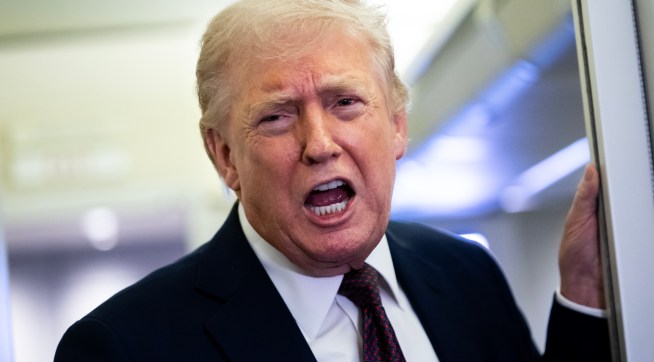
You’ve certainly seen or heard about President Trump’s morning threat to destroy Iran’s civil energy and bridge infrastructure if the country doesn’t reopen the Strait of Hormuz by Tuesday. To quote him: “Open the Fuckin’ Strait, you crazy bastards, or you’ll be living in Hell — JUST WATCH. Praise be to Allah.” (That’s not my arch summary. That’s a direct quote.) I will set aside that these would appear to constitute war crimes as going without saying. The man is careening from one day to the next, from ‘the strait doesn’t matter,’ to (alternatively) ‘not our problem/it will open itself’ to ‘I give you two fucking days or you’ll be living in hell.’ Of course, then, he has then repeatedly “postponed” the day of destruction after encouraging talks with Iran leaders, talks which we then learn a few days later never occurred. But now he says, “Tuesday will be Power Plant Day, and Bridge Day, all wrapped up in one, in Iran.” (This time I really, really mean it!)
In other words, talk like an insane person and carry a really small stick. He thinks these outbursts make him look stronger but each threat and retreat makes him look weaker and more clearly not in control of the situation. These are the words of a man who has spent a lifetime either TACOing or bullshitting his way out of messes suddenly coming up against an immovable object and at a moment when he already appears to be under some mix of extreme psychic strain and a more general senescent decompensation.
Read More

These days we often think of memes that capture a particular moment or idea. In the old days it was cartoons. There’s a classic that captures a big part of what is happening now with the stoppage of tankers (they’re not all oil or even other hydrocarbons) in the Strait of Hormuz. I think the cartoon in question is from The New Yorker. If anyone has a copy, do send it. In the cartoon a guy has jumped off a skyscraper. As he flies by the 50th floor a guy in the building asks him, “How’s it going?” The guy flying by says, “So far, so good!”
JoinI just had two emailers in a row who I had back and forths with about the comparison between the Iran War and the Suez Crisis of 1956. And at the end of each exchange they said, hey, looking forward to the live podcast in Austin next week! (Who knows? Maybe Austin is a big Suez Crisis town.) More important, it reminded me that we’ve secured additional space and now have small additional number of tickets for next Wednesday. So if you’re in Austin or near enough that it’s convenient to get there, come see us in Austin next Wednesday night, April 8. Click here for tickets.
Kate and Josh talk Pam Bondi’s ouster, Trump’s Iran stemwinder and the birthright citizenship oral arguments.
Read MoreMany of the smaller businesses that took a hit from Trump’s tariffs are not, court filings suggest, set up to collect a refund, and they may never be, Layla A. Jones reports.
We discussed a wild few weeks on Capitol Hill yesterday, including a comical series of maneuvers by Senate and House Republicans, each of whom are now swallowing legislation they pledged to oppose, and a seeming attempt by Republican leadership to get Trump off their backs when it comes to the SAVE Act. Watch here.
In the before times, when a president wanted to make a change at the top of a department, he had a talk with that person or have an intermediary do so and explain it was time for a change. The secretary was allowed to make the decision on their own, even if it was usually known that it wasn’t really their choice. I was thinking about that this week as Pam Bondi’s ouster speedran from hint to certainty in … what? 24 hours? Why doesn’t she just step down on her own, I thought? But I quickly realized why, just on the basis of thinking about the pattern and about Trump. If Trump is getting ready to fire you and you quit, I strongly suspect this would enrage him. He’d see it as a major and perhaps unforgivable act of defiance. Trump gets to fire you. Period. I think he would see anything else the way others might see a subordinate announcing and claiming credit for a project the executive felt he owned.
Read More
Iran said today that after the war with the U.S. and Israel concludes that it will “oversee” transit through the Strait of Hormuz. It says it will do so in some kind of common arrangement with Oman. (Oman is the country on the other side of narrowest point of the Strait.) This was mixed with statements that this does not mean ships will be blocked. Basically Iran and Oman will try to make it a better cargo experience for everyone. The Times reports that Kazem Gharibabadi, Iran’s deputy foreign minister for legal and international affairs says that this oversight “will naturally not mean restrictions; rather, they are intended to facilitate and ensure safe passage and to provide better services to ships passing through this route.”
Read More