


TPM Reader MO shares his thoughts after PT’s …
Read MoreI want to present a third view on the question of what will determine Trump’s decision on Iran. I suggest that the key factor will be what MbS and the other Middle Eastern leaders tell him they want. Ultimately Trump’s interest is in what will enrich him most and here Saudi Arabia and the others have by far the most to offer. For Trump, there is no money to be made in Israel or in regime change in Iran. Corruption overrides everything for him.
TPM Reader PT has a counterpoint to my post from last night on the offer Trump can’t resist. I’m not sure whether I agree with me or with him. If nothing else PT hits key elements of Trump’s MO …
Read MoreI’m going to lay down a marker here: the US is not going to join the attacks on Iran. I say this because I think that Trump’s being driven by an entirely different dynamic than his desire to stamp his name on what looks increasingly like an “easy win.”
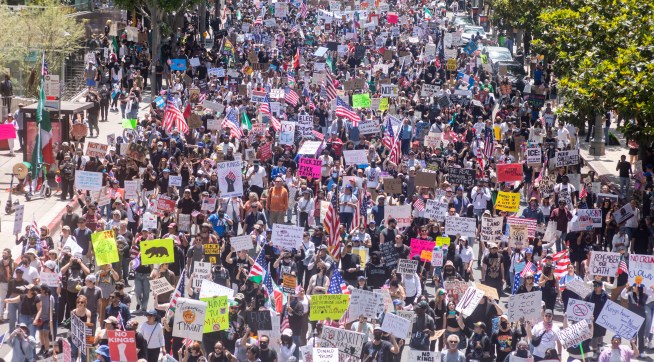
Let’s consider the context: just 3 days ago, Trump’s military parade was a bust and left him a laughingstock. Meanwhile, something like 2% of the population of the US turned out to protest his policies and his Presidency.
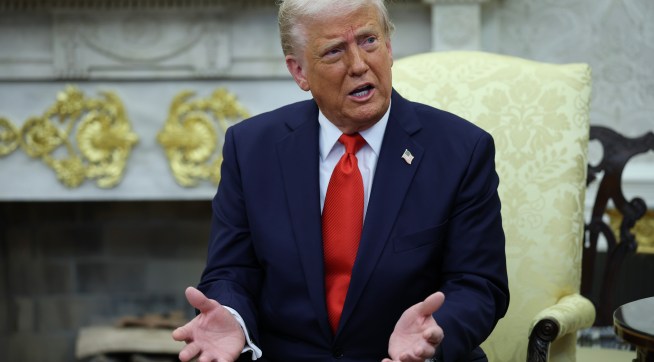
I’m seeing a lot of articles about Trump’s turn on Iran, how it’s in response to pressure from Israel, his evolving views. I think these are all either overblown or irrelevant. As I noted earlier, what’s driving Trump here is the hunger to get in on a “win.” It might be best to see it as a typical Trumpian branding exercise. Israel has got a product ready to go to market and they’ve offered Trump the opportunity to slap the Trump name on it. But even beyond all that there’s something more. The U.S. has wanted to get rid of the Iranian nuclear program for a very long time. We’ve used coercive sanctions. We’ve engaged in espionage and sabotage. Barack Obama spent a huge amount of time putting together a diplomatic agreement to restrict it.
Read More
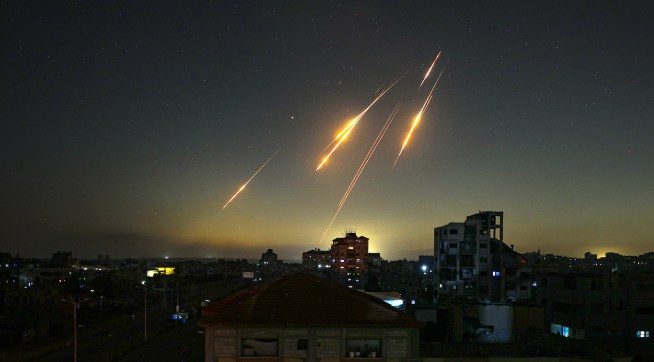
I haven’t had a lot to say about Israel and Iran because I haven’t had a lot to add. But I want to suggest something about the possible entry of the United States into the war. These aren’t conclusions, more questions I’ve had and questions that help me frame how I’ve looked at what’s happening.
In the first couple days of this hot conflict, the conventional wisdom and reporting went from Israel doing this more or less entirely on its own, perhaps even interfering in U.S. diplomacy, to the idea that the apparent rush of diplomacy between the U.S. and Iran was actually a ruse concocted by Israel and United States to lull the Iranians into letting their guard down. At first this seemed to be what they call in the online world right wing “cope,” shoving Donald Trump back into the center of the story as He-Man hero when he had actually seemed marginal to the action. But then it started showing up in news reports. And from what I can tell at this point, it’s almost treated as a given, just part of the reported story.
This certainly may be accurate. But I’m not sure that it is. I think it’s also possible that the initial attack was fabulously successful in tactical terms (no one would deny that) and Trump basically wanted in on it. Because he likes success. In a normal administration, reporters might get a clearer read on what was real or what wasn’t. But this isn’t a normal administration. Much of “what the plan is” is an unknowable thing in Donald Trump’s head and a feature of the Trumpian personality cult is that once there’s an approved story, that is the story. Period. I could be right or wrong on my supposition here. But I’m not even sure if the people inside the administration actually know. In any case, I think there’s a pretty good chance the whole ‘we were secretly working together to lull Tehran into complacency’ is a complete fiction, an online MAGA speculation that the White House and Trump glommed onto and made real because it was convenient and helpful.
JoinThere’s a good piece in the Post today by Philip Bump making an important corrective point which is that, no, we shouldn’t assume that millions of people going out and protesting against Donald Trump is actually great news for Donald Trump. The issue is sort of over-learning the fairly questionable lesson of the George Floyd protests, thinking that they somehow redounded to Trump’s benefit. As Bump notes, there’s pretty little evidence that this is true. At least in the short- to medium-term most evidence suggests the opposite.
Read MoreNot the biggest thing in the world. But it caught my attention. The Trump family is rolling out something called Trump Mobile, which is basically a mobile phone service for real Americans.
Read More
On Saturday, watching the President’s birthday celebration/Army parade, I commented that it seemed like it was going so poorly and Trump seemed so grumbly that I was afraid he might occupy a few more cities with the tantrum he was going to throw as a result. Of course, “going poorly” can mean a lot of different things. I didn’t watch a lot of the parade. But the moments I did catch gave me some reason for confidence in the durability of the America I know. The soldiers manning the tanks trundling down the city streets were all smiles, waving at the admittedly sparse crowd, saying “hi” to kids. I don’t think that’s the kind of parade Trump wanted. That’s not what a strongman’s military parade looks like. The soldiers are impassive. Their eyes are fixed on El Jefe. This wasn’t that.
And I wasn’t wrong about the tantrum.
JoinIn recent days, I’ve seen a number of comments or editorials which focus on a dichotomy between reacting to the crisis of the moment (which is portrayed as the ICE raids, military deployments and general attacks on democracy) and focusing on issues like Medicaid (which is portrayed as politics-as-usual and an inability to recognize a national crisis). I agree with the sentiment behind this, but it’s wrongheaded and I want to explain why.
Read MoreFor those who are attending “No Kings” events today in your areas, I encourage you to send photographs. They don’t need to be striking or unique. We’re just looking for what you’re seeing.
I of course know about the assassination and attack overnight in Minneapolis in which Rep. Melissa Hortman (D) and her spouse were killed.
My wording in this title is one part provocation. But there is a serious point to it.
American political debates use the term “elite” in a fairly impoverished way. Its use is pejorative rather than descriptive. The elites are the bad guys. And the good elites aren’t actually elites. We’re all familiar with this and perhaps it’s inevitable in a political culture so rooted in the imagery and ideology, if not always the reality, of popular rule and the power and valorization of the ordinary American.
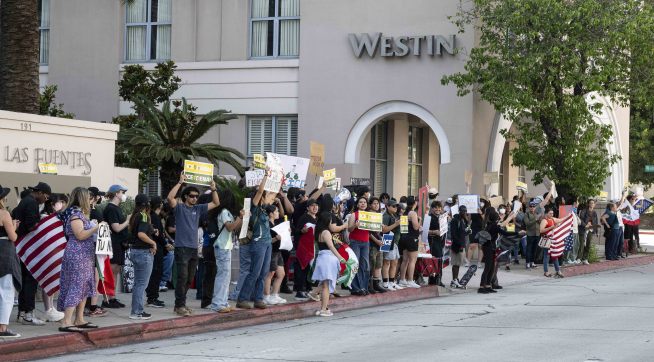
But the elite, in a more descriptive and non-evaluative sense, has been perhaps the biggest reveal of this live subject experiment we’ve been a part of since late January. Law firms, universities, big business, news publications and a million other examples. We’ve all been amazed, disheartened, aghast, whatever you want to call it, by the subservience of the prominent and the powerful. Even those who haven’t adopted a posture of subservience have generally adopted one of silence. I hear it from reporter after reporter. The kind of people they used to go to for quotes — a lot of those people don’t want to give them anymore. And, beyond moral evaluation, we know why: they have things on the line. A rogue President has vast untapped and illegal or unconstitutional but still usable power to come after really anyone who puts their head up. The challenges to Trump have much more been waged by ordinary Americans.
Join