



One of the most interesting and clarifying discussions I’ve read in recent weeks is Dr. Monica Gandhi’s discussion of the difference between ‘colonization’ and ‘infection’ in thinking about what counts as a case of COVID. It’s conceptually interesting but also highly relevant both for the choices we make balancing risk as individuals as well as how we approach the vaccine phase of the pandemic in policy terms.
As Gandhi tells it, in many cases a vaccinated individual will be exposed to COVID and have the pathogen briefly colonize their nasal passages. But vaccine-induced immunity will fight and defeat the virus there. Is that an infection or a case? If you take a PCR test, you’ll test positive. But Gandhi says we’re confusing things by treating it as one.
Gandhi is an infectious disease specialist and we spoke with her this morning in an Inside Briefing about this and related topics.
If you’re a TPM member you can watch our full interview after the jump.
JoinThis is perhaps a minor point. But I want to return to it. A key reason we’re experiencing the fourth COVID wave in the US – albeit one that has far less hospitalizations and deaths thanks to vaccines – is that way too many people still haven’t gotten vaccinated. From an epidemiological perspective we’re not nearly where we want to be. But as we talk about the political polarization over vaccines, things are a bit different.
Among Americans over the age of 18 fully 71% have gotten at least one vaccine dose.

Missouri senator and presidential aspirant Josh Hawley, best known for giving a thumbs up to the January 6 rioters and trying to overturn the November election, has now joined Florida Governor Ron DeSantis and Texas Governor Greg Abbott in furthering the spread of the pandemic. Hawley is sponsoring an amendment to the infrastructure bill that would restrict federal funding for K-12 schools that mandate Covid-19 vaccines for students or require students to wear masks.
We did a fascinating Inside Briefing this morning with Dr. Monica Gandhi discussing vaccines, different layers of the human immune system and what really counts as an infection. It’s really critical information when thinking about personal decisions about risk and about policies for society at large. Thanks to the Inside members who joined for the discussion. We’ll be publishing the full interview for all members either later today or at latest tomorrow. Don’t miss it.
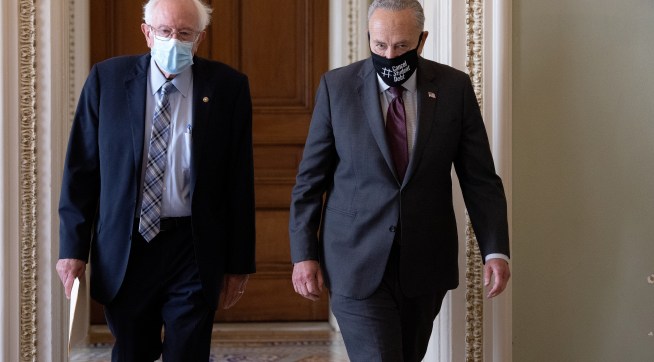
At TPM, we’ve been harping on the fact that the whole bipartisan back-and-forth that unfolded over the last two months — and that might conclude early tomorrow morning — doesn’t really matter that much. It’s the reconciliation package that matters. If it passes in a form similar to what Senate Majority Leader Chuck Schumer outlined this morning, it would be the most significant progressive legislation in at least a decade.
It might also be the last significant progressive legislation for at least a decade.

As we’ve been discussing there is a paucity of information on the precise effectiveness of vaccines vs the Delta variant and the contours of the pandemic in the new circumstances of the last eight weeks or so. We know in general that vaccines continue to be highly effective at preventing severe illness. But the details are not as easy as they should be to come by. This seems to be both the product of very new facts which studies are only catching up with and a continued paucity of good national data from the CDC. That vacuum is filled by anecdotal information.

I was raised by a man steeped in the life sciences. He wasn’t a climate scientist. He was a marine botanist who spent the first and last parts of his career teaching general biology at various colleges. But this professional description doesn’t capture the depth of the imprint on him and thus indirectly on me. For him it was an entire ethic and worldview, one rooted in evolutionary theory and furnished from various domains of knowledge: archeology, paleontology, paleo-zoology, ecology, astronomy in addition to biology.
A good run-down of the cataclysmic and imminent changes to the global climate sketched out in today’s big climate report.

The much-heralded bipartisan mini-bill actually seems on its way to passage in the Senate. On the critical (and mind-numbing) vote to allow a majority vote, 18 Republicans ended up voting in the affirmative. It now seems very likely that Biden will get his bipartisan deal while also managing to pass close to his entire fiscal, infrastructure and climate agenda. If that happens – and it is likely to happen notwithstanding a few more months of haggling and drama – it will be a major, major accomplishment.
Yet in a guest opinion piece Friday in The New York Times Alex Pareene argued that it is in fact a “pyrrhic victory in a broken Senate.” I’m almost never in the practice of responding to people in the Editors’ Blog. But I wanted to do so in this case because Pareene is a gifted writer and incisive political observer. So it’s important to explain why he’s wrong.