

This article is part of Cafe, TPM’s home for opinion and news analysis.
As insurgent candidates offering critiques of the Democratic Party won primary after primary in 2025 and 2026, pundits were left wondering: were the Democrats having their own “Tea Party moment”? Back in 2010, the Tea Party was key to securing massive GOP legislative gains, even as its reactionary edge cost the GOP winnable senate seats in places like Delaware and Nevada.
Progressive triumphs in Democratic primaries during president Trump’s second administration might suggest something similar is on the way. Zohran Mamdani beat Andrew Cuomo in the race for New York’s mayoralty, Abdul El-Sayed’s triumphed against establishment pick Haley Stevens in the Michigan Senate primary, and Graham Platner easily dispatched — despite scandals of such magnitude he would ultimately have to withdraw as the party’s general election candidate — Gov. Janet Mills in the Maine Senate primary. Each candidate offered fresher rhetoric, more ambitious politics, and a critique of the Democratic Party, allowing them to edge out — or in some cases destroy — their opponents. Cue the invocations of the Tea Party and questions about whether or not “the Democratic Party might very well be about to explode.”
But comparisons between the Democratic Party’s fresh crop of candidates and the Tea Party do not really stand up to scrutiny. Tea Partiers were motivated by an anti-systemic energy that had deeper roots than the current ire of Democratic voters, and the demographics of the GOP meant the party ultimately embraced a “burn it down” approach to governance. The insurgent left within the Democratic coalition remains focused on conventional liberal issues like human rights, affordability, and taxing the wealthy. New, animating issues for voters — such as ending military funding for Israel and harsher regulation of data centers — still do not see voters anywhere close to the Tea Party’s reactionary fervor to remake, or remove, much of the U.S. government. Democratic voters — and the candidates they elect — may find that current leadership is not fit for their objectives, but replacing a few key stakeholders is a different dynamic from the Tea Party’s anathema towards any Republican interested in “normal” governance.
Tea Partiers really did hold an extreme distrust of the Republican Party, or at the very least its politicians, who were understood to be a part of — rather than the enemies of — “the system.” Some of the Tea Party’s strongest boosters were, yes, “wealthy kingmakers and ultra-right-wing organizations” seeking to convert energized grievances of the Republican base into a new policy platform refusing even nominal compromises with Democratic opponents. But there was also a real, grassroots frustration with fallout from the financial crisis — which, even though it had taken place during the Bush years, became a generalized antipathy towards Obama, immigrants, and the political “system.” Even as Tea Party voters demonized the Republican establishment, that very establishment — including wealthy donors to the Republican Party and the Party’s leadership — harnessed their fury toward its own end of grinding down and breaking government during a Democratic administration.
The umbrella term “Tea Party” has come to encompass the full sweep of coordinated right-wing resistance to the early years of the Obama presidency, mixing top-down corporate support from Koch Brothers outlets like Americans for Prosperity and FreedomWorks with genuine (if misdirected) anxiety and fear from the Republican base. Its voters, Theda Skocpol and Vanessa Williamson, write, were generally motivated Republican partisans: upper-middle to upper-class, white, Christian. relatively comfortable if not outright wealthy, concentrated in suburbs and exurbs rather than densely populated cities. Republican politicians using right-wing rhetoric were meeting the base in its direction of travel. Nixon’s “silent majority,” Fox News messaging, Rush Limbaugh’s diatribes, and “love it or leave it” post-9/11 jingoism would naturally culminate in a politician like Sarah Palin speaking confidently about “real America” and its implied opposite.
The heterogeneity of the Democratic base, on the other hand, cuts against demonizing the establishment. Democratic voters tend to be more educated, less rural/exurban, and less white than the Republican base. But those comparative statements against the makeup of the Republican electorate do not in any way make clear what the populist version of a Democratic candidate should look like. For example, Black voters can seem conservative when one measures their attitudes along a number of questions, while the characteristics of some white urban NIMBY voters can read as selectively libertarian. Support for generic “health care reform” outruns support for Medicare for All, while general demands for more equitable antiracist policy remain more popular than specific proposals like affirmative action or reparations for slavery. The Democratic Party’s expansive coalition defies the single-mindedness of the Tea Party, a movement that was largely suburban or rural and, most importantly, white.
The Tea Party enabled the takeover of the GOP by a particular political faction. Tea Partiers’ resentment of government generally followed from how the GOP had incubated right-wing sentiment. If there is some parallel here, what long-boiling segment of the party will take over if they have a great night at the ballot box in 2026, or even in 2028’s presidential cycle?
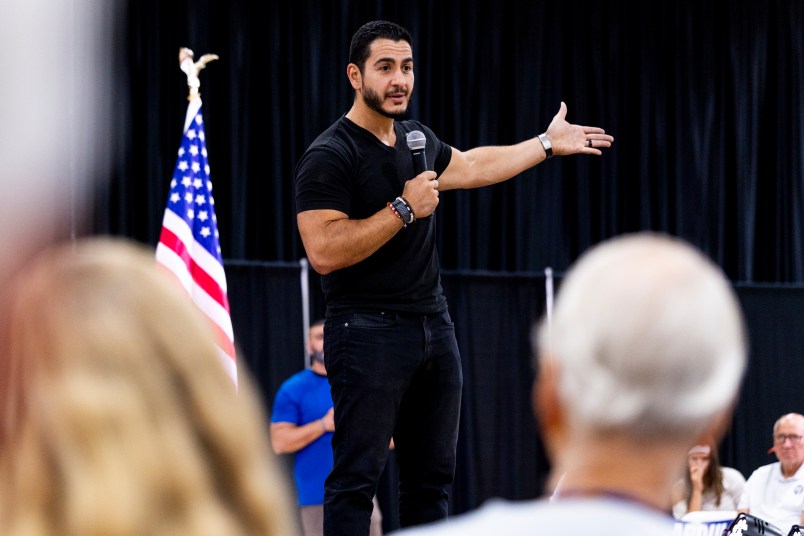
One could argue it would be the left wing of the party, making good on the slide from Occupy Wall Street to the standard-bearing presidential primary campaigns of Senator Bernie Sanders (I-VT). And, so, if the “Tea Party” analogy were to hold, we might expect to see rhetorical signs among left-wing primary victors that they will take the sword to the establishment. In 2010, when Christine O’Donnell defeated conventional Republican Mike Castle in the Delaware senate primary, she boasted that she could win the general election race without the support of the Republican Party and groused about how hard her Republican opponents had worked to try to defeat her. (O’Donnell ultimately lost by 17 points to Democrat Chris Coons). In contrast, consider El-Sayed, who ran against a candidate, Stevens, backed by Chuck Schumer and the Democratic Party. Despite a hard-fought primary, El-Sayed’s victory speech was focused on reaching out to Stevens’ supporters and immediately hitting his Republican opponent, Mike Rogers. Even as voters express extreme disillusionment with the current Democratic Party, successful left-ish Democratic primary candidates are not, generally, painting the Democratic establishment as the enemy. Tea Party candidates incessantly framed RINOs (Republicans in Name Only) as villains equivalent to Democrats. 2026’s Democratic candidates have, in many cases, distanced themselves from the existing party, but they are generally not on the campaign trail giving stemwinders against Joe Biden or Kamala Harris, or even Senate Minority Leader Chuck Schumer, even if his numbers suggest there would be gains rather than costs for a politician who engaged in such rhetoric. And they are generally not turning their critiques of Israel and the Iran war into broader calls for isolationist policy.
On policy, Tea Party rhetoric was set up to fall down a slippery slope, given their talking points about dramatically limiting government. The Affordable Care Act (aka Obamacare) and tax policy were among their more salient targets. The character of the ACA is especially telling: it was a relatively market-friendly reform that obligated broader paying participation into the insurance market from Americans in order to shore up the risk pool, while at the same time requiring insurance companies to expand their coverage to anyone who wanted it. In this respect it was a classic piece of political compromise, balancing a progressive politics of social obligation with a nod to conservative thought about market realities, making the backlash against it all the more telling. Contrast this with the current Democratic insurgents: Mamdani obsessively brings every topic back to affordability, while left-wing Florida Senate candidate Angie Nixon brought up universal health care and universal child care in her victory speech. On a recent CBS News appearance, El-Sayed called Trump a “barbarian” and brought up gas prices, while dismissing concerns about bombastic livestreamer Hasan Piker. A Tea Party hallmark was leaning into soaring talk about freedom and converting anti-establishment associations into capital with a raging base, less in evidence here. Even a more centrist candidate like Sen. Jon Ossoff of Georgia, up for reelection, is calling his opponent a bigot and attacking Trump instead of trying to surf some anti-establishment wave. It’s clear the next Democratic wave will be anti-Trump, but not necessarily anti-system.
There are also signs that Democratic voters, especially in swing states, have internalized “electability” as a factor in making candidate decisions. David Crowley, who won the Wisconsin gubernatorial primary, defeated Francesca Hong, the candidate of choice for the Democratic Socialists of America. Again and again in 2010, Tea Party candidates defeated more polished and professional candidates, in part because the capacity to signal outrage to the base took precedence over other elements of a candidate’s campaign.
In urban local races — and even a few House races — there does seem to be a hunger among Democratic voters to support a party more willing to adopt a rhetorical frame more suitable to extraordinary times. A string of DSA candidates who took sharp aim at the Democratic establishment swept their primaries this summer and were greeted with great enthusiasm by voters. But even these candidates have not advocated for the full-throated, burn-it-down approach to governance that defined the Tea Party, and a chunk of them, like Mamdani in New York, are operating in what are quite progressive local contexts. That’s quite distinct from the GOP Tea Party wave which by 2012 saw Republicans, by nominating extreme candidates, again throw away winnable seats in then-purple states like Missouri and Indiana.
Ultimately, the Tea Party ended up becoming the dominant faction in Republican politics not only because it spoke loudest and made the most extravagant demands, but because it sought to deliver on a worldview right-of-center media consumers had been stewing in for decades. The story of the right in the U.S. is a story of the long march against institutions: as historians like Larry Glickman and Kim Phillips-Fein have documented, the contemporary reactionary paranoia and enthusiasm for burning down institutions did not emerge ex nihilo in the 2000s. Talk about limited government, threatened freedom, and the promise “to take our country back” must be understood as flowing from a longstanding, deepseated, and heavily-cultivated grievance politics that conservatives politicians and the Republican Party itself had capitalized on for the decades leading up to 2010. Again, the Democratic Party has no analog.
It’s sensible that Democratic candidates are, for the most part, focusing on their opponents and the Trump administration rather than trying to start a messy factional fight. Democratic energy is full of antipathy for Donald Trump. Trump is what we in the rhetoric business call a “non-arbitrary” symbol: all by itself, his presidency makes the case for taxing the wealthy, punishing sexual predators, stamping out corruption, and embracing a more pluralistic understanding of freedom. This does suggest that the post-Trump reckoning with what, precisely, the Democratic Party stands for will be quite rancorous. But it will be different in character from the Republicans’ “dog who caught the car” routine from the last decade, since they will not sit astride the very thing they demonized and attacked for 60-plus years. They will, I think, have to start talking about the Republican Party not as an incidental entity with regards to Trump’s presidency but instead as an enthusiastic collaborator.
It’s totally plausible that if the Democrats sweep into power in this year’s midterms, the consequence is a change in leadership: Schumer especially does not read as a wartime consigliere, and if there is an accurate parallel between the Tea Party and today’s Democratic base it is that both conceive of their moments as ones of genuine crisis. But the GOP ran for decades on attacking the nuts and bolts of governance: functional government was a problem, a threat to individual liberty, and the “swamp” of corruption required Reaganesque right-sizing and eventually to be drained by Trump. There is no such set of priors or rhetorical commitment from Democrats, making for a more uncertain future.





Democrats and the left just don’t have that march in lockstep gene. In fact, the problem with Democratic and left-leaning organizations is that they want to dictate and members want to be heard on an equal level. The establishment can’t or won’t see that because, hey, Dr Professor PhD Esq. who is part of it knows what’s best for you.
The Tea Baggers were an AstroTurf movement. The current Progressive wave in the Democratic party is organic.
I don’t think that the Tea Baggers had any problem with functional government. They just had a very different idea of the functions of government. Conservatives do not believe that government should be in the Mommy/Gospels business. Governments, to their mind, are strictly in the punishment business. Active social engineering is fine, but the only permissible tool is punishment: soldiers, bombs, cops, prisons. And transfer payments, being non-punitive, are outside the legitimate business of government.
Consider the conservative response to abortion. For the sake of argument (only!), let’s assume that abortion is a Bad Thing, and suppressing it is part of the business of government. Hence, conservatives want to criminalize abortion, and put doctors and women in jail. The Catholic Church has some very conservative elements, but also has many Mommy people, motivated by the Gospels. Hence Catholics also show a non-conservative approach: programs like Birthright, which supports pregnant women both morally and financially, and is not averse to adoption.
The war on drugs is another example: full incarceration; no emphasis on prevention or treatment. Even on treatment, conservatives prefer Naloxone to buprenorphine. Naloxone saves lives, but does nothing about agonizing withdrawal symptoms: a chemical form of punishment.
There is no “Tea Party” on the left because it was never a central controlling ideology, and the “Tea Party” was a “astro turf” funded operation. Who's Raising Money For Tea Party Movement? : NPR
The election of a black man was the primary driver of the so-called tea party movement. Not sure why it’s so hard to unqualifiedly acknowledge that.