

This post is a part of TPM Cafe, TPM’s home for opinion and news analysis. An earlier version of it appeared on Project Syndicate.
Following Democrats’ dramatic sweep in state and local elections in the United States last November, a narrative emerged: affordability had become voters’ dominant concern. Elected officials in both parties quickly responded with promises to curtail inflation. Even if successful, however, such efforts would not make life more affordable. That is because the roots of America’s affordability crisis have virtually nothing to do with inflation. It is instead an indirect consequence of the unprecedented growth in income and wealth inequality that has been occurring since the 1970s.
This provides a strong opening for Democrats, because a large majority of voters already favor the pragmatic policies needed to address the issue. By advocating these policies unapologetically, Democrats could avoid the widely anticipated intraparty war between those urging greater focus on moderate swing voters and others favoring more vigorous attempts to energize progressive base voters. In fact, the policy response needed to defuse the affordability crisis will appeal just as strongly to both groups — and will win support from a nontrivial share of Republican voters as well.
Misdiagnoses
An effective solution to any problem requires understanding its origins. Why could parents in the 1950s get by on a single paycheck, whereas many two-earner households now struggle to make ends meet?
When she was a Harvard Law School professor, U.S. Senator Elizabeth Warren and her daughter, Amelia Warren Tyagi, posed this question in their 2004 book, The Two-Income Trap. Part of the answer, they suggested, is rooted in parents’ natural desire to send their children to the best schools. The problem is that school quality, like most other important things we value, is context-dependent: A good school is one that’s better than most other schools in the area; and in virtually every jurisdiction, the better ones are in more expensive neighborhoods.
Parents sought a second paycheck to boost their ability to bid for housing in better school districts. But when all families pursued this goal, the outcome wasn’t what they’d hoped. Their additional purchasing power served only to bid up the prices of houses in better school districts. Half of all children still attended bottom-half schools, as before.
The Two-Income Trap’s analysis is at once elegantly simple and deeply insightful. By itself, however, it cannot explain why families today find it so much harder to get by. The second paycheck let them bid more for housing, yes, but that alone cannot have made housing unaffordable, since it also boosted their purchasing power commensurately. As we teach our students in introductory economics, if your income and the prices you pay all double, you’re no better or worse off than before.
For the same reason, the surge in inflation that occurred during the COVID-19 pandemic cannot explain why so many Americans believe the economy no longer works for them. Prices did indeed rise rapidly during the first years of President Joe Biden’s administration, but comparable wage gains followed, leaving most goods no less affordable than before. Affordability was a problem, but it was one that families faced well before the pandemic, and, then, it had nothing to do with inflation.
The wealthy are spending more now on everything simply because they have more money, and this has spawned the changes in spending patterns that have made it much more difficult for low- and middle income families to achieve basic life goals.
Even so, there is little question that inflation has always been politically unpopular, and election analysts tell us that many who voted for Biden in 2020 switched parties in 2024 because of Donald Trump’s promise to curb inflation. During the 2024 campaign, Democrats told voters that price increases had been largely a result of pandemic-related supply-chain disruptions, and that the U.S. had done better than any other industrial democracy at keeping inflation in check. That is all well and good, but the message was ineffective because inflation was not the reason so many families were struggling.
Expenditure Cascades
The real culprit was, and remains, something that neither Democrats nor Republicans have shown any willingness to tackle seriously: unprecedentedly high and growing levels of income and wealth inequality. Since the 1970s, economic gains around the world have been heavily concentrated at the top of the income ladder. The wealthy are spending more now on everything simply because they have more money, and this has spawned the changes in spending patterns that have made it much more difficult for low- and middle income families to achieve basic life goals.
More expensive housing has been by far the most important trickle-down consequence of growing inequality. The wealthy have been building bigger mansions simply because they can afford to do so, and many of their slightly less wealthy friends leave gatherings in those mansions thinking they too need a little more living space. They, too, build bigger, and so on, all the way down. Without reference to this dynamic, there is no way to explain why the median newly built house in the U.S. is now 36% bigger than its counterpart from 1980, despite only modest growth in median real incomes.
First-time homebuyers in the U.S. now have a median age of 40 years, more than a decade older than first-time buyers in the 1980s. Mortgage payments, which accounted for 15.3% of median household incomes in 1984, had climbed to 38% by 2024. Housing costs are the biggest single cause of the affordability crisis at the heart of voter discontent, and that crisis is a direct consequence of rising inequality.
One could of course counsel struggling middle-income families not to buy a costlier house than they can comfortably afford. But budget-busting mortgages are seldom a consequence of people’s desire for accommodations that will impress their friends. Far more often, they are necessary to acquire a house in a reasonably safe neighborhood with decent schools.
Many orthodox economists claim that it is irrational for people to be influenced by others’ spending. But that view rests on the transparently implausible assumption that the satisfaction provided by any good is a function only of its absolute attributes.
Consider an interview suit. If you are one of several similarly qualified applicants aspiring to an investment banking job, it is in your interest to look good when you show up for your interview. But looking good is relative. All else equal, if rival candidates show up in $500 suits off the rack, you will be more likely to make a favorable first impression, and get a callback, if you wear a bespoke suit costing several thousand dollars. Recruiters may not even recall its color, but they will have sensed that you looked the part. Spending more is thus rational from a job seeker’s perspective. Job seekers as a group may understand that it would be better if everyone spent less, but if others were spending more, no one would have reason to regret spending more as well.
Or consider a middle-class family’s decision about how much to spend on their daughter’s upcoming wedding reception. They would almost surely scoff at the claim that this decision could have been influenced by reports that Amazon founder Jeff Bezos had spent $50 million on his multiday 2025 wedding celebration in Venice, Italy. Parents might agree with liberal social critics who were predictably provoked by the Bezos gala to complain that the rich have more money than they can spend, even as millions of others lack everyday necessities. Or they might side with conservative pundits, who, just as predictably, responded that Bezos’s net worth of $250 billion came from launching a company that benefited billions of people, and that he has every right to spend his money as he pleases.
Whichever of these views parents might endorse, what’s clear is that events like the Bezos wedding have spillover effects. Norms about appropriate levels of expenditure on wedding receptions are, like beliefs about school quality and appropriate attire, context-dependent. When the wealthy spend more heavily to celebrate important milestones, they surely do not intend to change expectations about what others must spend to mark those occasions suitably. Yet, just as surely, their spending alters the expectations of the wealthy guests who attend their galas, who then spend more themselves, altering the expectations of those just below them, and so on.
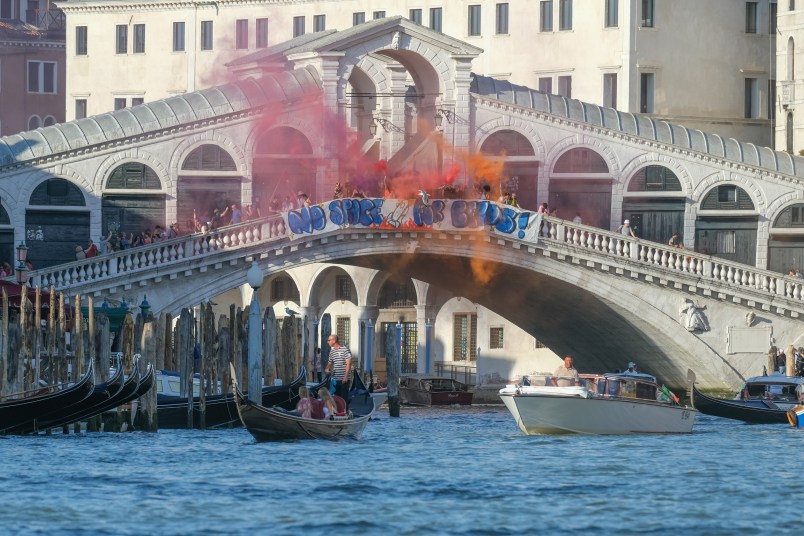
Without invoking this chain of influence, which has been greatly amplified by social media, it is difficult to explain why the inflation-adjusted average cost of wedding receptions in the U.S. is now more than double what it was in 1980 — again, a period during which real median income grew only modestly. There is no evidence that participants in today’s celebrations are any happier than their earlier counterparts. Yet if a wedding reception today were funded at 1980 levels, many guests would go home feeling that the bride’s parents were either cheapskates or had simply failed to grasp the importance of the occasion.
Middle-income households have responded to the affordability crisis by exploiting every available option. They are saving less, borrowing more, working longer hours, and moving farther from work. Census data reveal clear links between stresses associated with these responses and regional variations in the growth of inequality. Within the 100 largest U.S. counties, those where income inequality grew most rapidly also experienced the largest increases in three characteristic markers of financial distress: divorce rates, long commutes, and bankruptcy filings. Higher inequality is also associated with longer work hours, a relation that is not predicted by economic models that ignore expenditure cascades.
Fairness vs. Efficiency
The charge that current levels of inequality are unfair is firmly grounded, both in broadly accepted principles of moral philosophy and in the tenets of the world’s major religions. Yet this objection has had virtually no influence on policymakers. On the contrary, the fiscal policies that governments have adopted in recent decades have tended to exacerbate existing disparities in income and wealth.
The second Trump administration’s budget law (the One Big Beautiful Bill Act) — whose passage enacted large permanent tax cuts for the wealthy and deep spending cuts for healthcare and nutritional assistance for low-income families — is just the latest chapter in this story. It is already exacerbating the affordability crisis, and, ahead of this year’s midterm elections, critics are already campaigning vigorously against those who supported it. Perhaps the moral arguments they have used in the past (which I embrace without apology) will be more effective this time. Still, it might behoove them to include more pragmatic arguments among their appeals.
They might point out, for example, that the current level of economic inequality is bad not just because it is unfair, but also because it is profoundly wasteful. This claim rests on a consistent and intuitively plausible finding from the voluminous scientific literature on the determinants of human flourishing: Beyond a point long since passed in developed countries, across-the-board increases in most forms of private consumption yield no measurable gains in either health or life satisfaction. Building bigger houses costs a lot yet does little more than shift the bar that defines adequate housing.
Middle-income households have responded to the affordability crisis by exploiting every available option. They are saving less, borrowing more, working longer hours, and moving farther from work.
Since most income gains in recent decades have gone to those who were earning the most to begin with, this basic finding suggests that those gains will not have produced measurable increases in life satisfaction. And that is exactly what the available evidence shows. For example, even though the inflation-adjusted national income of the U.S. in 2019 (the last full year before the pandemic) was more than $5 trillion higher (in current dollars) than in 2012, the World Happiness Report found that Americans were slightly less happy in 2019 than in 2012. Whatever wealthy Americans managed to buy with all that extra money in 2019 does not appear to have made them any happier.
Nor are low- and middle-income consumers the only ones confronting an affordability crisis. Governments at every level have also been unable to meet public demands for services without running up punishing levels of debt. As the journalists Ezra Klein and Derek Thompson argue persuasively in Abundance, bureaucratic red tape and poorly considered regulations help explain why public goods and services have become prohibitively costly. But even if those obstacles were eliminated completely, a significant expansion of public services cannot happen without a massive increase in tax revenue. And that, in turn, presupposes a big tax hike on top earners.
Taxing the Rich
One consequence of such a tax hike would be that money now spent largely in vain on high-end consumption could instead pay for things that would actually improve the quality of life for rich and poor alike. Instead of building bigger mansions, we could have cleaner air and water. We could drive on roads that do not damage our cars. We could reduce flight delays and the risk of mid-air collisions by restoring the depleted ranks of air-traffic controllers. We could build high-speed rail networks like the ones citizens of many other countries have enjoyed for years.
Instead of staging more expensive wedding receptions, we could build and maintain more and better parks, and provide additional support for life-saving medical research. We could develop the machines needed to remove and sequester enough carbon dioxide from the atmosphere to ensure climate stability for future generations. We could offer universal access to pre-K. We could build millions of additional affordable housing units. We could provide universal health coverage and additional income security for retirees — and much, much more. In short, the simple step of restoring much of the earlier progressivity to federal income taxation would solve both the private and public affordability crises.
Many wealthy campaign donors will of course oppose this step, despite compelling evidence that it would improve their own lives. But tax rates are a political decision, and there are many more low- and middle-income voters than wealthy ones.
More importantly, we could explain to wealthy voters how a simple cognitive illusion appears to provoke much of their opposition to higher taxes. As most of them would be quick to concede, they already have everything anybody might reasonably be said to need, so if higher taxes posed any threat, it would be to make it more difficult for them to buy life’s special extras. But because a special extra is yet another relative concept, that threat is an illusion. To be special means to stand out in some way, and almost without exception, special things are in limited supply. There are only so many penthouse apartments with sweeping views of New York’s Central Park, for example, and to get one, a wealthy person must outbid other wealthy people who also want it. The outcomes of such bidding contests hinge ultimately on relative purchasing power, and since relative purchasing power is completely unaffected when the wealthy all pay higher taxes, the same penthouses would end up in the same hands as before the tax increase. (Some wealthy Americans might object that higher taxes would handicap them when bidding against foreign oligarchs, but a stiff levy on properties bought by non-Americans would eliminate that concern.)

There is also a strong case for a robust inheritance tax. Although denounced by its critics as a “death tax,” it is in fact one of the fairest and most efficient ways to pay for public goods and services. It functions much like a lawyer’s contingency fee contract, which helps people who have been unjustly injured obtain access to the legal system. If a lawyer believes an injury claim has merit, she may agree to represent a client on a contingency basis. If they lose in court, the client pays nothing; but if they win, the lawyer keeps a share of the judgment, often one-third. The estate tax is functionally equivalent to this type of contract. You pay for the better roads and schools it makes possible only if you end up one of life’s biggest winners.
Many progressives appear reluctant to advocate higher estate taxes, because attacks from conservatives have indeed made them less popular with the public. But an important purpose of political campaigns is to correct flawed beliefs about important policy issues. Would voters still oppose a robust estate tax if they understood how life would be different without it?
To find out, 20 years ago I asked the Survey Research Institute at Cornell University to administer two versions of a national survey. In one, respondents were asked simply whether they favored or opposed repeal of the estate tax. Typical of the findings in other similar surveys, these respondents favored repeal by nearly three to one. In the second version, respondents were reminded that the revenue shortfall from repealing the estate tax would entail some combination of raising other taxes, cutting government services, or increasing federal borrowing. Strikingly, these respondents opposed repeal by almost four to one.
Project 2029
My claim, in a nutshell, is that a few simple changes in tax policy would change spending patterns in ways that would boost conventional measures of health and happiness, not just for low- and middle-income families, but also for the wealthy themselves. Without requiring painful sacrifices from anyone, the same measures would also enable us to modernize our crumbling infrastructure and help parry the existential threat posed by climate change. These are bold assertions, to be sure, but they are solidly grounded in simple logic and broadly accepted evidence.
That the policy changes we need can be described in plain English also makes them an attractive platform on which to campaign for voter support. They stand in sharp contrast to the policies outlined in the Heritage Foundation’s Project 2025 playbook for using executive power to impose far-right policies. At every turn, Republicans in 2024 took pains to distance themselves from this document. (“I have nothing to do with Project 2025,” Trump said during his debate with Kamala Harris.) Yet the policies set forth by Heritage were eerily predictive of the second Trump administration’s agenda, which itself has proven profoundly unpopular.
By contrast, the policy proposals I am advocating describe a platform on which Democrats could appeal to voters openly and enthusiastically. “Here’s why what we propose would improve your lives and that’s why you should vote for us” is obviously a more effective pitch than “I never heard of Project 2025.” But if the party sticks with its cautious agenda of avoiding serious reforms to reduce inequality, the affordability crisis will linger. There is a compelling reason why swing voters have consistently voted incumbents out of office in recent election cycles. If Democrats win back the White House in 2028 and do nothing different from their last time in power, the pendulum will swing back to Republicans in 2032.
True, even if Democrats win and take the necessary steps, spending patterns will change only slowly. It will therefore be important also to adopt more immediate measures, such as using higher tax revenues to help middle-class families with health insurance, childcare, and other expenses.
The claim that Democrats face a civil war between moderates and progressives — a constant in coverage of Democratic campaigns and Congress — rests in part on the belief that expansive economic policy proposals will alienate swing voters. That belief is dangerously wrongheaded. In fact, most voters overwhelmingly favor these proposals and are frustrated that leaders have not enacted them.
This commentary was adapted from the author’s forthcoming book with the working title How Inequality Caused America’s Affordability Crisis. A version of it first appeared on Project Syndicate.




Not a cat.
This a thoughtful, detailed political and economic discussion and I see only one other comment from “Not a cat.” This says something about American politics: Bidenesque whitepapers, Leftish manifestos don’t get much traction with the general public. What is needed is Foxish, mass subversion where the public gets fed the message in 60 second bite-size nuggets or better yet, getting the message subliminally from a hip cat.
Perhaps you haven’t noticed, but this isn’t the general public here. Folks tend to stay with the Morning Memo thread until it looks like a chew toy for a couple of pit bull pups. I don’t disagree with your thesis, but it’s important to recall that outside of this pack of (largely) cranky retirees, people with jobs, kids, and a host of other distractions have limited bandwidth for the torrent of malfeasance and bullshit that passes for “politics” these days. Some of them (hopefully) will start to pay attention after Labor Day.
The point is that the “message” needs to get to people who are not paying attention. The message deeds to be delivered in a full spectrum of media 24/7/365. The message needs to be subtle, oblique, under the radar, stealth, when the psychological guards are down. This is old serpent wisdom.
Recall, if you will, the words of Will Rogers: '“I’m not a member of any organized political party. I’m a Democrat.” And that was over ninety years ago.
Americans don’t do subtle very well.