A coalition of media groups and a think tank want the Federal Communications Commission to declare a recent shut-down of cell phone service by transit authorities in the Bay area unlawful.
The group on Monday lead by Public Knowledge have filed a petition with the FCC requesting that the Bay Area Rapid Transit’s August 11 action be declared unlawful and in violation of federal communications law.
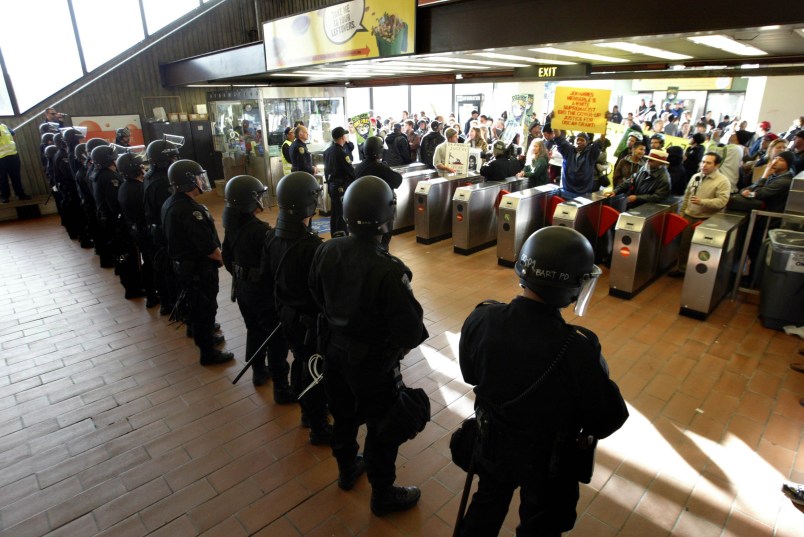
BART temporarily cut off wireless phone service during peak travel hours at four stations on August 11 to pre-empt a planned protest of BART police’s shooting and killing of a homeless man.
The groups who signed the petition include the Broadband Institute of California, the Center for Democracy and Technology, the Center for Media Justice, Electronic Frontier Foundation, the Media Access Project, the Minority Media and Telecommunications Council, the National Hispanic Media Coalition, and the Open Technology Institute at the New America Foundation.
The group’s lengthy petition, available as a PDF here, argues that BART’s approximately three-hour cell service shutdown “deliberately interfered with access to the Commercial Radio Service (CRMS) by the public.” (Cell phones, after all, transmit calls via radio signal).
They also write that “unilateral action by law enforcement, however well intentioned, risks depriving the public of vital emergency communications at the worst possible moment,” and urge that the FCC “act swiftly to clarify that local authorities may not turn off wireless networks before other local jurisdictions seek to replicate the actions of BART.”
As grounding for their case, Public Knowledge and its partners refer back to FCC Chairman Julius Genachowski’s own words in a November 2010 address noting that 450,000 of 650,000 9-1-1 emergency calls daily come from mobile phones.
They also refer to a lengthy list of prior cases from around the country to bolster their case, including the oft-cited 1955 case Pike vs. Southern Bell, in which the Supreme Court of Alabama ruled that Eugene “Bull” Connor, then Commissioner of Public Safety in Birmingham, wasn’t allowed to disconnect phone service on suspicion of criminal activity. The court penned a strong admonition, saying: “The unconstitutional and extra-judicial enlargement of coercive governmental power is a frightening and cancerous growth on our body politic. Once we assumed as axiomatic that a citizen was presumed innocent until proved guilty. The tendency of governments to shift he burden of proof to citizens to prove their innocence is indefensible and intolerable.”
Also referenced, the 1963 case Telephone News System, Inc. vs. Illinois Bell Telephone Co., which found telephone service to be a property right and therefore protected from government disruption under the Fifth Amendment.
Interestingly, one argument that the coalition doesn’t push is that BART, in cutting cell service specifically to disrupt a planned protest, might have violated the First Amendment rights of freedom of speech and assembly.
In fact, the petition specifically states: “whether BART can cut off service in a manner consistent with the First Amendment – an issue we do not address in this petition – the fact remains that such disconnections involve willful interference with CMRS and are discontinuations of service without prior authorization based on the mere suspicion of future illegal activity.”
Harold Feld, a Public Knowledge attorney, provided a teaser for the coalition’s arguments in the petition in a blog post that was widely cited by bloggers last week on the popular tech news aggregator Techmeme.
This afternoon, a Twitter account identified with the hacker group Anonymous, which has called for numerous protests since the August 11 cell service disruption, and last week leaked private nude photos of BART’s chief spokesman to the web, tweeted in support of the petition, writing “#opBART wants The FCC make a ruling on @SFBART –Now. bit.ly/ofXhby Join us.”
A spokesman for FCC acknowledged the agency had received the petition and was reviewing it, The Hill reported.
Separately, activist group Demand Progress circulated a shorter public petition urging netziens to sign condemning BART’s decision.
Meanwhile, BART stations were due to be engulfed by another protest Monday night, as well as a counterprotest from friends and supporters of the BART spokesman whose nude photos were posted online by an Anonymous hacker, Gawker reported.